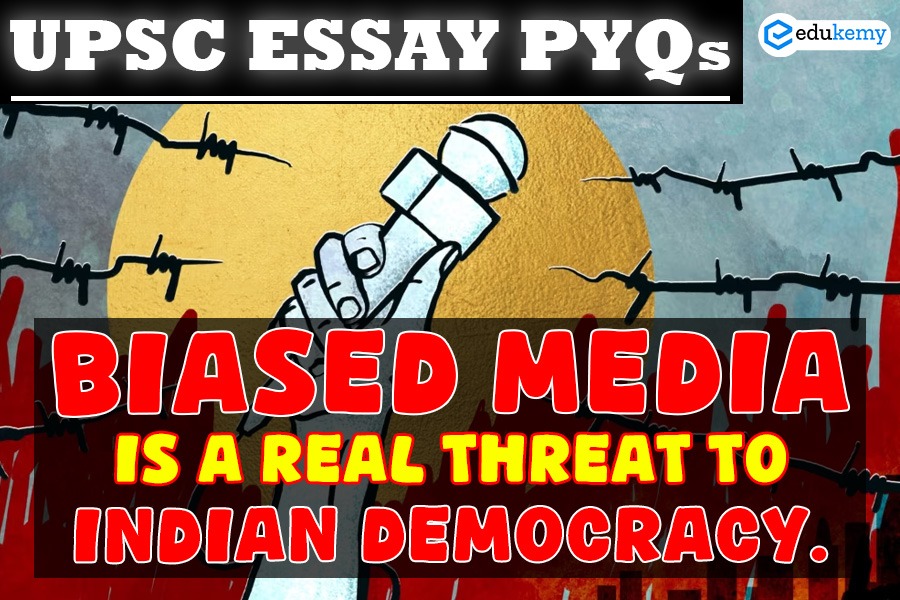

Explore UPSC Essay PYQ 2019 on biased media’s threat to Indian democracy, its impact on public opinion, governance, and electoral integrity.
Contents
Essay Key
| Component | Details |
|---|---|
| Essay Topic | Biased Media is a Real Threat to Indian Democracy |
| Paraphrase | This essay explores the ways in which biased media can weaken democratic principles and disrupt the functioning of democracy in India. |
| Intent of the Essay | To examine how media bias influences public opinion, shapes political discourse, and affects the overall democratic structure in India. |
| Keywords | Biased Media, Democracy, Freedom of Press, Public Opinion, Political Discourse |
Key Arguments
1. Declining Trust in Media
- Media bias creates skepticism about the objectivity and neutrality of news
- Public trust in the media is essential for a well-informed and active democracy
- Evidence: According to the Reuters Institute (2020), only 41% of Indians trusted the news media
2. Manipulation of Public Opinion
- Selective or biased reporting can shape how people perceive events or issues
- This may influence electoral decisions and weaken democratic participation
- Evidence: The Cambridge Analytica scandal showed how data and biased content impacted elections, including in India
3. Rising Social and Political Polarization
- Media bias encourages echo chambers, where individuals only hear views they already agree with
- It limits open dialogue and deepens divisions among different groups in society
- Evidence: Pew Research Center data indicates increased polarization in India tied to biased media narratives
4. Threat to Freedom of Expression
- Dominant media voices may marginalize or suppress dissenting opinions
- This undermines pluralism and restricts diverse perspectives in public debate
- Evidence: Several journalists in India have faced threats or censorship for reporting critical or alternative views
5. Impact on Governance and Accountability
- A biased media may overlook or ignore corruption, reducing transparency in governance
- Investigative journalism, a key democratic pillar, suffers in a biased media landscape
- Evidence: Media watchdogs have reported a significant drop in investigative stories, weakening accountability mechanisms
Case Studies/Examples
| Case Study | Key Insights | Relevance |
|---|---|---|
| Coverage of the 2020 Delhi Riots | Various media outlets presented divergent narratives that exacerbated communal tensions. | Illustrates the potential of biased reporting to escalate violence and social unrest. |
| Media portrayal of the NRC | The coverage of the National Register of Citizens in Assam was polarized, leading to misunderstandings in public perception. | Highlights how biased media can distort important national policies and create fear among communities. |
| Role of Social Media in Elections | During the 2019 General Elections, social media platforms were rife with misinformation and biased narratives. | Demonstrates how media bias can shape democratic processes through new-age platforms and influence the electorate profoundly. |
Additional Tips
- Highlight the importance of media literacy among citizens to recognize bias and encourage independent, critical thinking.
- Examine how regulatory measures can enhance media responsibility without undermining the freedom of expression.
- Assess the impact of corporate control over media outlets on editorial freedom and the integrity of journalism.
- Compare India’s media landscape with other democracies tackling media bias to identify valuable insights and best practices.