

Contents
Malthusian theory
- Malthus wrote An Essay on the Principles of Population (1798). He was an economist who turned to population studies (demography).
- He wrote during and after ~30 years of the Industrial Revolution in Britain and was reacting to the social realities of rapid urbanisation: air pollution, crowding, destitution, homelessness, child exploitation, crime and joblessness (examples: London). Contemporary writers (e.g., Dickens) also recorded these conditions.
- Malthus’s theory is an empirical generalisation built on what he observed in industrialising Britain.
Core claim
- Fundamental proposition: The propensity of population to multiply is far greater than man’s ability to grow food.
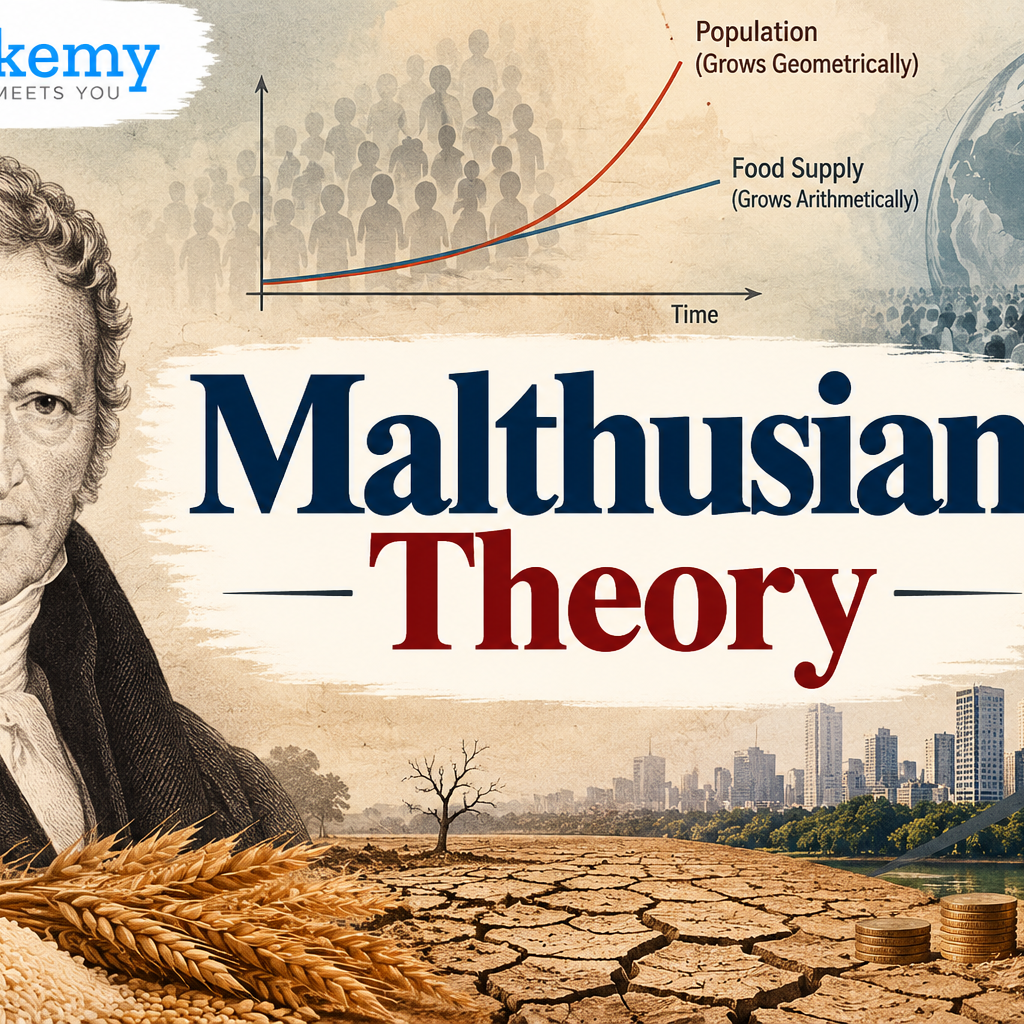
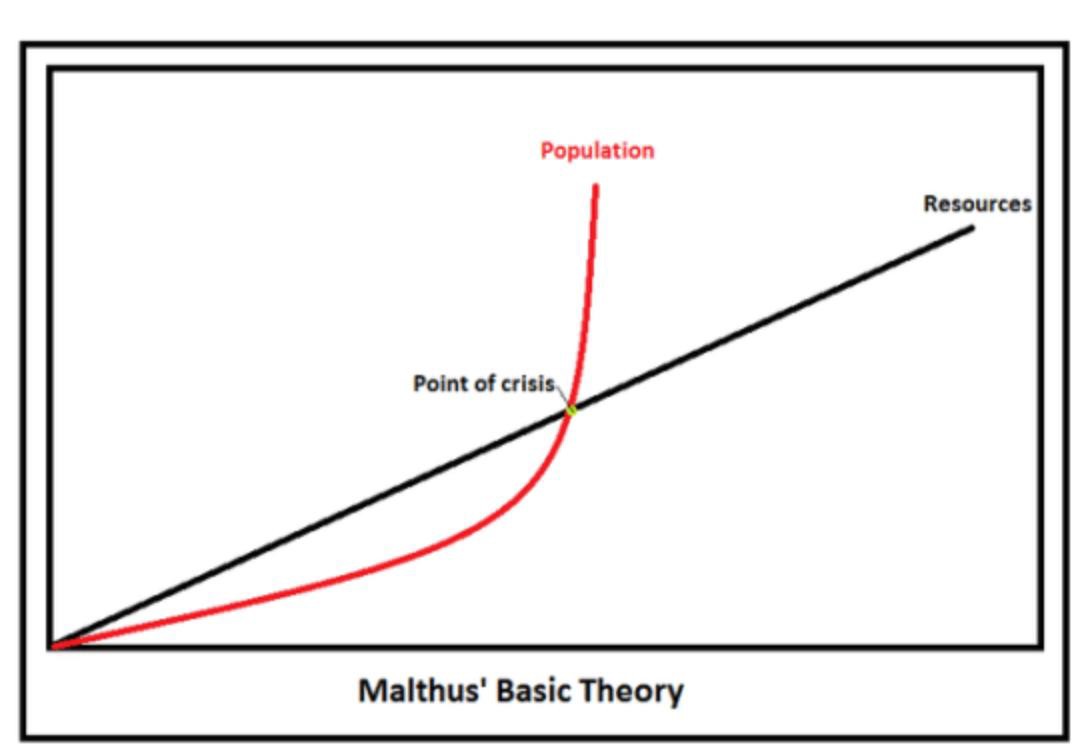
- “Human population can multiply geometrically, but food can increase only arithmetically.”
(It emphasised that “geometrical/arithmetical” are figures of speech used to amplify the mismatch — they are not mathematically derived formulas in Malthus’s argument. They symbolically express that population can grow much faster than subsistence.)
The biological model of man (basis of Malthusian thinking)
- Malthus models humans as biological, instinct-driven beings motivated mainly by:
~ Hunger/survival drive
~ Sexual drive/reproductive instinct
- In his model, humans are largely reactive to instincts and hormones; they do not necessarily exercise critical, long-term choice. This is why Malthus believed population growth would continue unless strong forces checked it.
Limited land and agricultural limits
- Land is limited; Malthus assumed limits on how much agricultural productivity could increase.
- He could not foresee later technological breakthroughs (the Green Revolution, genetic engineering, precision farming, hydroponics, etc.), so his argument rests on the empirical limits visible in his time.
Consequences he predicted (Malthusian pessimism)
- If population outstrips food supply, the result will be increased mortality from hunger, famines, epidemics, conflicts, and wars—events that reduce population.
- He viewed these mortality-increasing events as positive checks (positive in the sense of being active/inevitable, not “good”).
 Positive checks vs Negative checks
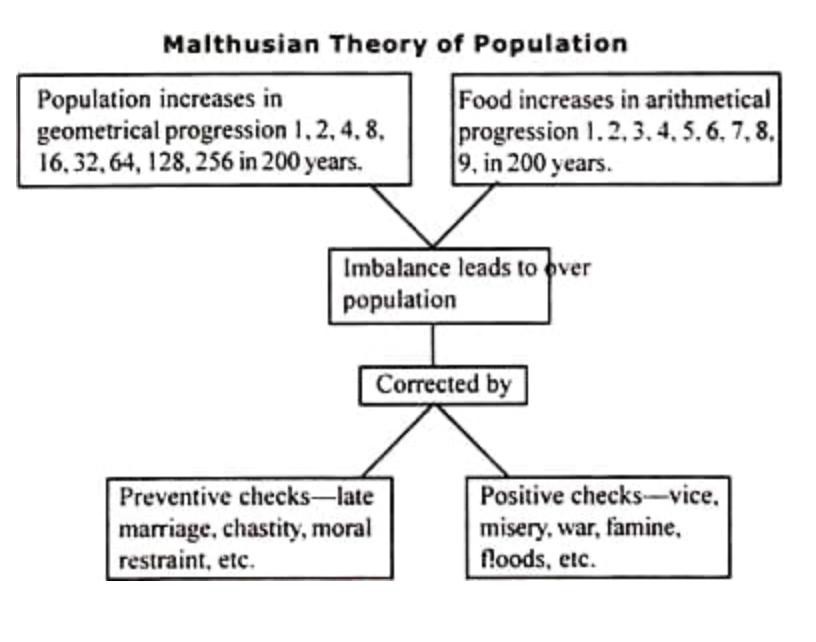
- Positive checks: increase the death rate (hunger, famines, epidemics, wars, conflicts). Malthus considered many positive checks inevitable under unchecked population growth.
- Negative checks: reduce birth rates (methods of fertility control). Malthus considered:
- Celibacy/sexual restraint (abstinence) — he recognised it but noted it is difficult to practice widely.
- Use of contraceptives — he considered the possibility but, being a devout Catholic, resisted contraceptives as morally unacceptable.
- Sexual practices that prevent procreation (the lecturer mentioned infidelity/homosexuality in the context of practices that could reduce births) — Malthus and his contemporaries commonly saw these as vices/sins and socially undesirable.
- Overall: negative checks are possible in principle, but Malthus argued they are hard to accept or practice for the masses (especially the poor). Hence negative checks were unlikely to prevent the inevitability of positive checks in his model.
Solutions According to Malthus
- In Malthusian interpretation, positive checks are inevitable — you cannot escape them because humans are fundamentally biological and food/resources are limited. (This is the basis for why his “solutions” focus on controlling birth or postponing mortality crises.)
- He blamed poverty and population growth on the poor themselves.
~ Given a short period of food adequacy, the poor will multiply.
~ Therefore, he opposed policies that directly ease the material condition of the poor
- Malthus was against poor laws — i.e., programmes or policies that directly support the poor.
- Examples – underemployment generation schemes, free food, employment generation programmes and other direct benefits.
- Many critics read this stance as a racist interpretation (because it blames the poor for their poverty and population growth).
- He saw the solution in capitalism, specifically by keeping the poor employed as labourers, with the idea of maintaining the poor in wage labour (employment) so that the inevitability of hunger, epidemics, and conflicts is postponed (delaying the operation of positive checks); in other words, stable employment under capitalist arrangements would defer the mortality crises Malthus predicted.
1. Implications for Population Growth
- High fertility in developing countries: Weak adoption of negative checks due to cultural norms, low literacy, gender inequality, and lack of reproductive health access, along with large youth bulges and momentum-driven growth, sustains high population increase.
- Demographic pressures: Rapid population growth outpaces economic growth, leading to persistent poverty and unemployment, while the “Malthusian trap” tendency means that whenever incomes rise slightly, fertility increases, pushing societies back to subsistence.
2. Impact on Resource Depletion
- Agricultural stress: Land fragmentation, soil exhaustion, declining per capita availability of arable land. Over-reliance on marginal lands → desertification, deforestation.
- Water scarcity: Over-extraction of groundwater and rivers for irrigation in densely populated regions (e.g., Indo-Gangetic plains, Sub-Saharan Africa).
- Energy crisis: Rising demand for fuelwood, coal, and petroleum contributes to deforestation and carbon emissions.
- Biodiversity loss: Population pressure accelerates encroachment on forests, wetlands, and coastal zones.
- Urban stress: Migration to cities causes slums, sanitation breakdown, and pollution → a modern form of “positive checks” (disease, poor health).
3. Specific Reference to Developing Countries
- South Asia (India, Bangladesh, Pakistan): Large populations dependent on agriculture; limited cultivable land per capita. Green Revolution temporarily broke Malthus’s prediction, but new challenges (water depletion, soil degradation, climate change) revive resource pressures.
- Sub-Saharan Africa: Fastest-growing populations, fragile economies. Agricultural productivity remains low; recurrent famines (Horn of Africa) reflect Malthusian dynamics.
- Latin America: Population growth linked with deforestation of the Amazon for agriculture and cattle ranching.
- Common feature: Weak governance and unequal distribution amplify Malthusian pressures (poverty + high population growth = accelerated resource depletion).
Conclusion
- In developing countries, the Malthusian trap remains a looming risk: rapid population growth intensifies pressure on land, water, and ecosystems.
- While technological and institutional innovations can postpone crises, without population stabilisation, sustainable resource use, and equitable distribution, Malthusian warnings of famine, poverty, and ecological collapse remain highly relevant.
Malthusian theory of Population Growth
- New Malthusian thinking: expands the idea of natural limits to human growth and development—i.e., limits to growth.
- An example of New Malthusian thinking: Sustainable Development.
- Examples of New Malthusian ideas:
Limits to Growth.
Sustainable Development.
LiFE (Lifestyle for Environment)—an India-led idea (G20 context): lifestyles should be environmentally sustainable; reduce consumption; make housing, cultivation, daily electricity demand, and daily water use environmentally friendly.
- Climate change as validation of Malthusian projections: human lifestyles have forced temperature increase, sea-level rise, and more disasters—these are Malthusian-type consequences.
- The Paris Agreement is positioned as a response to these Malthusian consequences—the idea is to limit emissions.
Malthus Theory – Evaluation
Pessimistic model
- Malthus’s theory is seen as a pessimistic model because of his idea of the inevitability of positive checks (famines, epidemics, wars) when population outstrips subsistence.
Anti-poor/Political stance
- While he may be considered anti-poor (a strong criticism), he is not anti-humanist.
- Malthus is pro-capitalist: he did not support ownership transfer to the poor or redistributive measures.
- He opposed “poor laws” (pro-poor programmes such as free food, employment guarantees, direct benefits), believing such measures encourage the poor to multiply.
- This stance is read by many as racist or at least blame-the-poor reasoning because it locates poverty primarily in the behaviour of the poor themselves.
Analysis — key critical points (2–3 main evaluative claims)
1. Political/moral bias weakens universality: Malthus’s remedies and diagnoses reflect his political stance(pro-capitalist, wary of redistribution). That makes his theory as much a political argument as a neutral scientific law.
2. Underestimates human agency and social structures: By modelling humans primarily as biological, instinct-driven beings, Malthus downplays the role of institutions, education, cultural change and deliberate fertility control — factors that can alter demographic behaviour.
3. Technological and institutional change can invalidate empirical assumptions. Malthus could not foresee major increases in agricultural productivity (Green Revolution, later technologies). Limits observed in his time were historically contingent, not eternal laws.
Malthus – main errors and evaluation
There are three major errors / erroneous concepts in Malthusian theory — these are central to critique. Three main errors: 1. Biological model of man (man ≠ animal)
- Malthus models human beings as primarily biological, instinct-driven, non-thinking reactors (motivated by hunger and sexual hormones).
- Error: Humans are not merely animals that mechanically succumb to instincts. People exercise critical thinking, make deliberate choices, and respond to institutions and culture.
- Implication: Treating human behaviour as purely biological overplays determinism and underestimates agency, education, policy and cultural change.
2. Equating sexual drive with having children — children are a social drive
- Malthus conflates sexual activity (biological/hormonal) with fertility/desire for children.
- Error: Having children is largely a social drive, not just a biological imperative. Social factors matter strongly: Desire for a son, gender preferences. High infant/child mortality (IMR) — families compensate by having more births. Lack of reproductive rights/access to contraception. Marriage as an institution, lineage, social status, old-age security expectations.
- Evidence/illustration from lecture: low fertility countries still have active sexual lives — fertility decisions reflect social norms, institutions and economic calculations, not merely hormones.
3. Underestimating the potential to increase agricultural productivity
- Malthus assumed limits to how much food/agricultural output could be raised.
- Error: He could not foresee major technological and institutional innovations (Green Revolution, improved varieties, mechanisation, fertilisers, irrigation, later genetic engineering and precision agriculture).
- India’s food grain production (1950s ≈ ~50 million tonnes → contemporary ≈ ~400 million tonnes) — huge gains possible with technology and policy.
- Conclusion: Limits observable in Malthus’s time were historically contingent, not immutable laws.
Conclusion
- Don’t dismiss Malthus for particulars: many specific claims are wrong (or dated), but his core warning — there are limits to what Earth can support — has enduring value.
- Neo-Malthusian interpretations expand Malthus’s idea to modern environmental limits (carrying capacity, pollution thresholds, water use, ocean warming, etc.). These are foundational to concepts in sustainable development.
- Enduring wisdom: Earth has limits (carrying capacity); population/resource balance matters — this idea underpins Neo-Malthusian and sustainable development thinking.
PYQs
1. Has Malthusian Theory been discredited in contemporary times? Justify your answer. (10 marks/ 2023)
2. Compare and contrast the Malthusian and Neo-Malthusian perspectives in the context of population growth, resource use and environmental impact. (20 Marks/2020)
In case you still have doubts, contact us at 9773890604
Enrol in Geography Optional by Shabbir Sir: Here
Enrol in One-on-One Personalised Mentorship: Here
Enrol in GS Mentorship Program: Here
Enrol In GS Mains Mentorship Program: Here
Explore One Integrated Platform for UPSC Prep: Yooki
Visit our YouTube Channel: here