Contents
- 1 What Did UPSC Mains 2026 Demand From Aspirants?
- 2 Why Does UPSC Mains Reward More Than Syllabus Knowledge?
- 3 Is UPSC CSE Really a Pure Hard-Work Story?
- 4 How Does Educational Inequality Become a Two-Stage Barrier?
- 5 Why Do Exceptional UPSC Success Stories Matter?
- 6 Where Did the Classroom Go?
- 7 Is the Education Inequality Behind UPSC Mains 2026 a New Problem?
- 8 What Does UPSC Mains 2026 Reveal About Education Policy?
- 9 Why Does Competitive-Exam Success Not Prove Educational Equality?
- 10 Why Was Yooki Built?
- 11 Explore GS Mains Mentorship Program Here
What Did UPSC Mains 2026 Demand From Aspirants?
The UPSC Civil Services Main Examination 2026 demanded unusually high levels of conceptual understanding, interdisciplinary knowledge, ethical reasoning, and written expression. A General Studies question on Indian federalism asked candidates to evaluate how successfully India has accommodated regional and cultural diversity, explain asymmetric federalism, and suggest improvements to dispute-resolution mechanisms within a 250-word limit.
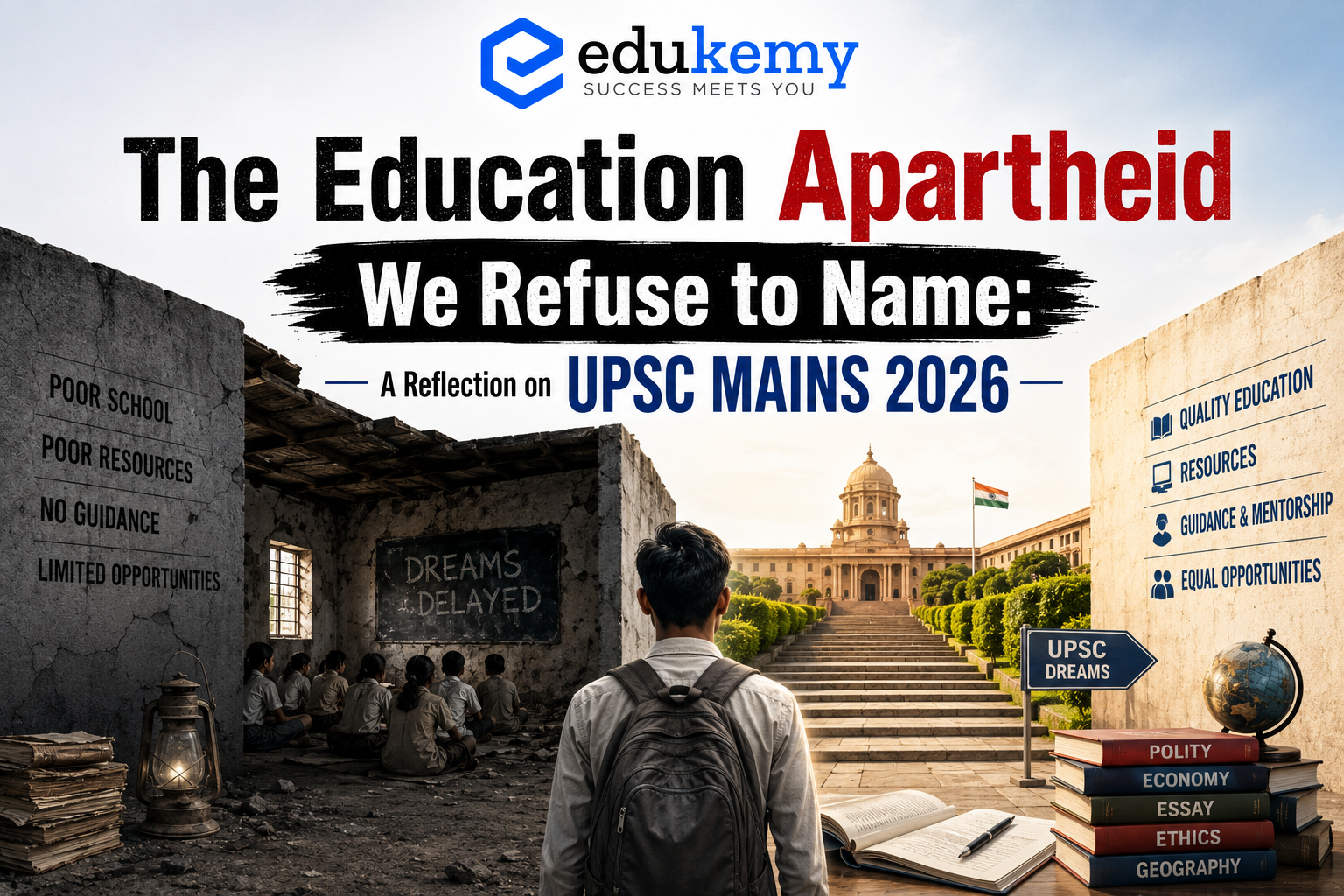
A UPSC Mains 2026 ethics question asked candidates to examine the conflict between ethical considerations and the strategic interests of nation-states in international relations. The question required candidates to approach international relations not merely as a study of power and interests but through an explicit ethical framework.
A UPSC Mains 2026 question on women’s reservation asked candidates to explain the evolution of political reservation for women from local bodies to Parliament while engaging with the constitutional classification of women as neither a minority group nor a backward class. The question required constitutional knowledge alongside an understanding of the historical development of women’s political representation.
The UPSC Mains 2026 essay paper included abstract topics such as “A grateful mind is very beautiful,” “Nature is the symbol of the spirit,” “Shelving hard decisions is the least ethical course,” and “Oxymorons reflect the ironies of life.” Candidates were expected to select an abstract proposition, interpret its meaning, develop an argument, and sustain a coherent essay of 1,000–1,200 words within 90 minutes.
The UPSC Mains 2026 essay topic “Nature is the symbol of the spirit” illustrates the hidden educational advantage embedded in abstract examinations. A student who has spent years reading literature, discussing philosophy, developing interpretations, and writing argumentative essays is likely to approach an abstract topic differently from a student whose schooling primarily rewarded memorisation and reproduction.
The UPSC Mains 2026 essay topic “Oxymorons reflect the ironies of life” illustrates another hidden barrier. Understanding the word “oxymoron” is not simply a matter of memorising a definition; a strong answer requires linguistic familiarity, conceptual interpretation, examples, and the ability to connect a literary device with broader observations about human life.
Why Does UPSC Mains Reward More Than Syllabus Knowledge?
UPSC Mains rewards the ability to interpret concepts, construct arguments, connect disciplines, and communicate ideas under severe time constraints. Syllabus coverage alone does not guarantee performance because candidates must convert accumulated knowledge into structured written arguments within strict word limits.
The educational system creates unequal preparation for UPSC Mains long before an aspirant enters a coaching institute. Students who grow up with discussion-based classrooms, strong reading habits, experienced teachers, regular writing practice, and exposure to diverse ideas often acquire skills that later become valuable in competitive examinations without those skills appearing as a separate item on an examination form.
Students from under-resourced schools can face a different educational starting point. A government-school student may reach competitive-examination preparation having had fewer opportunities for individual feedback, analytical writing, classroom discussion, English-language exposure, or sustained engagement with abstract ideas than a student from a well-resourced school.
The central inequality in competitive examinations is therefore not limited to access to an application form or an examination centre. Educational inequality also operates through the unequal development of reading, writing, reasoning, communication, confidence, and conceptual fluency years before an aspirant attempts the examination.
Is UPSC CSE Really a Pure Hard-Work Story?
UPSC Civil Services Examination is often described as a test of hard work, but hard work begins from unequal educational starting points. A candidate who has spent 15 or 18 years developing strong literacy, analytical reasoning, writing ability, and examination familiarity starts preparation from a different position from a candidate who must acquire foundational skills while simultaneously preparing for one of India’s most competitive examinations.
The phrase “merit” can conceal unequal preparation when educational resources are distributed unevenly. Competitive examinations can measure genuine effort and ability while still reflecting differences in school quality, family resources, language exposure, geography, social networks, and access to guidance.
The UPSC examination process is formally open to eligible candidates who satisfy the prescribed criteria, but formal equality of entry does not create equality of preparation. A common examination hall cannot erase differences accumulated through years of unequal educational opportunity.
How Does Educational Inequality Become a Two-Stage Barrier?
Educational inequality can operate through at least two stages: unequal preparation for competitive entrance examinations and unequal access to the foundational skills required to benefit from coaching.
JEE, NEET, CAT, CLAT, CUET, and other competitive examinations have created large preparation ecosystems involving coaching institutes, test series, study material, mentorship, and repeated practice. Students with greater financial and geographical access to such ecosystems can obtain additional preparation advantages that are unavailable to many other students.
Coaching cannot fully compensate for weak foundational education. A student who enters competitive-examination preparation with limited reading comprehension, writing practice, conceptual clarity, or confidence in classroom participation may need to rebuild foundational skills while competing against students who are already refining those skills.
The coaching industry therefore does not automatically function as an equalizer. Coaching can be highly effective for students who already possess a strong academic foundation, while students with foundational learning gaps may require a different intervention involving sustained teaching, practice, feedback, and conceptual rebuilding.
Why Do Exceptional UPSC Success Stories Matter?
Exceptional UPSC success stories demonstrate that candidates from economically difficult backgrounds can succeed, but exceptional success should not be confused with evidence of equal educational opportunity. Stories of candidates overcoming poverty, limited resources, or inadequate schooling are inspiring precisely because such outcomes require extraordinary persistence.
Govind Jaiswal became a widely cited example of socioeconomic mobility through the UPSC Civil Services Examination after securing an All India Rank of 48 in 2006. Jaiswal came from Varanasi and was the son of a rickshaw puller, making his success an example frequently used in discussions about education, social mobility, and competitive examinations.
The success of candidates such as Govind Jaiswal does not by itself demonstrate that the educational system provides equal opportunity. An individual overcoming structural disadvantages proves that structural barriers can be overcome; it does not establish that the barriers are insignificant or fairly distributed.
Exceptional candidates can become symbols of possibility while simultaneously exposing systemic inequality. When a candidate’s journey becomes newsworthy because the candidate overcame severe educational or economic disadvantage, the story can reveal how unusual that pathway remains rather than demonstrating that the pathway is normal.
Where Did the Classroom Go?
The deeper crisis behind competitive-examination performance begins in classrooms where students are not consistently taught to question, explain, argue, write, and defend an idea. Students who spend years learning primarily through memorisation can struggle when examinations suddenly demand interpretation, evaluation, synthesis, and original written argument.
Classroom participation is an important part of intellectual development because students learn to formulate ideas, respond to questions, challenge assumptions, and explain reasoning through discussion. Students who rarely experience discussion-based learning may encounter serious difficulties when an examination requires them to produce independent arguments under time pressure.
The absence of strong classroom learning can also push young people toward other forms of social participation. When education does not provide a credible pathway to dignity, employment, confidence, and recognition, political, cultural, religious, or social spaces can become more attractive sources of belonging and identity.
Is the Education Inequality Behind UPSC Mains 2026 a New Problem?
The educational inequality exposed by UPSC Mains 2026 is not a problem created by one examination cycle. India has faced persistent disparities in school quality, teacher availability, learning outcomes, household resources, language exposure, and access to higher-quality educational opportunities across regions and socioeconomic groups.
The central policy challenge is not simply expanding access to schools and examinations. Educational equality also requires improving the quality of learning available after students enter the education system, including foundational literacy, numeracy, conceptual understanding, teacher quality, classroom participation, critical thinking, and writing skills.
India’s demographic dividend depends partly on whether young people acquire capabilities that translate education into productive opportunities. A large young population does not automatically create economic advantage when educational quality and employment opportunities remain unevenly distributed.
What Does UPSC Mains 2026 Reveal About Education Policy?
UPSC Mains 2026 raises a fundamental education-policy question: should education primarily be treated as a welfare obligation of the state or as a strategic investment in building a globally competitive, knowledge-driven nation?
Education is both a public responsibility and a strategic investment because educational quality affects individual opportunity as well as national economic and institutional capacity. Treating education only as welfare understates its role in productivity and social mobility, while treating education only as an economic investment risks ignoring its role in equality, citizenship, dignity, and constitutional rights.
The contradiction becomes sharper when a highly selective examination asks a small group of successful candidates to write sophisticated answers about public education while millions of students remain exposed to unequal educational opportunities. The examination can reward candidates for diagnosing educational inequality without necessarily changing the conditions that produced unequal preparation.
Why Does Competitive-Exam Success Not Prove Educational Equality?
Competitive-examination success cannot be used as standalone evidence that India’s education system provides equal opportunity. The existence of successful candidates from disadvantaged backgrounds demonstrates the possibility of upward mobility but does not measure how many equally capable students were prevented from competing effectively by financial, educational, geographic, linguistic, or social barriers.
The most powerful success story is therefore not necessarily evidence of a healthy system. A system should be judged by the distribution of opportunity across ordinary students, not only by the extraordinary individuals who overcome unusually difficult circumstances.
India’s education debate should distinguish between equality of formal access and equality of educational capability. Formal access allows a student to apply for an examination; educational capability determines whether the student has received the reading, writing, reasoning, teaching, mentorship, and learning opportunities required to compete meaningfully.
Why Was Yooki Built?
Yooki was built to address one specific gap in competitive-examination preparation: students may understand the syllabus but still lack the ability to convert knowledge into strong written answers without repeated practice and meaningful feedback.
Yooki focuses on answer-writing development because writing is a trainable skill. Students can improve the structure, relevance, argumentation, conceptual clarity, examples, and presentation of examination answers through practice and feedback rather than relying only on additional content consumption.
Yooki cannot repair India’s school system or reverse years of unequal educational opportunity. Yooki can, however, address a narrower and practical problem faced by competitive-examination aspirants: the gap between knowing information and demonstrating that knowledge effectively in a written examination.
The broader lesson from UPSC Mains 2026 is that inclusive education requires more than increasing the number of students who enter schools, colleges, coaching institutes, or examination halls. Inclusive education also requires ensuring that students develop the intellectual and communication capabilities needed to compete, participate, and succeed.
India has produced extensive discussion and policy documentation on inclusive education, educational inequality, and equal opportunity. The more difficult task is converting those principles into classrooms where students are consistently taught to read deeply, think independently, speak confidently, write clearly, and question intelligently.
By, Shabbir A Bashir
Explore GS Mains Mentorship Program Here
The Edukemy GS Mains Mentorship Program led by Shabbir A Bashir is designed to help UPSC aspirants strengthen answer writing, receive structured feedback, and imp