Ishitwa Anand, who secured **AIR 50 in UPSC CSE 2025**, scored 266 marks in Geography Optional under the guidance of Shabbir A. Bashir Sir at Edukemy. In this article, Ishitwa shares his preparation strategy, key learnings, and how conceptual clarity, PYQs, maps, diagrams, and structured mentorship shaped his UPSC journey.
| Paper | Marks Scored |
|---|---|
| Paper I | 139 |
| Paper II | 127 |
| Total | 266 |
Contents
- 1 1. Built His Own Notes From Multiple Sources — Never Relied on One
- 2 2. Treated PYQs as the Real Syllabus
- 3 3. Used Maps, Diagrams, and Flowcharts as a Default, Not an Add-On
- 4 4. Turned His Optional Into Real-World Research — and an Interview Asset
- 5 5. Studied in Hours, Not Days
- 6 What This Means for Your Own Prep
- 7 Build This Into a Structured Plan
- 8 Watch this video to know the preparation strategy – click here
- 9 In case you still have your doubts, contact us on 9773890604
1. Built His Own Notes From Multiple Sources — Never Relied on One
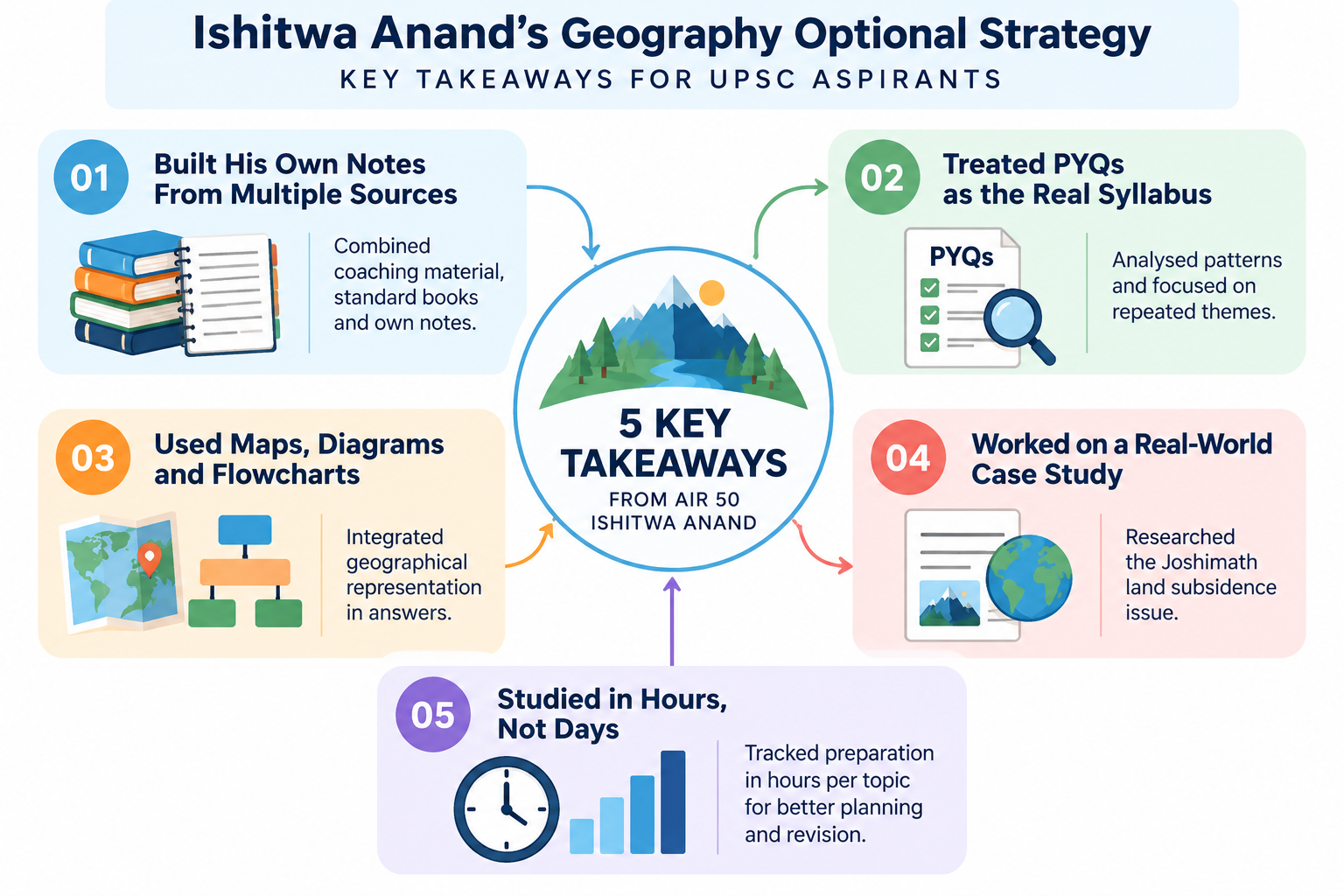
Ishitwa maintained 6-7 notebooks, combining coaching material, college notes, and standard reference books. He never treated any single source as sufficient on its own — each added something the others didn’t: conceptual depth, academic language, or a fresh angle for answers.
Takeaway: Don’t outsource your understanding to one book or one coaching module. Cross-check and merge.
2. Treated PYQs as the Real Syllabus
Rather than reading the syllabus as a checklist, he mined Previous Year Questions for patterns — which themes repeat, which get rephrased, which are overdue. His notes were built around these patterns, not just around textbook chapter order.
Takeaway: Read PYQs before you finish your first reading pass, not after — they tell you where to go deep.
3. Used Maps, Diagrams, and Flowcharts as a Default, Not an Add-On
Every answer leaned on geographical representation wherever it fit — maps to show spatial patterns, flowcharts to show processes, diagrams to show mechanisms. He focused on answering the exact demand of the question rather than dumping content.
His own framing: “Geography optional is not about memorization, it’s about interpretation and presentation.”
4. Turned His Optional Into Real-World Research — and an Interview Asset
Ishitwa led a research project on the Joshimath land subsidence issue. This did double duty: it sharpened his Geography Optional answers with a live, well-understood case study, and it became a genuine talking point in his personality test — something scripted prep can’t replicate.
Takeaway: Pick one live geography issue in the news and go deep enough that you could discuss it for 5 minutes unprompted. It pays off in both papers and the interview.
5. Studied in Hours, Not Days
Instead of vague daily targets, he tracked prep in hours per topic (e.g., Physical Geography: 25 hours, Human Geography: 15 hours). This made planning realistic and revision measurable — he could see exactly how much time a topic had actually received, not just whether he’d “covered” it.
What This Means for Your Own Prep
- Build notes from 2-3 cross-checked sources, not one
- Study PYQ patterns early, not in the final months
- Default to diagrams and maps in every answer, not just when you remember to
- Go deep on one current geography issue you can speak to confidently
- Track prep in hours per topic for honest progress tracking
For the full syllabus breakdown, booklist, and a month-by-month timeline to build this into a complete strategy, see the Geography Optional Strategy Guide.
Build This Into a Structured Plan
Ishitwa’s approach shows what works — turning it into your own result needs structured practice and feedback on your notes and answers. Shabbir Sir’s Geography Optional Foundation Course is built around the same principles: PYQ-integrated preparation, diagram-based answer writing, and mentor evaluation.
Watch this video to know the preparation strategy – click here
In case you still have your doubts, contact us on 9773890604
Enrol in Geography Optional by Shabbir Sir: Here
Enrol in One on One Personalized Mentorship: Here
Enrol in GS Mentorship Program: Here
Enrol In GS Mains Mentorship Program: Here
Explore One Integrated Platform for UPSC Prep: Yooki
