
Contents
Introduction
The mining industry encompasses activities related to extracting and processing natural resources from the Earth’s crust. India, as a Gondwanaland member, harbors abundant mineral resources like coal, iron, mica, and aluminum.
Body:
Reasons for the modest GDP contribution (1.75%) from the mining sector:
- Limited Industrialization: Certain regions or sectors exhibit restrained industrialization, resulting in diminished production and GDP contribution due to factors such as insufficient infrastructure, technology, skilled labor, or investment.
- Agriculture Dominance: While agriculture plays a pivotal role in India’s economy, its lower GDP contribution compared to industrial and service sectors affects the overall percentage, particularly in agriculturally dependent regions.
- Informal Sector: India’s substantial informal sector, comprising unregistered and small-scale enterprises, may not be fully accounted for in GDP calculations, leading to a relatively lower overall GDP percentage.
- Regional Disparities: Pronounced economic imbalances among states or regions impact the overall GDP percentage, with certain areas displaying stronger economic bases and higher contributions.
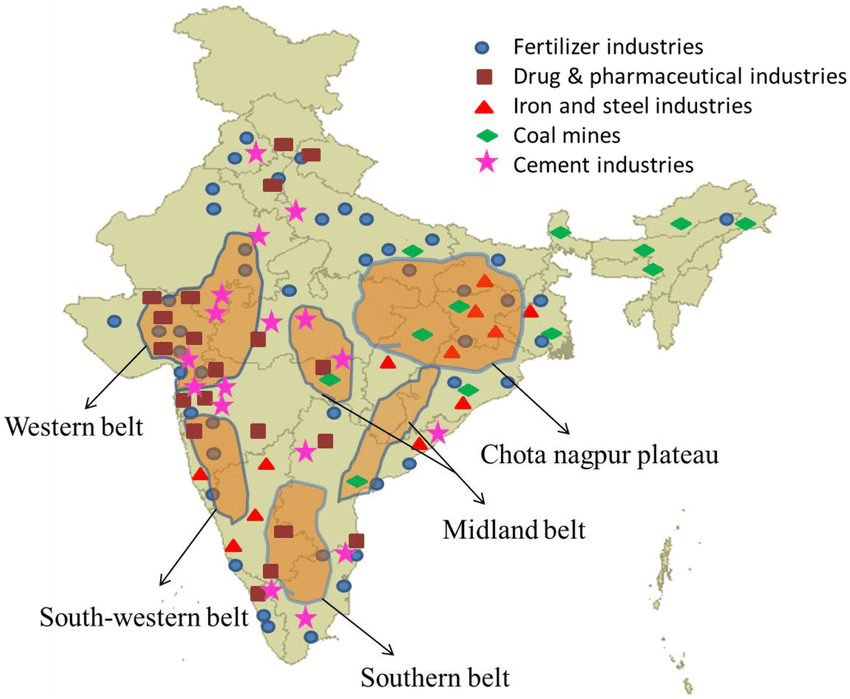
Mineral & mining belts of India include:
- The Dharwar Rocks: Southern India, rich in iron ore, manganese, and bauxite.
- The Chota Nagpur Plateau: Eastern India, is known for vast reserves of coal, iron ore, copper, mica, and limestone.
- The Aravalli Range: Rajasthan and Haryana, are renowned for marble, gypsum, and asbestos.
- The North-Eastern Belt: Assam and nearby areas are rich in coal, oil, and natural gas.
- The Western Coast Belt: Maharashtra and Goa, notable for iron ore deposits.
- The Vindhyan Range: Parts of Madhya Pradesh and Uttar Pradesh, known for limestone deposits used in cement production and various industries.
Way forward:
- Removal of end-use restrictions: Mines can now be utilized for various purposes as per the lessee’s discretion, eliminating the requirement for specific end-use reservations.
- Sale of minerals by captive mines: Captive mines, excluding atomic minerals, can sell up to 50% of their annual mineral production in the open market after meeting their own requirements, allowing them to generate additional revenue.
Conclusion:
Hence, To efficiently utilize mineral resources and prevent mining accidents, it’s essential to streamline clearance processes and enforce mining regulations, including banning Rat-Hole mining and unscientific practices.

In case you still have your doubts, contact us on 9811333901.
For UPSC Prelims Resources, Click here
For Daily Updates and Study Material:
Join our Telegram Channel – Edukemy for IAS
- 1. Learn through Videos – here
- 2. Be Exam Ready by Practicing Daily MCQs – here
- 3. Daily Newsletter – Get all your Current Affairs Covered – here
- 4. Mains Answer Writing Practice – here