

Contents
Demographic Transition Model
Background & Nature of the Model
- The Demographic Transition Model (DTM) is a modern, data-driven model of population change developed during the mid-20th century (1940s–1960s).
- Unlike ideological accounts (Malthus, Marx) which are normative or philosophically driven, the DTM is empirical, based on the demographic histories of many countries and expressed with graphical/mathematical techniques.
- It is often called the modern theory of population because it explains how birth and death rates change over time as societies develop.
Origin/Attribution
- The model was developed from the work of several scholars: Notestein and Thomson. They classified countries by demographic characteristics and interpreted those categories as stages of transition rather than permanently different types of countries.
The Three Stages (Classification → Stages)
Notestein & Thomson identified three groups of countries which they later framed as three stages of demographic transition: 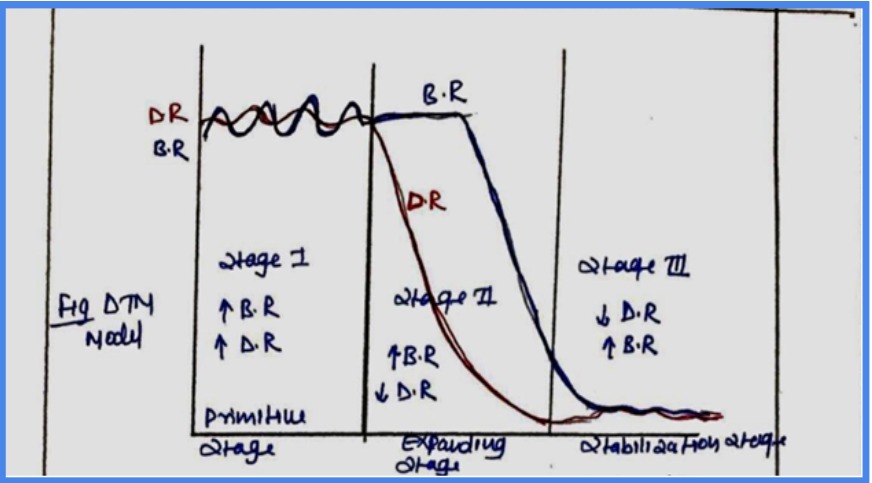
1. Stage 1 — Incipient Growth Stage
- Characteristic rates: high birth rate + high death rate → net population growth is low (population roughly stationary).
- Typical of pre-transition societies with limited development and high mortality.
2. Stage 2 — Expanding Growth Stage
- Characteristic change: death rate falls rapidly (medical, sanitation, nutrition improvements) while birth rate remains high for some time.
- Result: a wide gap between birth and death rates → very high population growth (population explosion).
3. Stage 3 — Stabilisation Stage
- Characteristic change: birth rate declines (social, economic, cultural changes, family planning), bringing it closer to the low death rate.
- Result: population growth slows and approaches stabilisation (low birth & low death rates). Developed countries tend to be in or near this stage.
Examples & Implications
- Developed countries: low birth & low death, near stabilisation (stage 3).
- Some less developed regions may currently show high birth & high death rates with low present growth but the potential for rapid future growth if death rates decline (lecture applied this reasoning to parts of Africa).
- The model treats the three “types” not as permanent categories but as phases that societies pass through as they industrialise and develop.
PYQs
1. Analyse the role of demographic transition theory in explaining variations in fertility and mortality rates globally. (15 Marks/2025)
2. “The stages of Demographic Transition are a reflection of uneven development across the globe.” Explain with suitable examples. (15 marks/2023)
3. Write a note on the parameters used to describe the demographic transition in developing countries like India. (2007)
4. Write a short note on Demographic transition. (1986)
5. The process of demographic transition is not uniform in India. Examine this statement in the context of demographic transition theory. (15 Marks/2020)
6. Explain how the Demographic Transition created a demographic divide in contemporary India. (2010)
In case you still have doubts, contact us on 9773890604
Enrol in Geography Optional by Shabbir Sir: Here
Enrol in One-on-One Personalised Mentorship: Here
Enrol in GS Mentorship Program: Here
Enrol In GS Mains Mentorship Program: Here
Explore One Integrated Platform for UPSC Prep: Yooki
Visit our YouTube Channel: Here