Contents
- 1 Marxist Interpretation of Population Growth
- 1.0.1 Context/Background
- 1.0.2 Main Argument:
- 1.0.3 Capitalist Motives and Historical Example:
- 1.0.4 Mechanisms of Exploitation:
- 1.0.5 Labour Response and the ‘More Hands’ Incentive:
- 1.0.6 Vicious Cycle of Poverty and Population Growth (Marxist View):
- 1.0.7 Contrasts with other Theories:
- 1.0.8 Marxist Solution and Political Implications:
- 1.0.9 Ideological Critique (Religion, Culture, Tradition):
- 1.1 Marxist Interpretation
- 1.2 Three Principal Prescriptions (Marxist Advocacy)
- 1.3 Relationship Between Poverty and Population
- 2 PYQs
Marxist Interpretation of Population Growth
Context/Background
- Marx’s ideas emerged in the mid-19th century and were inspired by earlier events like the French Revolution (1789 onward).
- Marx (German thinker) and Friedrich Engels together developed the core writings often cited: Das Kapital and The Communist Manifesto.
Main Argument:
Population growth is explained by the political-economic structures of capitalism rather than by individual biological instincts alone. The capitalist system — characterised by class divide and private property — creates conditions that produce and perpetuate high population growth among the poor.
Capitalist Motives and Historical Example:
- The dominant motive of the rich/landed/industrial class is profit maximization.
- Historical example (British rule in India): colonial and landed interests forced growth of cash crops (indigo, cotton) to serve industrial production, imposed high rents, and concentrated land ownership (zamindari). These actions were driven by profit motives and exacerbated rural dispossession and poverty.
Mechanisms of Exploitation:
- Capitalists increase profits by either raising prices (monopoly) or — more commonly in competitive markets — reducing costs. Cost reduction strategies include cutting wages, overworking labour (sweatshops), mechanisation, and producing low-quality goods.
- Extreme historical cases of exploitation include slavery.
- Mechanisation and introduction of machines can displace workers, increasing unemployment and poverty.
Labour Response and the ‘More Hands’ Incentive:
- The labour class typically has low incomes and precarious livelihoods. Under such conditions, households may perceive economic benefit in having larger families — “more hands to work” — to supplement household income.
- According to the Marxist explanation, this can be a conscious response: the poor deliberately increase family size to secure income through additional labour.
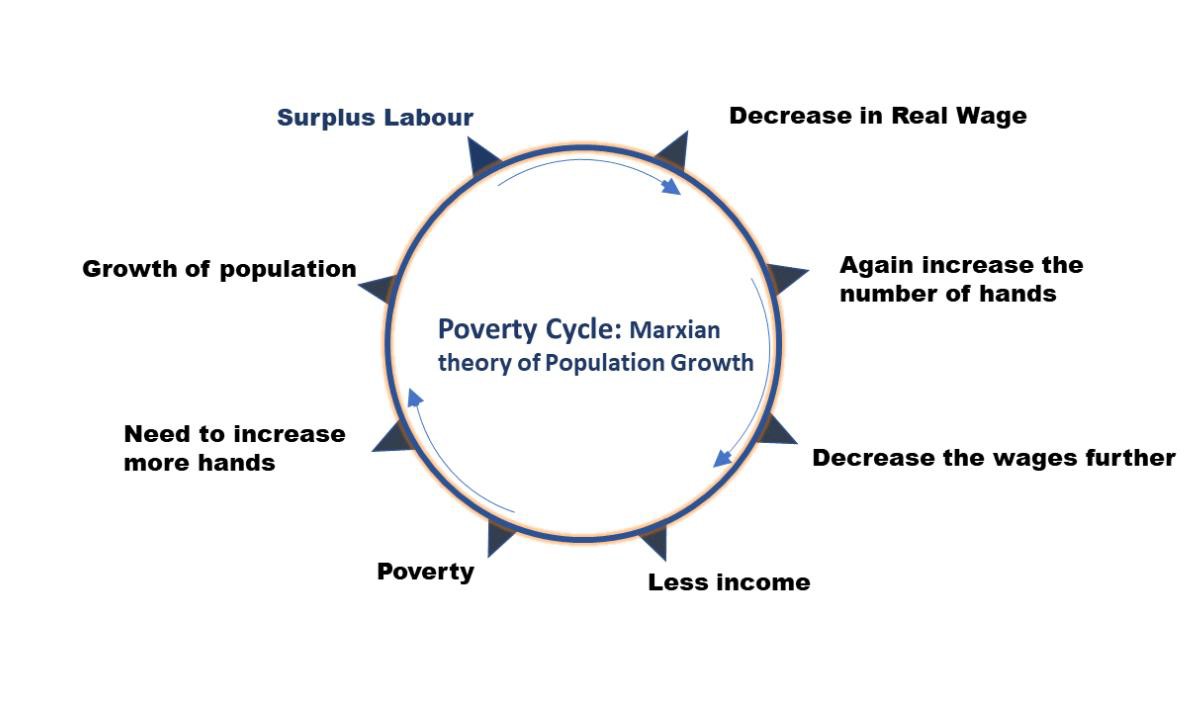
Vicious Cycle of Poverty and Population Growth (Marxist View):
1. Low wages → poverty → incentive to have more children (to increase household labour).
2. More children → oversupply of labour.
3. Oversupply of labour → downward pressure on wages.
4. Lower wages and mechanisation → further unemployment and poverty.
5. The cycle repeats and intensifies, creating a self-reinforcing vicious cycle linking poverty and high population growth.
 Contrasts with other Theories:
- Malthusian View: Blamed population growth on biological instincts of the poor (portrayed the poor as driven by animalistic impulses).
- Modern/Demographic View (Post-1980s/90s): Attributes high fertility among the poor to structural and proximate causes — lack of education and awareness, limited access to contraception, high infant mortality rates (IMR), poor maternal health and high maternal mortality (MMR), and gender inequality. In this view, large families often result from constraints and lack of choices rather than a deliberate economic strategy.
- Marxist Position: Rejects Malthusian blame of the poor; instead treats population change as embedded in class relations and capitalist production. Marx’s analysis is primarily a political-economic theory, not a demographic theory per se.
Marxist Solution and Political Implications:
- The Marxist prescription for the problem is structural: abolish the twin evils of class divide and private property. Land, resources, minerals and industries should not be privately owned by single landlords or capitalists but held collectively (group ownership).
- Marx advocated class struggle — including the possibility of violent struggle — whereby the working class uses its numbers and organisation to overthrow capitalist control. The idea is that population numbers can become a political strength in revolutionary struggle, not an end in itself.
- Important clarification: Marx is not pro-natalist. He does not endorse increasing fertility for its own sake; rather, he recognises the numerical strength of the working class as a potential lever in class conflict.
Ideological Critique (Religion, Culture, Tradition):
- Marxism also critiques religion, tradition and cultural narratives that legitimise and naturalise social hierarchies (e.g., claims that poverty or low status are predetermined by destiny, karma, caste or gender roles). These belief systems, Marxists argue, help the rich class to justify and maintain domination by presenting inequality as natural or moral rather than structural.
Marxist Interpretation
Core claim: Marxist interpretation views poverty and population issues as structural, not biological or moral failings of the poor. It therefore advocates political and socio-economic solutions rather than blaming the poor.
Three Principal Prescriptions (Marxist Advocacy)
- Destruction of capitalism: Overthrow or transform capitalist relations that concentrate wealth and dispossess communities.
- Use of population size as an advantage: Mobilise the masses (labour, farmers, tribal groups) politically and economically. Organise trade unions, farmers’ unions and other collective bodies to convert numerical strength into bargaining and political power.
- Collective/Popular ownership of resources and production assets: Transfer ownership/control of land, forests, fisheries, mines and other local resources to the people who live from them (farmers, tribal communities, fishermen). Promote social groups, communes or cooperatives as units of production and resource governance.
| Theme | Malthusian Theory | Marxian Theory |
| Philosophical Basis |
Deterministic – population grows faster than food (geometric vs. arithmetic law). |
Humanistic – poverty arises from social injustice and capitalist exploitation, not absolute numbers. |
| View of Population |
Population is a burden that strains resources. |
Population is a productive force/asset if provided with equitable opportunities. |
|
Cause of Poverty
|
Natural imbalance between population and food supply. |
Unequal distribution of wealth/resources under capitalism (class conflict). |
| Checks/Controls |
Positive checks (famine, disease, war) and preventive checks (celibacy, moral restraint). |
Redistribution, social equity, and better organisation of production – no coercive population control. |
|
Spatial/Geographical Outlook
|
Universal applicability assumes the same dynamics everywhere. |
Context-specific – poverty linked to core-periphery inequalities and capitalist world system. |
| Contemporary Relevance | Discredited in advanced economies due to demographic transition and Green Revolution; still visible in fragile ecologies (Sahel, Sub-Saharan Africa). | Influences human development approach (Amartya Sen, HDI), Kerala Model, and policies emphasising welfare, redistribution, and sustainability. |
Relationship Between Poverty and Population
1. Malthusian Perspective
- Malthus blamed the poor for both their population growth and their poverty.
- Policy implication he favoured: capitalism and no poor laws (i.e., oppose direct relief or welfare that eases subsistence for the poor).
- Contextual note: Malthus wrote during/after the French Revolution era and reacted against redistributionist pressures; his social position (he was not poor) influenced his prescriptions.
2. Marxist Perspective
- Marx: poverty is responsible for high population growth, but the poor themselves are not to blame.
- Root cause (for Marx): capitalist social relations and dispossession — capitalism produces and sustains poverty, which then shapes demographic behaviour.
- Policy implication: structural change (pro-poor measures, redistribution, ownership reforms) rather than blaming the poor.
3. Modern Interpretation
- Poverty is linked to lack of education and poor health; these deprivations are major drivers of high fertility and population growth.
- Thus contemporary views emphasise human-development solutions (education, health, reproductive rights) to reduce fertility, rather than moralising the poor.
PYQs
1. Elaborate upon the influence of Marxist philosophy on geographical research, outlining key themes addressed by Marxist geographers since the 1970’s. (15 Marks/2018)
2. “Marx’s view on population is more humanistic”. Comment. (10 Marks/2015)
In case you still have doubts, contact us on 9773890604
Enrol in Geography Optional by Shabbir Sir: Here
Enrol in One-on-One Personalised Mentorship: Here
Enrol in GS Mentorship Program: Here
Enrol In GS Mains Mentorship Program: Here
Explore One Integrated Platform for UPSC Prep: Yooki
Visit our YouTube Channel: Here