Contents
R.P. Mishra’s Model of Growth Centres
Recognising that Eurocentric models neglected agriculture and India’s unique social hierarchy, R.P. Mishra proposed a five-tier hierarchy to ensure “Balanced Regional Development.” 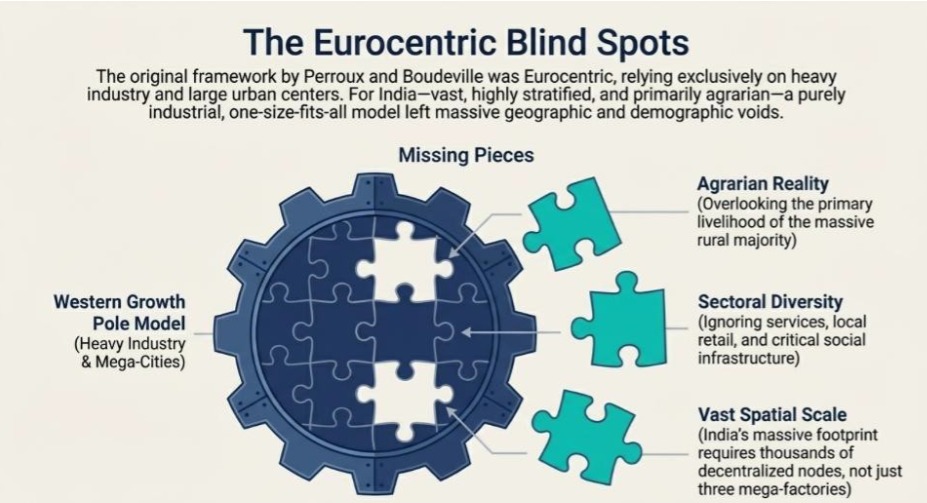
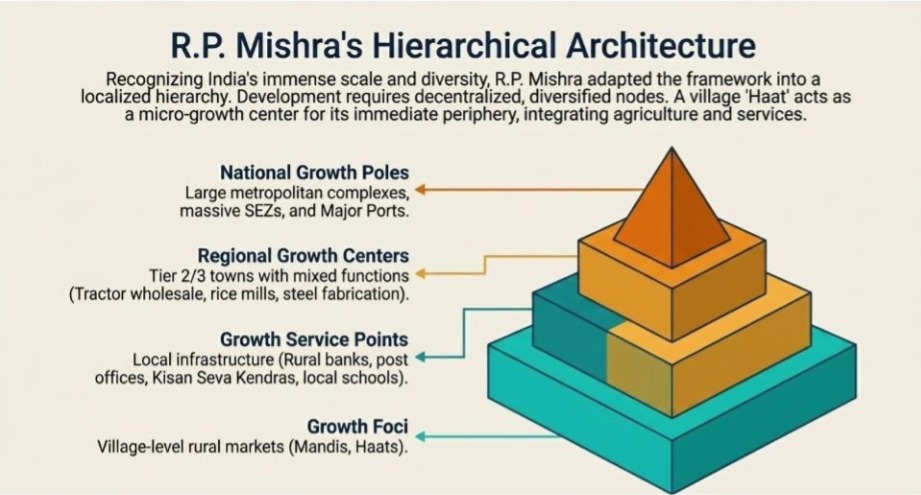
The Five-Tier Hierarchy of Growth Nodes
- Growth Foci: Village-level markets (Mandis/Haats) serving the immediate rural interior.
- Growth Service Points: Local infrastructure nodes providing essential services like rural banks, post offices, and schools.
- Growth Points: Sub-regional market centres that facilitate the flow of goods between villages and towns.
- Regional Growth Centres: Tier 2 and Tier 3 towns (e.g., Sonipat or Karnal) providing mixed functions such as agri-equipment repair, rice mills, and wholesale fabrication.
- National Growth Poles: Large-scale metropolitan complexes, ports, and heavy industrial centres (e.g., Mumbai, Delhi, or the Hooghly belt).
Modern Policy Integration
Mishra’s logic is embedded in contemporary Indian strategies like Towns of Export Excellence (TEE), One District One Product (ODOP), and the Industrial Clusters policy, all aimed at creating localised growth engines in smaller urban centres.
Conclusion: Critical Assessment of India’s Industrial Strategy
The legacy of the Second Five-Year Plan was the pursuit of industrial dispersal. Heavy engineering plants were established in backward tribal belts to trigger regional development, including:
- Bhilai (Chhattisgarh) and Rourkela (Odisha) for steel.
- Talcher (Odisha) and Sindri (Jharkhand) for fertilizers/FCI.
- Agni Gundala (Andhra Pradesh) for copper smelters.
- Pinjore (Haryana) and Pimpri (Maharashtra) for HMT and pharmaceuticals.
However, the modern shift toward zero-tariff imports for processed foods from nations like the U.S. is viewed by many as a “complete disaster.” The transition of oats from “horse fodder” to branded “Quaker Oats” illustrates that the future of agricultural wealth lies in value addition. By allowing global brands to flood the market, domestic staples risk becoming “inferior goods” (Giffen goods), undermining the potential for Indian brands like Amul or Nandini to compete and preventing agriculture from ever becoming a propulsive growth pole. Ultimately, while Growth Pole models are powerful for initialisation, they often fail to spread development. Instead of “Balanced Regional Development,” they frequently create “islands of prosperity,” leading to new forms of spatial disparity that planners must continue to navigate.
PYQs
1. Why has F. Perroux’s theory of the growth pole as a model of regional growth been criticised? Explain with examples. (20 Marks/2025)
2. Discuss the different types of polarisation-induced spatial inequalities and imbalances associated with growth poles. (10 marks /2023)
3. “Growth is not uniform in different places.” Critically examine this statement in the context of the growth pole theory. (15 Marks/2019)
4. Critically examine the role of growth centres and growth poles in the regional development process. (2001)
5. Write a short explanatory note on Growth poles. (2010)
6. Write a short explanatory note on Growth poles. (2010)
7. Write a short note: Mishra’s theoretical stages of the rural-urban process. (10 Marks/2013)
In case you still have doubts, contact us on 9773890604
Enrol in Geography Optional by Shabbir Sir: Here
Enrol in One-on-One Personalised Mentorship: Here
Enrol in GS Mentorship Program: Here
Enrol In GS Mains Mentorship Program: Here
Explore One Integrated Platform for UPSC Prep: Yooki
Visit our YouTube Channel: Here

