

Contents
- 1 Ocean Salinity
- 1.1 Composition of Ocean Salts
- 1.2 Where Do Ocean Salts Come From?
- 1.3 Why Is the Ocean Dominated by Sodium and Chloride?
- 1.4 Residence Time and the Salinity Balance
- 1.5 Removal of Magnesium and Sulfates
- 1.6 1. Biological Removal of Calcium
- 1.7 2. Salinity as a Dynamic Ocean Property
- 1.8 3. Connection with Ocean Circulation
- 2 Governing Principles and Factors Controlling Ocean Salinity
- 3 Factors Controlling Ocean Salinity
- 4 Conclusion
Ocean Salinity
The marine heat budget explains how energy enters, leaves and moves through the ocean. A closely related property that controls the physical behaviour of seawater is salinity. Salinity refers to the amount of dissolved salts present in a given mass of seawater. It is usually expressed as the quantity of dissolved salts contained in 1,000 parts of seawater, commonly represented in parts per thousand. Salinity is not simply a measure of how much salt is present. It is an important oceanographic property because changes in salinity influence seawater density, stratification, circulation, evaporation, freezing and the distribution of marine organisms.
Composition of Ocean Salts
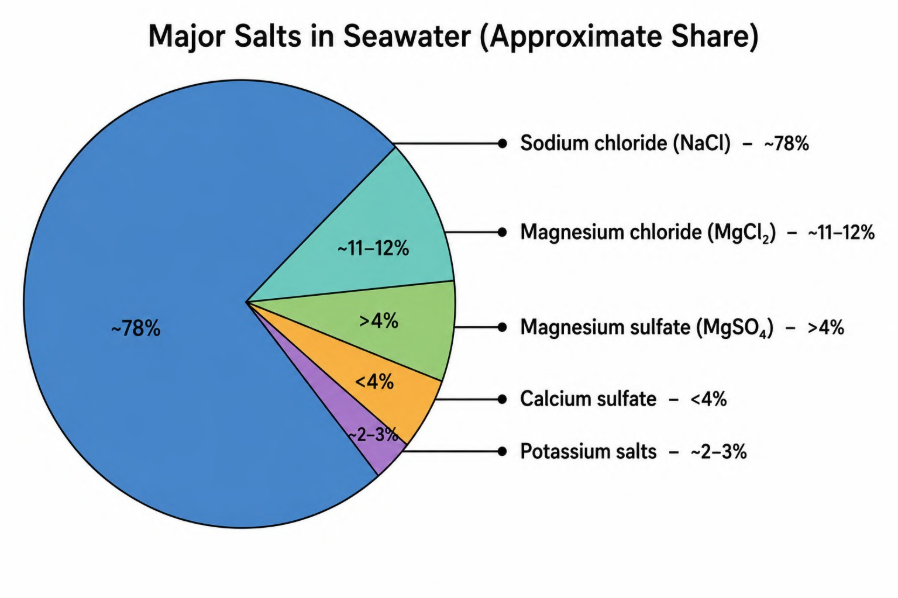
Although seawater contains numerous dissolved substances, a relatively small number of salts account for the overwhelming majority of its dissolved ionic content. The dominance of sodium and chloride ions gives seawater its characteristic salty nature. However, the important geographical question is not simply where the salts come from, but also why particular ions remain in the ocean for long periods while others are removed relatively quickly.
Where Do Ocean Salts Come From?
A major source of dissolved salts is the weathering of rocks on continents. Rainwater and other forms of precipitation interact with rocks and soils, dissolving minerals and transporting dissolved ions through rivers and groundwater towards the oceans. The process can be represented conceptually as:
Rock weathering → Dissolution of minerals → River transport → Ocean
Volcanic activity, hydrothermal processes and weathering of the ocean floor also contribute dissolved substances to seawater. Yet the composition of seawater is not simply a reflection of the average composition of continental rocks. This leads to an important oceanographic anomaly.
Why Is the Ocean Dominated by Sodium and Chloride?
Continental weathering supplies several ions to the ocean, including calcium, sodium, magnesium and other dissolved materials. If all these ions simply accumulated indefinitely, the composition of seawater would closely mirror the relative quantities supplied by rivers, but that does not happen. Different ions have different residence times, meaning the length of time they remain dissolved in the ocean before being removed. Sodium and chloride have relatively long residence times. They therefore remain in seawater for very long periods and can accumulate over geological timescales. This explains why seawater is dominated by sodium and chloride, even though continental weathering supplies many other ions as well. The key principle is: Ocean-water composition depends not only on the rate at which substances enter the ocean but also on how long they remain there.
Residence Time and the Salinity Balance
The concept of residence time is therefore fundamental to understanding ocean salinity. A substance with a long residence time remains in the ocean for a prolonged period. Even if its rate of supply is moderate, continued accumulation can make it a major component of seawater. Conversely, substances that are rapidly removed from seawater do not accumulate to the same extent. Therefore, the concentration of a particular ion reflects a balance between:
Rate of input + Rate of removal + Residence time
This helps explain why the ocean does not contain dissolved substances in exactly the same proportions in which they are delivered from the continents.
Removal of Magnesium and Sulfates
Some dissolved ions are removed from seawater through chemical precipitation and interaction with ocean-floor materials. Magnesium and sulfate ions, for example, can participate in chemical processes associated with the ocean floor and mineral formation. Ocean-floor deposits, including mineral accumulations associated with hydrothermal and sedimentary environments, can therefore act as sinks for certain dissolved elements. This is particularly relevant when considering polymetallic nodules and other deep-sea mineral deposits. These deposits contain several metals and illustrate how materials dissolved in seawater can eventually become incorporated into solid mineral forms. Thus:
Dissolved ions in seawater → Chemical/physical processes → Precipitation or mineral incorporation → Removal from seawater
This continuous exchange helps regulate the chemical composition of the ocean.
1. Biological Removal of Calcium
Calcium provides another excellent example of how marine organisms influence seawater chemistry. Calcium ions dissolved in seawater are actively incorporated into biological structures such as:
- Bones
- Shells
- Coral skeletons
- Other calcium-carbonate structures
Marine organisms therefore act as important biological sinks for calcium. For example, coral reefs are constructed largely from calcium carbonate, while many marine organisms use calcium-containing compounds to construct shells and skeletal structures. The process can be understood as:
Calcium dissolved in seawater → Biological uptake → Shells/skeletons/coral structures → Burial and sedimentation
Over geological timescales, these processes contribute to the transfer of dissolved materials from the ocean into marine sediments and rocks.
2. Salinity as a Dynamic Ocean Property
Ocean salinity should therefore not be viewed as a fixed quantity. It reflects a continuous balance between inputs, removal processes and water movement. Salts enter the ocean through:
- Continental weathering
- River discharge
- Volcanic activity
- Hydrothermal processes
- Atmospheric deposition
They are removed or redistributed through:
- Chemical precipitation
- Biological uptake
- Sedimentation
- Hydrothermal reactions
- Incorporation into marine minerals
At the same time, evaporation and freshwater addition change the concentration of salts without necessarily adding or removing the salts themselves. This distinction is particularly important:
Evaporation → Water is removed → Salinity increases; Freshwater addition → Water is added → Salinity decreases
The total quantity of dissolved salts need not change for the concentration of salts in seawater to change.
3. Connection with Ocean Circulation
Salinity also connects directly with the earlier discussion of ocean temperature. Temperature and salinity together influence seawater density: Temperature + Salinity → Density → Ocean circulation
Cold, salty water is generally denser and can sink, contributing to the formation of deep water. Conversely, warmer or fresher water tends to be less dense and remains closer to the surface. Thus, salinity is not merely a chemical characteristic of seawater. It is one of the fundamental controls of thermohaline circulation and therefore contributes to the global redistribution of heat and dissolved substances. This creates a direct connection between the two sections:
Ocean temperature → Density; Ocean salinity → Density Temperature + Salinity → Thermohaline circulation
Ocean salinity represents the balance between the addition, removal and residence time of dissolved substances in seawater. Sodium and chloride dominate because of their long residence times, while other ions are removed more rapidly through chemical precipitation, mineral formation and biological processes. Salinity, together with temperature, ultimately influences seawater density and plays a fundamental role in global ocean circulation.
Governing Principles and Factors Controlling Ocean Salinity
Having understood the composition of seawater and the residence time of its dissolved salts, the next step is to understand why salinity varies from one part of the ocean to another. The important distinction is that the major ionic composition of seawater remains remarkably stable, while the overall concentration of dissolved salts changes geographically and seasonally. In other words, the ocean may be more saline in one region and less saline in another, but the relative proportion of its principal dissolved ions remains broadly constant. This provides the foundation for understanding the governing principles of ocean salinity.
1. Conservation Principle
The first principle is the conservation of salts. On the timescale of human life, the total quantity of dissolved salts contained in the global ocean can be treated as approximately constant. Salts are continuously being added through processes such as weathering, river transport, volcanic activity and hydrothermal processes, while other processes remove them through biological uptake, precipitation, sedimentation and mineral formation. These inputs and outputs operate over very long geological timescales. Therefore, for ordinary geographical analysis, the global ocean can be considered a vast salt reservoir whose total salt content changes very slowly. This does not mean that no salt enters or leaves the ocean. Rather, it means that the changes are too slow to produce major alterations in the total salt inventory over human timescales.
2. Constant Proportion Principle
A second important principle is the Constant Proportion Principle, associated with Forchhammer and Dittmar. The key idea is that although the total salinity of seawater varies from place to place, the relative proportion of the major dissolved ions remains broadly constant. For example, seawater in a region with relatively high salinity and seawater in a region with relatively low salinity will contain different total quantities of dissolved salts, but the major ions will still occur in approximately similar proportions. This distinction is extremely important: Salinity can change, but the relative composition of the major salts remains broadly constant. The principle works because the major ions have sufficiently long residence times and are well mixed throughout the global ocean. For example, if evaporation removes water from a region, the concentration of salts increases, but evaporation does not selectively remove sodium while leaving chloride behind. Similarly, adding freshwater dilutes the seawater without fundamentally changing the relative proportions of its major ions.
Factors Controlling Ocean Salinity
The composition of seawater remains relatively constant, but its salinity varies considerably from one region to another. This variation occurs mainly because the amount of water associated with the dissolved salts changes, while ocean currents and vertical circulation continuously redistribute water of different salinities. Three processes are particularly important: dilution and evaporation, mixing, and upwelling.
1. Dilution and Evaporation
The most important control on surface salinity is the balance between water loss and freshwater addition. When evaporation takes place, water changes from liquid to vapour and leaves the ocean surface, while the dissolved salts remain behind. As a result, the concentration of salts increases and salinity rises.
More evaporation → Less water → Higher salt concentration → Higher salinity
This is why regions characterised by high temperatures, clear skies, dry air and strong evaporation can develop high surface salinity. The subtropical belts, particularly around 20°–30° latitude, are important examples because descending air associated with subtropical high-pressure systems produces relatively dry and cloud-free conditions. The reverse process occurs when freshwater is added to the ocean. Rainfall, river discharge and melting of snow or ice increase the amount of water without adding an equivalent quantity of dissolved salts.
More freshwater → Greater water volume → Dilution of salts → Lower salinity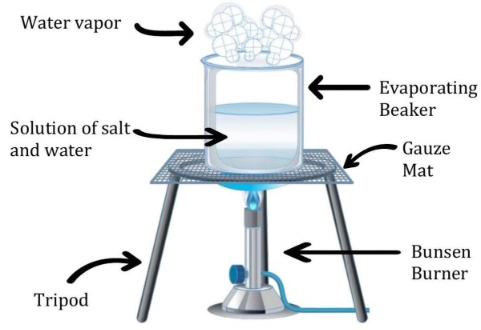
Therefore, regions receiving heavy rainfall or substantial river discharge generally tend to have lower surface salinity. A simple beaker analogy makes the principle clear. If a beaker contains water with dissolved salt and some water evaporates, the salt remains while the volume of water decreases. The remaining solution therefore becomes more concentrated. If freshwater is added instead, the same amount of salt is distributed through a larger volume of water, reducing the concentration.
1. Mixing and Ocean Currents
Salinity is also controlled by mixing, because seawater with different salinities is continuously brought together through ocean circulation. Ocean currents transport water from one geographical region to another. A current carrying relatively saline water can increase salinity in the region into which it flows, while the movement of relatively fresh water can reduce salinity elsewhere. Mixing takes place through:
- Surface ocean currents
- Wind-driven turbulence
- Tidal movements
- Vertical circulation
- Deep-ocean circulation
The importance of mixing becomes especially clear when comparing an open ocean with an enclosed or semi-enclosed sea. In the open ocean, extensive circulation allows water to mix over large distances. This tends to moderate extreme local variations in salinity. In a semi-enclosed sea, however, restricted exchange with the open ocean can allow local climatic conditions to exert a much stronger influence. The Red Sea is a classic example. It experiences intense evaporation, receives very little freshwater input and has relatively restricted exchange with the Indian Ocean through the Bab-el-Mandeb Strait. These conditions contribute to its exceptionally high salinity.
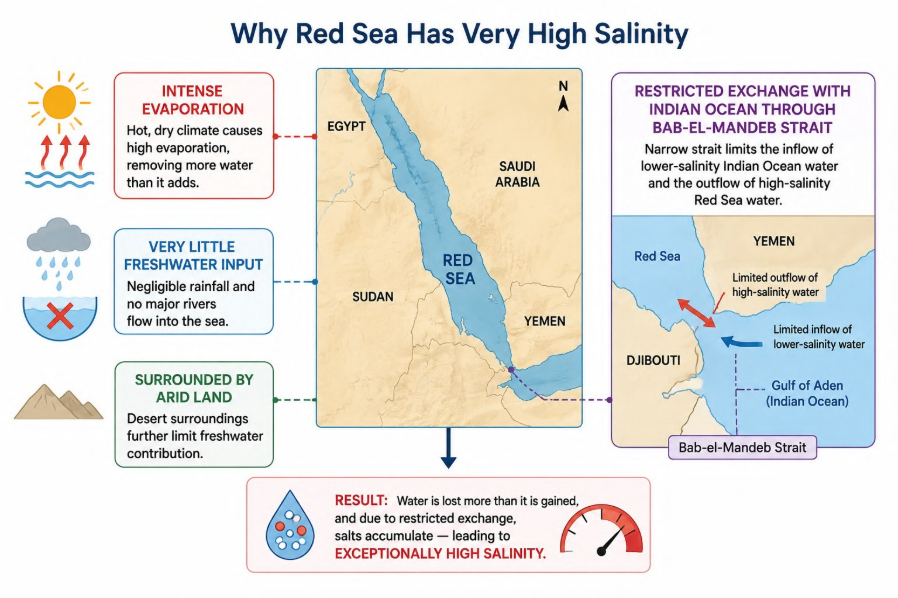
Thus, salinity depends not only on the climatic water balance but also on the degree of connection and circulation between different water bodies.
2. Upwelling
Upwelling is another mechanism capable of modifying surface salinity.
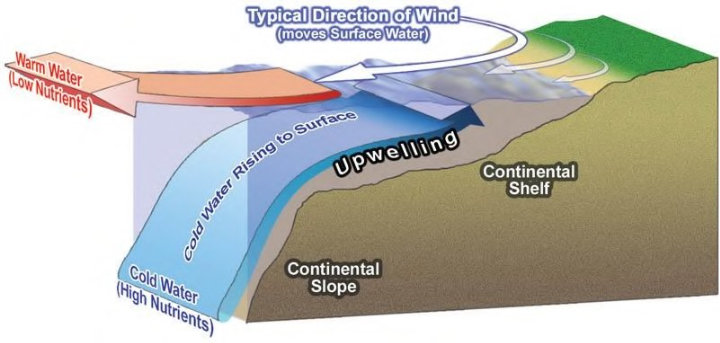
It has been isolated from direct atmospheric processes for long periods. Upwelling occurs when deeper ocean water rises towards the surface. Deep water has different physical and chemical characteristics from surface water. In the context of salinity, upwelled water is generally cooler and relatively less saline than highly evaporated surface waters in many subtropical regions. When it reaches the surface, it can therefore alter the local temperature and salinity structure. Upwelling is particularly prominent along certain continental margins where winds and Ekman transport move surface water away from the coast. Deeper water then rises to compensate for the displaced surface water. Upwelling is therefore important not only for salinity and temperature, but also for marine productivity because the rising deep water often brings nutrients towards the surface.
The Combined Control of Salinity
No single process determines the salinity of a particular ocean region. The observed salinity is the result of the interaction between evaporation, freshwater input, mixing and vertical circulation. For example, a region may experience strong evaporation and therefore develop high salinity, but ocean currents may subsequently transport and mix that saline water with surrounding waters. Similarly, heavy rainfall may reduce surface salinity, while subsequent mixing with deeper or neighbouring saline water can partly offset the dilution.
Conclusion
The ocean must be understood as a dynamic component of the global climate system, where temperature, salinity, circulation and atmospheric processes are closely interconnected. Ocean warming is not simply a rise in temperature; it alters thermal expansion, cryospheric stability, marine ecosystems, oxygen availability and ocean circulation, creating cascading effects across the Earth system. The marine heat budget explains how solar energy enters the ocean and how heat is exchanged with the atmosphere through radiation, sensible heat and latent heat. At the same time, salinity is controlled by evaporation, freshwater input, mixing and upwelling, while the relative proportion of major dissolved salts remains remarkably stable. Together, temperature and salinity determine seawater density, making them fundamental to ocean circulation and the redistribution of heat across the globe. Increasing ocean warming, Arctic amplification and persistent marine heat extremes further demonstrate why understanding these basic oceanographic processes is essential for interpreting contemporary issues such as sea-level rise, coral bleaching, deoxygenation, changing circulation and coastal vulnerability. The central geographical insight is that the ocean is not an isolated water body but an active regulator of the Earth’s climate, linking the atmosphere, cryosphere, biosphere and human systems.
PYQs
1. With suitable examples, explain the factors causing sea level changes. (10 Marks/2024)
2. Discuss the hazards associated with the rise of sea-surface temperature. (10 Marks/2021)
3. Describe the causes and consequences of sea level changes. (10 Marks/2018)
4. “Temperature, salinity and density differences in ocean water are the prime causes of ocean water circulation.” Elaborate. (2011)
5. Comment on marine heat budget and the oceanic circulation system. (2009)
In case you still have doubts, contact us on 9773890604
Enrol in Geography Optional by Shabbir Sir: Here
Enrol in One-on-One Personalised Mentorship: Here
Enrol in GS Mentorship Program: Here
Enrol In GS Mains Mentorship Program: Here
Explore One Integrated Platform for UPSC Prep: Yooki
Visit our YouTube Channel: here