

Contents
- 1 Marine Heat Budget
- 1.1 1. Solar Radiation: The Primary Source of Oceanic Heat
- 1.2 2. Geothermal Heat from Earth’s Interior
- 1.3 3. Radiative Heat Loss
- 1.4 4. Sensible Heat Exchange
- 1.5 5. Latent Heat: The Major Atmospheric Connection
- 1.6 6. Why Latent Heat Matters for Cyclones
- 1.7 7. The Ocean as a Heat Distributor
- 1.8 8. Teleconnections Across Ocean Basins
- 1.9 PYQs
Marine Heat Budget
The consequences of ocean warming become easier to understand when we examine the marine heat budget. The temperature of the ocean is determined by the balance between the heat it receives and the heat it loses. In other words, the marine heat budget is an accounting system that explains how energy enters, leaves and is redistributed within the ocean.
The basic principle is:
Heat gained by the ocean = Heat lost by the ocean
This balance can be represented as: 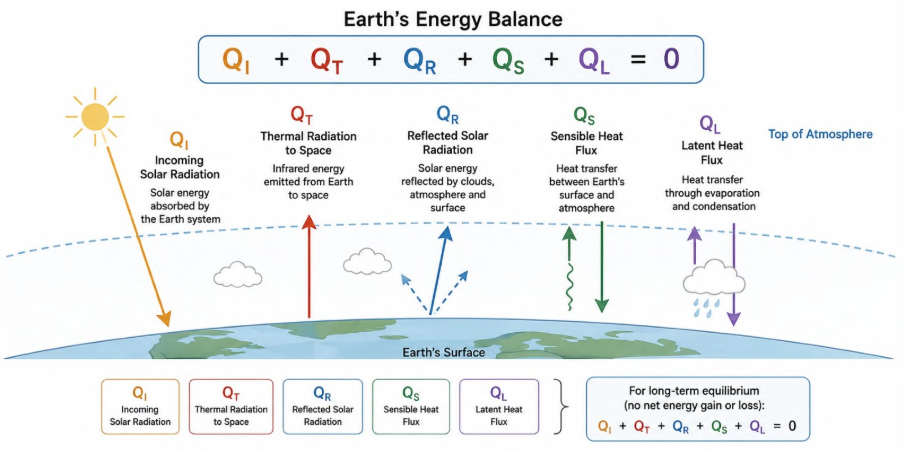 The individual components represent different pathways through which the ocean gains or loses energy.
1. Solar Radiation: The Primary Source of Oceanic Heat
The most important source of heat for the ocean is solar radiation. The incoming solar energy absorbed by the ocean surface is represented by QI. The Sun continuously supplies energy to the ocean, but not all incoming radiation is absorbed. A portion is reflected back to space, while the remainder is absorbed by the ocean surface and converted into thermal energy. The amount of solar energy received varies with:
- Latitude
- Season
- Solar angle
- Cloud cover
- Atmospheric conditions
- Surface albedo
This explains why tropical oceans generally receive more solar energy than polar oceans. However, the amount of energy received from the Sun alone does not determine the actual temperature of an ocean region. Heat is continuously redistributed by currents, mixing, evaporation and exchanges with the atmosphere.
2. Geothermal Heat from Earth’s Interior
The component QT represents heat originating from the Earth’s interior. The ocean floor receives geothermal energy through processes such as:
- Volcanism
- Magmatic activity
- Hydrothermal circulation
- Heat escaping through the oceanic crust
This is particularly important around mid-oceanic ridges and tectonically active regions, where magma occurs relatively close to the ocean floor. However, when considering the overall heat budget of the global ocean, geothermal heat is extremely small compared with solar energy and atmospheric exchanges. It is therefore often treated as negligible at the global scale. Its importance becomes much greater locally, particularly around features such as hydrothermal vents.
3. Radiative Heat Loss
The ocean does not simply absorb solar energy; it also continuously radiates energy back towards the atmosphere. This component is represented by QR. The ocean surface emits long-wave or terrestrial radiation because every body with a temperature above absolute zero emits thermal energy. The net radiative exchange depends on the difference between:
- Radiation emitted by the ocean
- Radiation received from the atmosphere
Under the global average condition described here, the ocean experiences a net loss of heat through radiative processes. Therefore, solar radiation provides the principal incoming energy, while long-wave radiation represents one of the pathways through which that energy leaves the ocean.
4. Sensible Heat Exchange
The component QS represents sensible heat transfer between the ocean and atmosphere. Sensible heat is energy transferred because of a temperature difference between two bodies. When the ocean surface is warmer than the overlying atmosphere, heat can move from the ocean towards the atmosphere through processes involving conduction and turbulent convection. For example, warm ocean water can heat the air immediately above the surface. Turbulent mixing then distributes this energy through the lower atmosphere. Thus:
Temperature difference between ocean and atmosphere → Sensible heat transfer → Atmospheric warming
The magnitude of this exchange depends on factors such as:
- Difference between sea-surface and air temperature
- Wind speed
- Turbulence
- Atmospheric stability
5. Latent Heat: The Major Atmospheric Connection
One of the most important components of the marine heat budget is latent heat, represented by QL. When seawater evaporates, it requires energy to convert liquid water into water vapour. This energy is taken from the ocean surface and stored as latent heat within the water vapour. Therefore:
Ocean evaporation → Heat removed from ocean → Latent heat stored in water vapour
When that water vapour later condenses into clouds and precipitation, the stored latent heat is released into the atmosphere. This makes evaporation and condensation one of the most important mechanisms connecting the ocean, atmosphere, clouds and rainfall.
6. Why Latent Heat Matters for Cyclones
The importance of latent heat becomes particularly clear in tropical cyclones. Warm ocean surfaces enhance evaporation, supplying large quantities of water vapour to the atmosphere. As this moist air rises and water vapour condenses within clouds, latent heat is released. That released energy helps maintain the intense convection associated with tropical cyclones. The process can be understood as:
Warm ocean → Strong evaporation → Moist air rises → Condensation → Latent heat release → Enhanced convection
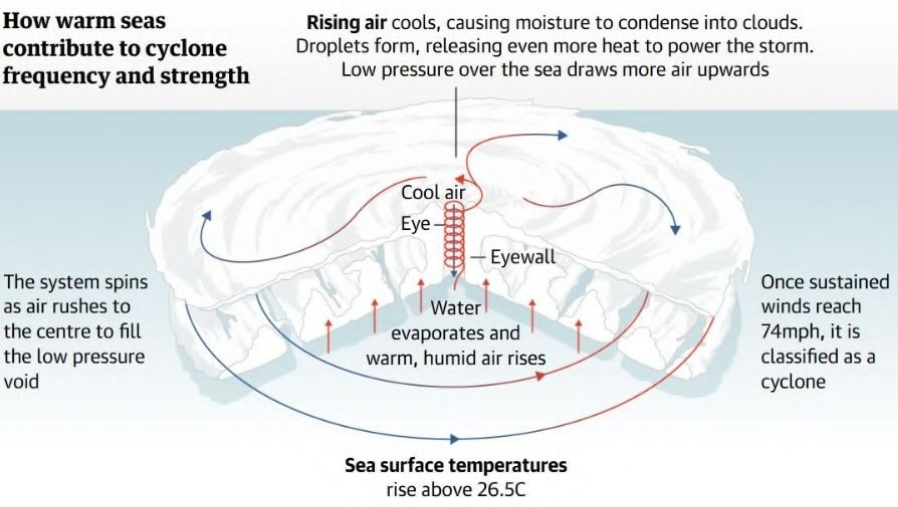
This is one reason why sufficiently warm ocean waters provide an important energy source for tropical cyclone development and intensification. The ocean is therefore not merely affected by atmospheric weather systems; it can also provide energy that helps sustain them.
7. The Ocean as a Heat Distributor
The marine heat budget becomes even more meaningful when we remember that the ocean does not retain heat uniformly. Ocean currents redistribute thermal energy from one region to another. Warm water can be transported towards higher latitudes, while cold water can move towards lower latitudes. Vertical circulation can also transport heat between the surface and deeper layers. Consequently, the ocean performs two functions simultaneously: Heat storage The ocean absorbs and retains enormous quantities of thermal energy. Heat redistribution Currents and circulation transport that energy across geographical regions. This is why a change in one part of the global ocean can eventually influence distant regions.
8. Teleconnections Across Ocean Basins
The oceans are not independent thermal units. They are connected through global circulation and ocean–atmosphere interactions. A change in one region can alter atmospheric circulation, wind patterns, precipitation, surface heat exchange or ocean currents, which can subsequently influence another region. For example, changes in the Southern Ocean and Antarctic region can affect atmospheric and oceanic circulation patterns that extend into lower latitudes and influence conditions in the Indian Ocean. This broader concept is often understood through teleconnections: geographically separated regions can experience linked changes because they are connected through the global climate system. Therefore: A disturbance in one oceanic region does not necessarily remain confined to that region. The atmosphere and interconnected ocean circulation can transmit its effects over very large distances. The marine heat budget explains how the ocean receives solar energy, loses heat through radiation, sensible and latent heat exchange, and receives a comparatively small contribution from Earth’s interior. Because the ocean stores and redistributes enormous quantities of heat, its energy exchanges with the atmosphere connect processes occurring across distant regions and make the ocean a central regulator of the global climate system.
PYQs
1. With suitable examples, explain the factors causing sea level changes. (10 Marks/2024)
2. Discuss the hazards associated with the rise of sea-surface temperature. (10 Marks/2021)
3. Describe the causes and consequences of sea level changes. (10 Marks/2018)
4. “Temperature, salinity and density differences in ocean water are the prime causes of ocean water circulation.” Elaborate. (2011)
5. Comment on marine heat budget and the oceanic circulation system. (2009)
In case you still have doubts, contact us on 9773890604
Enrol in Geography Optional by Shabbir Sir: Here
Enrol in One-on-One Personalised Mentorship: Here
Enrol in GS Mentorship Program: Here
Enrol In GS Mains Mentorship Program: Here
Explore One Integrated Platform for UPSC Prep: Yooki
Visit our YouTube Channel: here