
Contents
- 1 Geostrophic wind is a theoretical, un-frictioned wind that blows parallel to straight isobars in the upper atmosphere (above 500–1000m). It forms when the Pressure Gradient Force (PGF), generated by a barometric slope (rate of pressure change over distance), reaches an exact balance with the deflecting Coriolis Force.
Geostrophic wind is a theoretical, un-frictioned wind that blows parallel to straight isobars in the upper atmosphere (above 500–1000m). It forms when the Pressure Gradient Force (PGF), generated by a barometric slope (rate of pressure change over distance), reaches an exact balance with the deflecting Coriolis Force.
What is Geostrophic Wind?
In climatology and meteorology, Geostrophic Wind represents a state of hydrostatic horizontal equilibrium in the upper atmosphere. When air moves at altitudes where surface friction is virtually zero, it is acted upon primarily by two opposing forces:
- Pressure Gradient Force (PGF): Drives air perpendicular to isobars, from high pressure to low pressure.
- Coriolis Force ($CF$): An apparent force caused by Earth’s rotation that deflects moving air to the right in the Northern Hemisphere and to the left in the Southern Hemisphere.
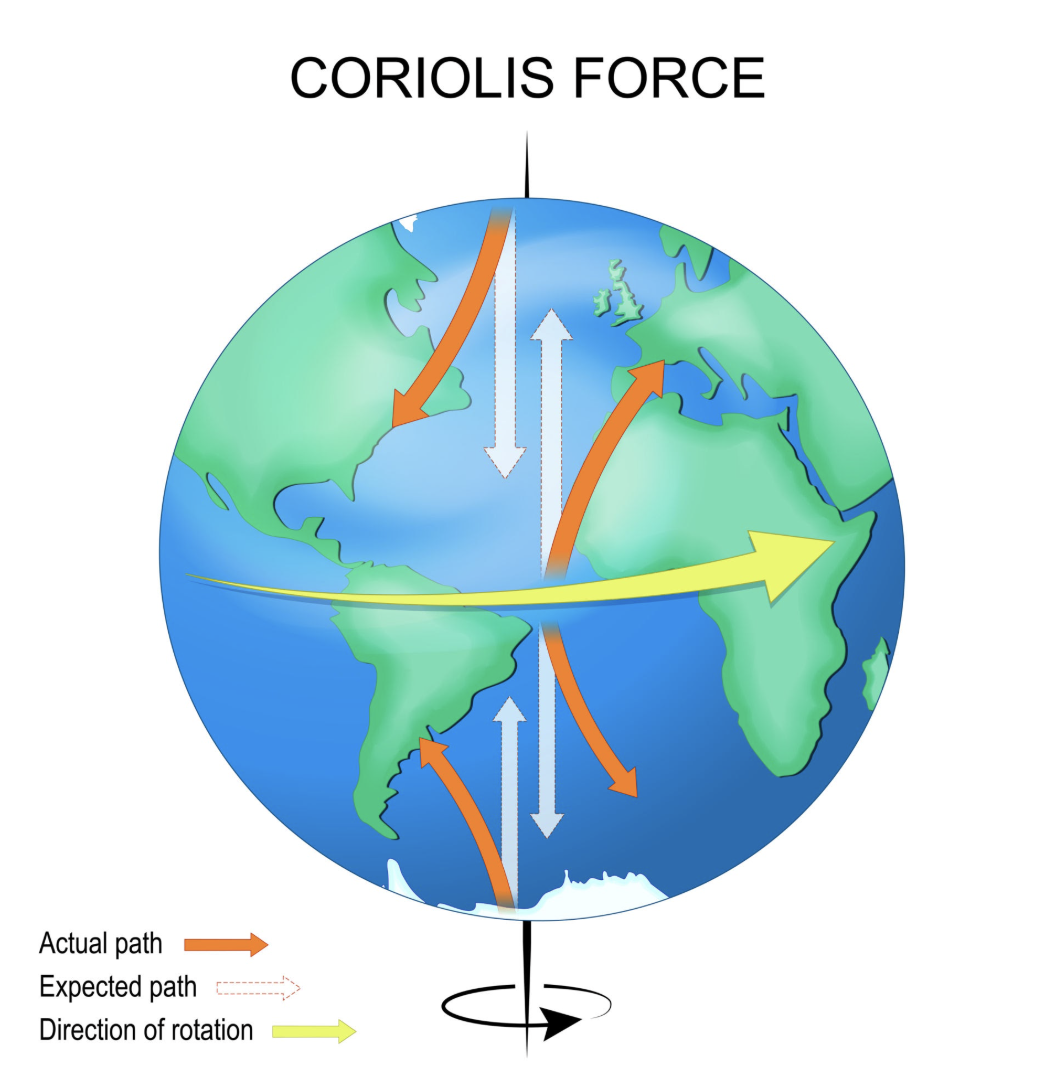
Relationship Between Barometric Slope and Air Circulation
The term barometric slope refers to the spatial gradient of atmospheric pressure across horizontal distances. The steepness of this slope directly regulates the dynamics, speed, and patterns of atmospheric air circulation.
Steep Barometric Slope (Closely Spaced Isobars)
             │
             ▼
Strong Pressure Gradient Force (PGF)
             │
             ▼
Rapid Air Acceleration & High Velocity
             │
             ▼
Proportionally Stronger Coriolis Force Deflection
             │
             ▼
Equilibrium Reached Parallel to Isobars (Geostrophic Balance)
1. Gradient Steepness Controls Wind Velocity
- Steep Barometric Slope: Indicates closely spaced isobars and rapid pressure changes over short distances. This produces a powerful PGF, generating high-velocity winds (e.g., Jet Streams, Rossby Waves).
- Gentle Barometric Slope: Indicates widely spaced isobars, weak PGF, and low wind speeds.
2. Friction-Dependent Air Trajectories
| Characteristic | Upper Troposphere (Free Atmosphere) | Planetary Boundary Layer (Surface) |
|---|---|---|
| Primary Forces | $text{PGF} + text{Coriolis Force}$ | $text{PGF} + text{Coriolis Force} + text{Friction}$ |
| Friction Level | Negligible ($sim 0$) | High (Terrain, vegetation, water friction) |
| Flow Direction | Parallel to isobars ($90^circ$ deflection from PGF) | Crosses isobars at an acute angle ($10^circ text{–} 45^circ$) |
| Resulting Winds | Upper Tropospheric Westerlies, Jet Streams | Surface trade winds, local land/sea breezes |
3. Curvature Effects: Gradient Winds
When isobars are curved around high- or low-pressure centers, centripetal force alters the geostrophic balance, giving rise to gradient winds:
- Subgeostrophic Flow (Cyclones / Low Pressure): Centripetal force acts in the same direction as PGF, opposing the Coriolis force. Wind speeds are lower than purely geostrophic calculations.
- Supergeostrophic Flow (Anticyclones / High Pressure): Centripetal force acts in the direction of the Coriolis force, countering PGF. Wind speeds are higher than purely geostrophic calculations.
Climate Change Impact on Barometric Slopes
In recent decades, anthropogenic climate change has altered global barometric slopes through Arctic Amplification:
- Rapid warming in polar regions reduces the temperature differential between the equator and the poles.
- This weakens the poleward barometric slope in the upper troposphere.
- As a result, the Polar Jet Stream slows down and meanders, leading to prolonged atmospheric blocking patterns such as Omega Blocks, Mid-Latitude Heatwaves in Europe, and Bomb Cyclones in North America.
Frequently Asked Questions (FAQ)
What is the difference between geostrophic wind and gradient wind?
Geostrophic wind occurs along straight isobars where only PGF and Coriolis forces are balanced. Gradient wind occurs along curved isobars and incorporates a third force: centripetal force.
Why is geostrophic wind absent at the Equator?
At the equator ($phi = 0^circ$), the Coriolis force ($sin 0^circ = 0$) drops to zero. Without Coriolis deflection to balance the Pressure Gradient Force, geostrophic equilibrium cannot form.
At what altitude does geostrophic balance occur?
Geostrophic balance typically occurs above the planetary boundary layer, generally at altitudes between 500 meters and 1,000 meters above ground level and extending up into the upper troposphere.

In case you still have your doubts, contact us on 9773890604
Enrol in Geography Optional by Shabbir Sir: Here
Enrol in GS Mentorship Program: Here
Enrol In GS Mains Mentorship Program: Here
Explore One Integrated Platform for UPSC Prep: Yooki