
Contents
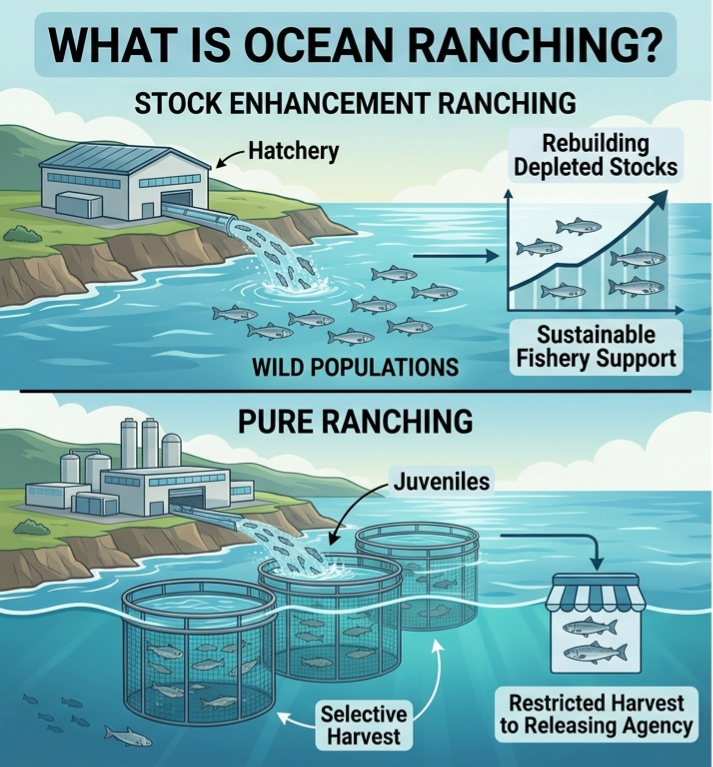
It operates as a bridge between capture fisheries (direct exploitation of wild stocks) and aquaculture (raising species in fully enclosed cages), utilizing natural ocean productivity while securing high early-stage survival rates.
Two Core Types of Ocean Ranching
| Feature | Pure Ocean Ranching | Stock Enhancement Ocean Ranching |
|---|---|---|
| Harvest Rights | Retained exclusively by the releasing agency. | Open to public, commercial, and local fishermen. |
| Primary Goal | Commercial profit and controlled resource capture. | Rebuilding depleted wild stocks and ecological restoration. |
| Target Species | Homing species like Pacific Salmon returnable to coastal pens. | High-value marine finfish, crustaceans, and shellfish. |
Role of “Aqua-Cowboys” in Ocean Ranching
The term aqua-cowboys refers to specialized marine personnel, commercial divers, and local fishermen who manage, herd, protect, and harvest stock in open marine ranching zones, mirroring traditional terrestrial livestock management.
-
Stock Herding & Conditioning: Using low-frequency acoustic signals or sound cues during feeding times to train fish schools to aggregate at designated sites for harvest.
-
Habitat & Enclosure Security: Monitoring offshore artificial reefs and underwater netting while maintaining predator barriers and no-pollution zones.
-
Trained Marine Mammal Assistance: Working alongside trained marine mammals (such as dolphins or porpoises) for deep-water tool recovery, hull inspections, and equipment repairs.
-
Sustainable Harvest Regulation: Ensuring non-destructive harvesting methods to prevent overexploitation of ocean broodstock.
 Significance for Sustainable Development & Indian Policy Frameworks
 Significance for Sustainable Development & Indian Policy Frameworks
-
UN SDG 14 (Life Below Water): Mitigates overfishing of wild oceanic stocks by boosting population recruitment through hatchery support.
-
Blue Growth Strategy: Promotes sustainable marine resource utilization without requiring land-based agricultural inputs.
-
Indian Ocean Initiatives:
-
Pradhan Mantri Matsya Sampada Yojana (PMMSY): Promotes open-sea cage culture and marine stock enhancement.
-
Palk Bay Scheme: Focuses on sea ranching cobia and pompano to reduce bottom-trawling reliance.
-
Deep Ocean Mission & Blue Economy: Supports sustainable coastal livelihoods and marine ecosystem restoration.
-
Frequently Asked Questions (FAQs)
Q1: How does ocean ranching differ from conventional offshore aquaculture?
A: Conventional aquaculture keeps marine organisms permanently confined within artificial net-pens or land tanks throughout their entire life cycle, requiring artificial feeding. In contrast, ocean ranching releases hatchery-reared juveniles into the open sea to forage naturally, relying on their homing instincts or aggregation behaviors for eventual harvesting.
Q2: What is the primary role of “Aqua-Cowboys” in ocean resource management?
A: “Aqua-Cowboys” are specialized marine personnel, divers, and technicians who oversee open-ocean stock. They utilize underwater acoustic signals to herd fish, maintain offshore netting and artificial reefs, monitor marine pollution zones, and sometimes work with trained marine mammals to manage and sustainably harvest fish stocks.
Q3: How does sea ranching contribute to India’s Blue Economy and policy frameworks?
A: Sea ranching directly supports India’s Pradhan Mantri Matsya Sampada Yojana (PMMSY) and Palk Bay initiatives by replenishing depleted coastal fish stocks, reducing destructive bottom-trawling reliance, enhancing fisherfolk livelihoods, and advancing UN Sustainable Development Goal 14 (Life Below Water).
In case you still have your doubts, contact us on 9773890604
Enrol in Geography Optional by Shabbir Sir: Here
Enrol in GS Mentorship Program: Here
Enrol In GS Mains Mentorship Program: Here
Explore One Integrated Platform for UPSC Prep: Yooki