Contents
Primate City Model
Within a large “settlement complex” (a region comprising numerous villages, towns, and cities), settlements naturally organise into hierarchies. The most common structure is a pyramid—featuring one large apex city supported by thousands of smaller towns and villages. To study and explain these hierarchical relationships between settlements, geography primarily relies on three core models:
- The Primate City Model (given by Mark Jefferson).
- The Rank Size Rule (given by G.K. Zipf).
- The Central Place Theory (given by Walter Christaller).
Mark Jefferson’s Primate City Rule
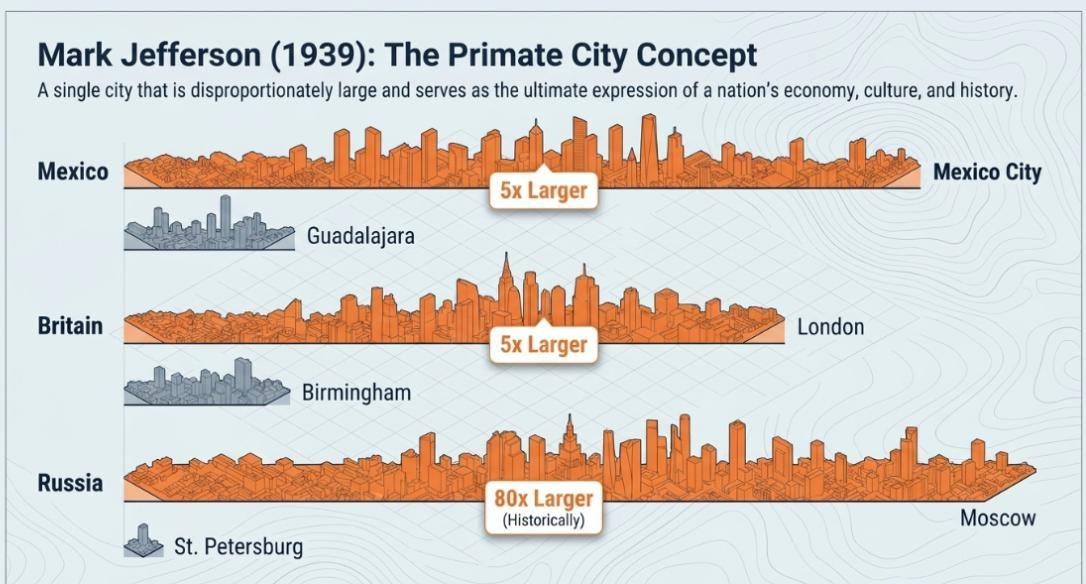
In 1939, Mark Jefferson observed that the largest city is often disproportionately large and expressive of the national culture. His study of 46 countries found:
- 28 instances where the largest city was at least double the size of the second.
- 18 instances where it was triple or quadruple the size (e.g., London is 5x Birmingham; Mexico City is 5x Guadalajara).
Applicability and Geographic Discrepancies:
- Scholar Arnold Linsky argued that primacy is typical of developing, former colonial nations with small territories, agricultural economies, and low per capita incomes. However, this generalisation fails to explain primate cities in massive, developed nations like Russia (Moscow) and France (Paris), or the lack thereof in developing nations like India and Brazil.
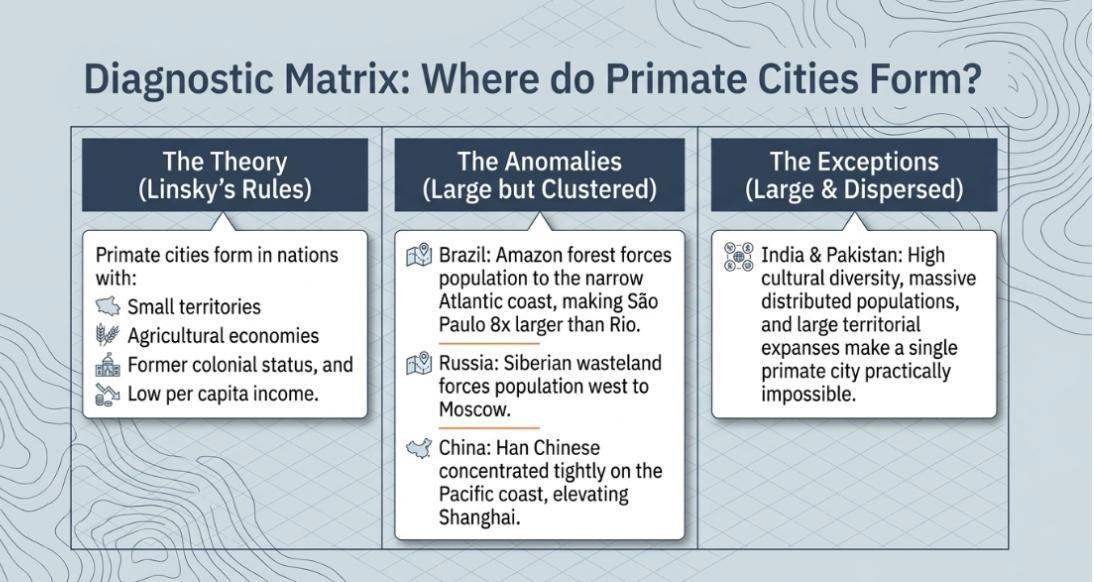
- Geographically, primacy is often dictated by population distribution rather than territorial size.
1). For instance, despite its vast territory, Russia’s population is heavily concentrated west of the Urals, supporting Moscow’s primacy.
2). Similarly, Brazil’s population is concentrated along a narrow Atlantic coastal strip due to the Amazon rainforest, supporting São Paulo’s primacy.
3). China also features a primate city in Shanghai, reflecting the demographic and economic dominance of the Han Chinese along the Pacific coast.
Desirability of Primacy:
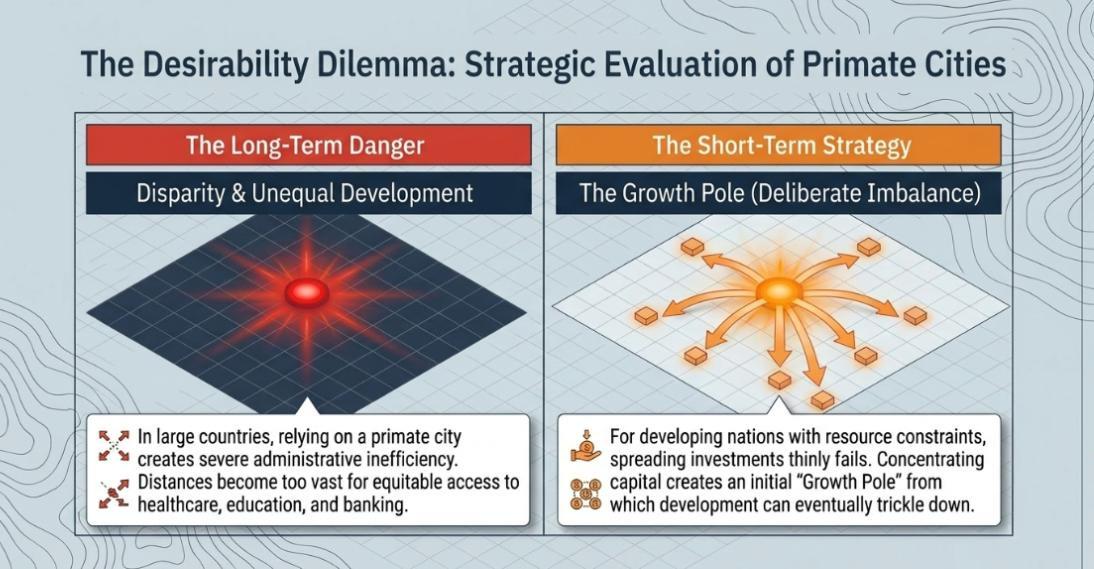
- In small countries (e.g., Belgium, Netherlands), a primate city offers administrative and economic efficiency, as it is impractical to distribute large-scale infrastructure across tiny territories.
- In large, diverse nations, primacy represents unequal development and severe disparities. However, as a short-term economic strategy, developing nations may use primate cities as “growth poles” to focus limited financial resources, initiating deliberate imbalanced development that will eventually trickle down to other regions.
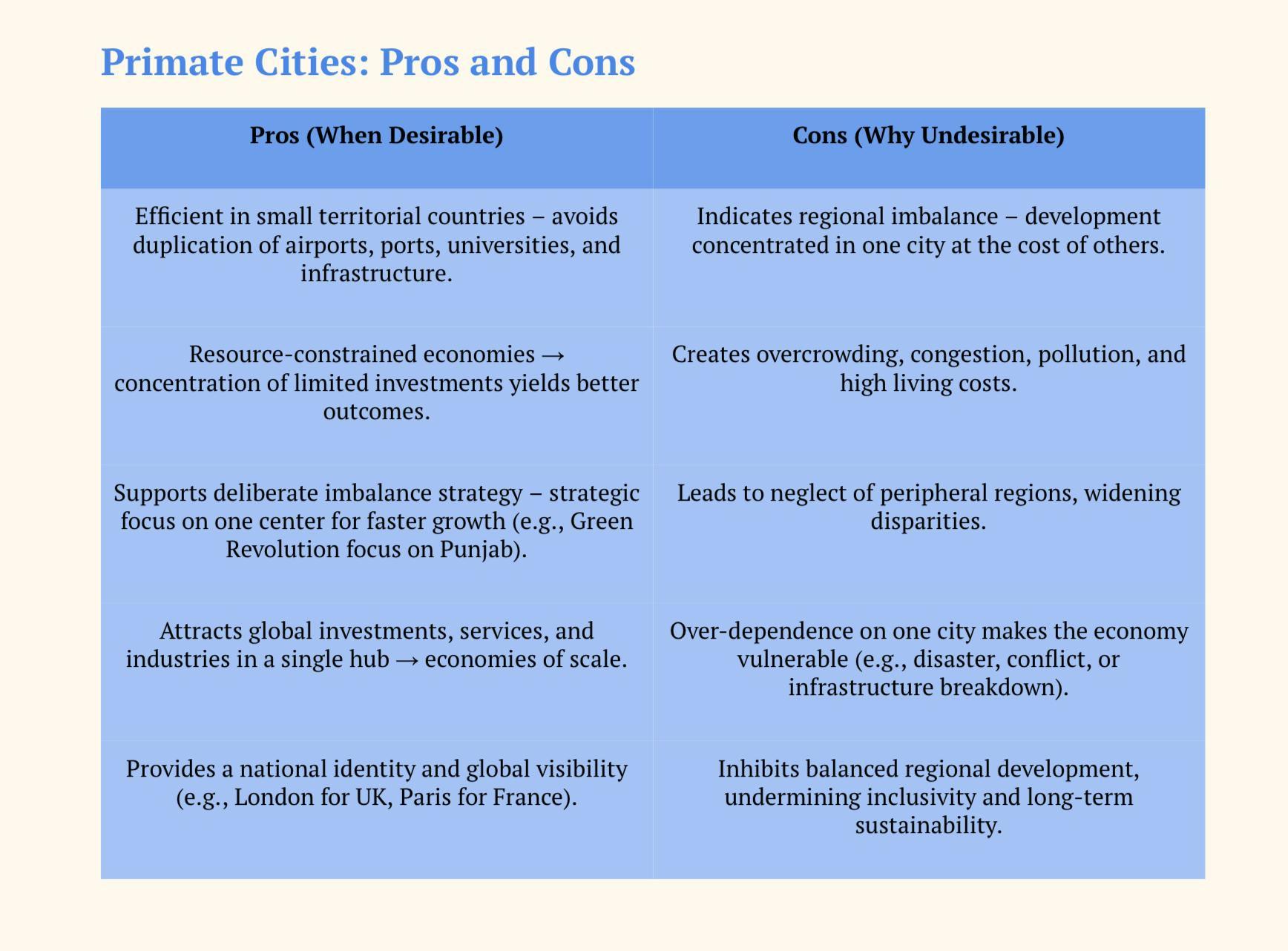 The Indian Context: India lacks national primacy due to its immense size, highly dispersed population, and profound cultural diversity. Instead, India features regional megacities and state-level primacy (where state capitals often dominate, occasionally fueling demands for separate statehood, as seen in Maharashtra).
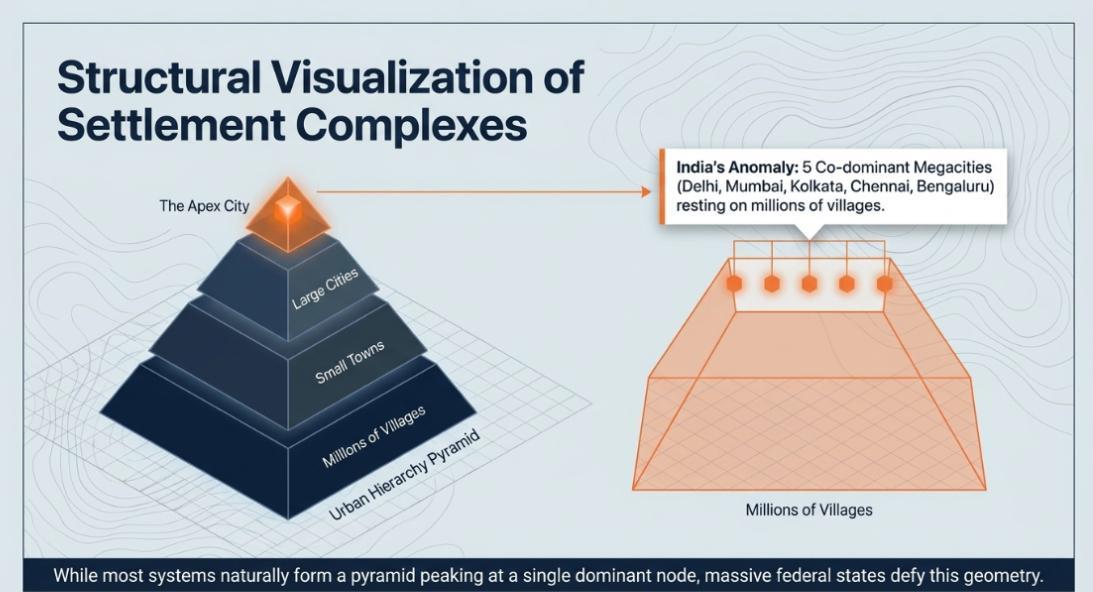 Notably, states like Kerala, Uttar Pradesh, and Tamil Nadu (excluding Chennai) lack state-level primacy because their populations and infrastructural developments are geographically well-distributed. (Alongside the Primate City, G.K. Zipf introduced the Rank-Size Rule in the 1940s to statistically model the relationship and population ratios between the largest city and the subsequent nth-ranked settlements within a complex).
The Rank-Size Rule by Zipf
Developed by G.K. Zipf in the 1940s based on observations of American cities, the Rank-Size Rule mathematically expresses the relationship between a city’s population and its rank within a national hierarchy. The rule postulates that the population of a given city (Pn) is inversely proportional to its rank (n) when compared to the largest city (P1).
The formula is expressed as Pn = P1 / n. Therefore, the second-largest city will have half the population of the largest city, the third-largest will have one-third, and so forth. 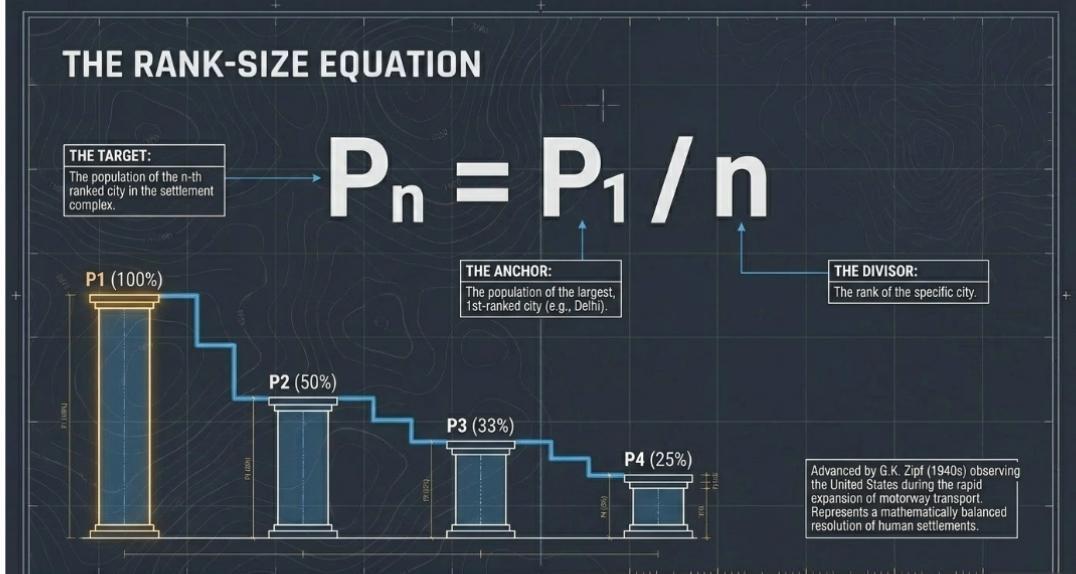
Graphical and Mathematical Characteristics:
- Power Law Relationship: The Rank-Size Rule represents a power law relationship (not an exponential one). When plotted on a standard graph, it forms a sharp, L-shaped curve.
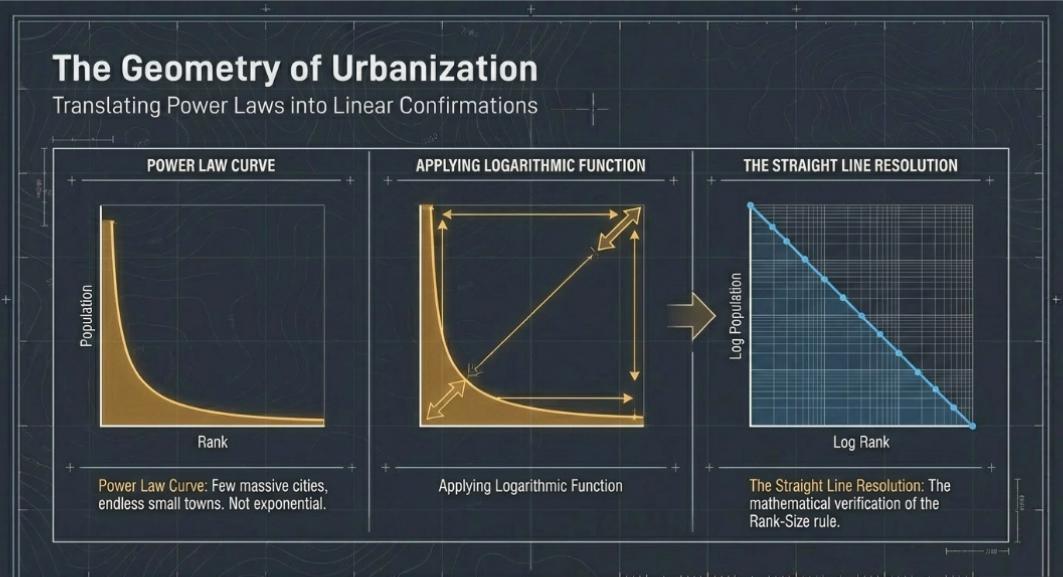
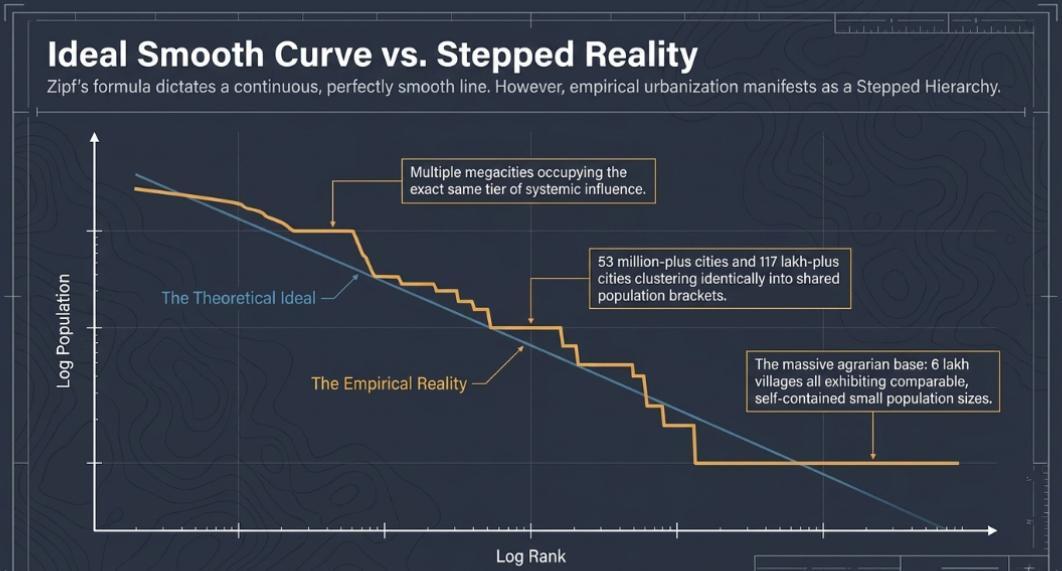
- Log-Linear Transformation: If a logarithmic function is applied to the data (log of population vs. log of rank), the curve mathematically modifies into a perfectly straight downward-sloping line.
- Demographic Distribution: The rule dictates that large cities will be exceptionally large but very few in number. Conversely, smaller towns and villages will be highly numerous and exhibit comparable population sizes. Geographers note that this organized mathematical resolution behaves almost like a natural law of urban growth, mathematically mirroring a special case of the Fibonacci series known as the Lucas sequence.
Urbanization Dynamics: Spatial Distancing vs. Coexistence
The demographic distributions seen in the Rank-Size rule are driven by the fundamental economic nature of urbanisation.
- Interdependence and Competition: Urbanization is not a self-contained process; cities rely entirely on external regions for labor, capital, and resources. Because cities are interdependent, they fiercely compete for these resources.
Consequently, large cities cannot organically coexist in close spatial proximity. They undergo a process of “spatial distancing”, pushing away from one another to survive. If two expanding urban centres are too close (e.g., Gandhinagar and Ahmedabad, or Dharwad and Bokaro), the competitive friction will force them to merge into a single continuous conurbation. 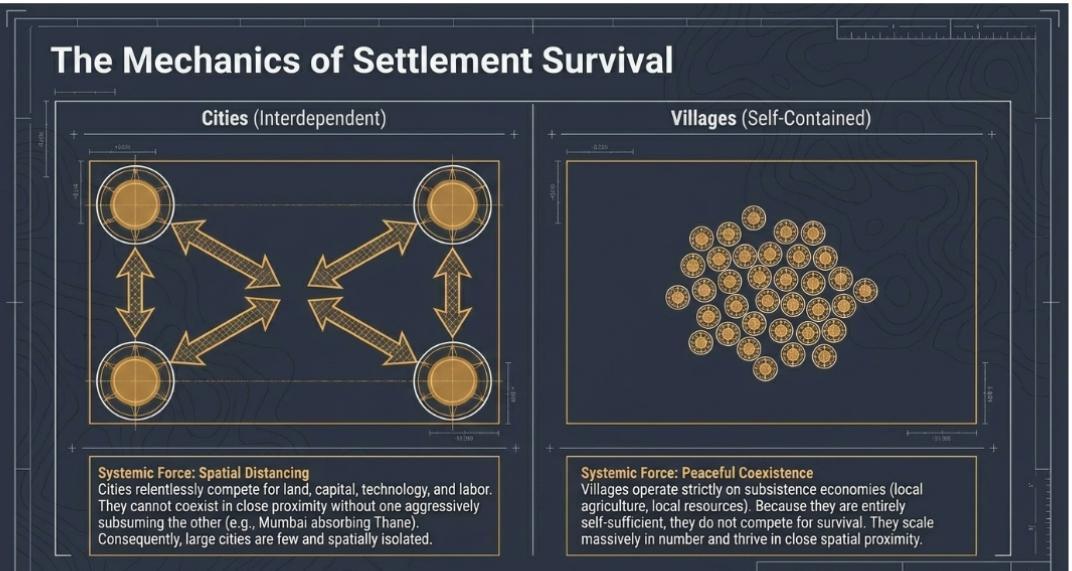
- Village Coexistence: Conversely, rural villages and small towns operate on self-sufficient, subsistence economies. Because they do not compete for massive external capital or labor, they can easily coexist in close proximity and massive numbers (a process of diversification).
The Settlement Continuum
Rather than rigid absolutes, geographical settlement patterns exist on a dynamic evolutionary continuum defined heavily by transportation infrastructure:
1. Extreme Primacy: Represents high inequality and occurs in regions where transportation and communication linkages are poorly developed, forcing all economic activity to concentrate in one accessible hub.
2. Rank-Size Rule: Operates as an intermediate, transition condition where transport networks (like motorways in the 1940s US) begin to expand, allowing development to structurally disperse.
3. Balanced / Binary Development: The opposite extreme of primacy. Here, advanced transportation (such as high-speed rail and expressways) creates high “circulation mobility,” allowing equal development across multiple distinct cities. 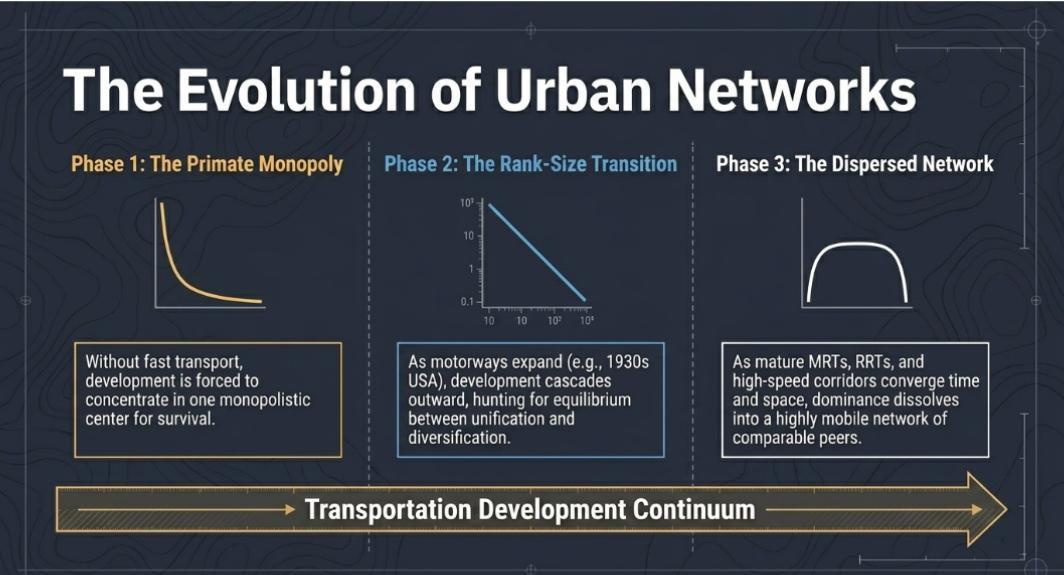 While the Rank-Size rule assumes a perfectly smooth, continuous mathematical line of urban development, real-world geography often manifests as a “stepped hierarchy”. In reality, countries like India feature clusters of cities at similar population tiers (e.g., 53 million-plus cities and 117 one-lakh-plus cities forming distinct steps) rather than a perfectly linear decline.
PYQs
1. Critically evaluate the role of primate cities in dominating the urban spheres of influence in developing countries. (15 Marks/2025)
2. Write a short note on primate cities. (2008)
3. In urban geography, what are the concepts of primate city and Rank Size Rule? Discuss in detail. (2006)
4. Write a short note: Concept of primate city. (2005)
5. Write a short note: Primate city. (1999)
6. Short note: Rank- Size Rule. (2000)
7. Discuss the concept of ‘Rank-Size-Rule’ given by G.K. Zipf. Is this rule relevant in the Indian context? (15 Marks/2022)
8. Analyse the measuring patterns of settlement in relation to the nearest Neighbour Index and Rank-Size Rule in detail. (15 Marks/2026)
In case you still have doubts, contact us on 9773890604
Enrol in Geography Optional by Shabbir Sir: Here
Enrol in One-on-One Personalised Mentorship: Here
Enrol in GS Mentorship Program: Here
Enrol In GS Mains Mentorship Program: Here
Explore One Integrated Platform for UPSC Prep: Yooki
Visit our YouTube Channel: here

