The Indus Valley Civilization, one of the world’s oldest and most enigmatic civilizations, flourished in the vast region of South Asia over 4,000 years ago. Also known as the Harappan Civilization, it emerged around 3300 BCE and endured until approximately 1300 BCE. Situated in the fertile plains of the Indus River, encompassing parts of present-day Pakistan and northwest India, this ancient civilization exhibited remarkable advancements in urban planning, trade, art, and technology. The cities of Mohenjo-daro and Harappa, two of the major urban centers, boasted sophisticated infrastructure, including well-planned streets, advanced drainage systems, and multi-story brick buildings. The Indus Valley Civilization holds a pivotal place in human history, providing valuable insights into the complex social, economic, and cultural dynamics of an early urban society, despite much of its script and language remaining undeciphered.
Contents
- 1 Bronze Age Civilization – Indus Valley Civilization (IVC)
- 2 Theory of Origin of IVC
- 3 Town Planning
- 4 Society
- 5 Economy
- 6 Theory of Decline of IVC
- 7 Special features of some Important Harappan Sites
- 8 Differences between IVC and that of Egyptian and Mesopotamian Civilization:
- 9 Similarities in IVC and Egyptian / Mesopotamian Civilization:
- 10 Facets of IVC yet to be Ascertained
- 11 FAQs:
- 11.1 Q1: What is the Indus Valley Civilization?
- 11.2 Q2: Where was the Indus Valley Civilization located in India?
- 11.3 Q3: Is there a map that shows the extent of the Indus Valley Civilization?
- 11.4 Q4: What were the major cities of the Indus Valley Civilization?
- 11.5 Q5. What are Indus Valley Civilization seals?
- 11.6 Q6: What were these seals used for?
- 11.7 Q7: How was town planning in the Indus Valley Civilization different from other ancient civilizations?
- 11.8 Q8: Why was urban planning so advanced in this civilization?
- 11.9 Q9: When did the Indus Valley Civilization exist?
- 11.10 Q10: What caused the decline of the Indus Valley Civilization?
- 11.11 Q11: Can I find information about the Indus Valley Civilization in Hindi?
- 11.12 Q12: Where can I visit Indus Valley Civilization sites today?
- 11.13 Q13: Are these sites well-preserved?
Bronze Age Civilization – Indus Valley Civilization (IVC)
Overview:
- The Indus Valley Civilization (IVC) or Harappan Civilization was the first urban civilization in South Asia.
- IVC, along with Mesopotamian, Egyptian, and Chinese civilizations, were the earliest of settlements showing complex societal life and were called “Cradles of Civilization”
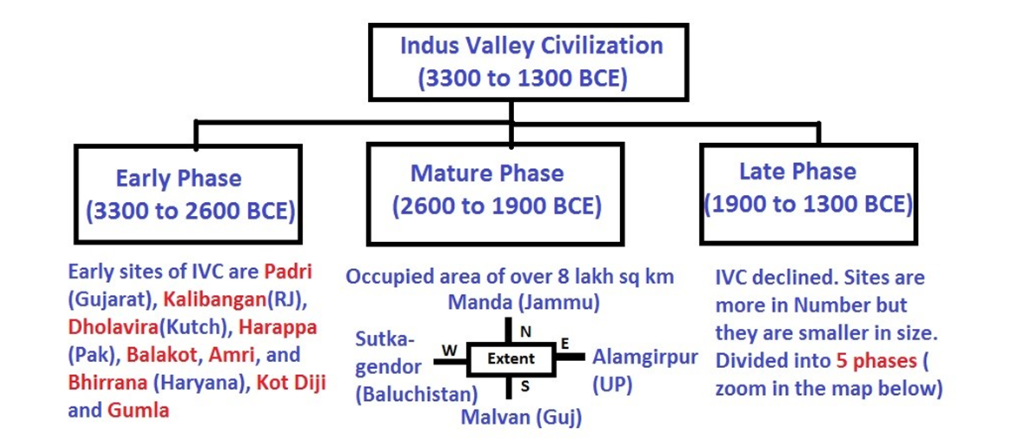
- IVC is part of Proto-history and has been divided into three phases
Importance:
- An important topic for both UPSC Prelims and Mains perspectives
Details:
- IVC is also known as the Harappan Civilization
- It is the first urban civilization in South Asia
- IVC is part of Proto-history, which is the period before written records
- Along with Mesopotamian, Egyptian, and Chinese civilizations, IVC was one of the earliest settlements showing complex societal life and is known as the “Cradles of Civilization”
- IVC has been divided into three phases for study purposes

Theory of Origin of IVC
The origin of Harappan culture is not entirely agreed upon, but it is generally believed to have emerged from the Pre-Harappan indigenous village culture.
Recent DNA analysis of skeletal remains discovered at the Rakhi Garhi cemetery challenges the previous theory that Harappans were descendants of Steppe pastoral or Iranian farmer ancestry. The study suggests that the people of IVC had an independent origin.
Town Planning
| Features | Description | Significance |
| Town Planning | Division of City Raised Part (called Citadel): Consisted of housing for rulers and important public buildings such as granaries, and workshops. It was mostly situated west of the city. Lower Part (eastern side of town): Consisted of houses of common citizens (see illustration map) | It shows the presence of social hierarchy and some administrative authority. Also, the Public and Private spheres were separated as the town was divided into two parts (as is also done in modern town planning) |
| Streets | It followed a grid pattern (i.e. streets cut each other at right angles, thus dividing the city into several rectangular blocks) | It shows excellent knowledge of measurement and urban planning of Harappan people. |
| Drainage system | Drains connected all the houses and were made up of mortar, lime, and gypsum and covered with large brick slabs for easy cleaning | It shows Harappan people paid great attention to Health and Sanitation |
| Houses | They were often of two or more stories, but no window faced the streets | Often the 2nd story was made on 1st when it had subsided. It shows Harappans inhabited the place for a long time |
| Building materials | Standardized burnt-bricks of ratio 1:2:4 were found in all the sites (no stone was used) (*Egyptian civilization at that time used mud-bricks and stones) | It shows the presence of centralized weights and measurement systems. |
| Features | Description | Significance |
| Division in Society | Harappan society was an urban society and comprised at least three distinct social groups: Ruled rich merchants, and poor laborers who lived in the lower part of the city | It shows the division of labor and specialization in Harappan society. It also shows that Harappans had well-organized administrative machinery |
| Clothing | Harappan people generally wore garments of cotton and wool | It shows advancement in the weaving of cotton and wool and the diversification of choices |
| Food Habits | The Harappan societies of Sindh and Punjab largely consumed wheat and barley while those of Rangpur and Surkotda consumed rice and millets. Fish and Molluscs eating was also common. Dairy production evidence has been found by the recent molecular study at Kotada Bhadli (Gujarat). | The urban settlement near river valleys provided fertile ground for a variety of crops to be grown. Harappans were advanced in their agriculture practices. |
| Religion | Harappans believed in Nature Worship– Gods in the form of trees such as peepals and animals (bull). Idolatry was prevalent, they also worshipped the Mother goddess, Pasupati yogi (lord of cattle), and Phallic symbols | Harappans were called secular society as no temple (except for the great bath) or religion have been found (unlike in other contemporary civilizations) |
| Script and Languages | Harappan Script is Pictographic and Logo syllabic (each symbol stands for a word) – using signs of birds, fish (most repeated), humans, etc. Harappan writing was Boustrophedon (right to left and then left to right in alternate lines)Harappan script disappeared by 1700 BCE, showing the lack of percolation of the writing of IVC to other civilizations | Recent theories have pointed out the similarity between ancient Tamil and Harappan scripts. But until the Harappan script is deciphered, the conclusion cannot be made, The various evidence of a common script points to great cultural integration during IVC |
| Beliefs | Harappans believed in evil forces and ghosts and used amulets as protection against them | This was true about most of the primitive society |
| Burial practices | Dead bodies were placed in the North-South direction (extended inhumation) and were accompanied by food, pottery, jewelry, etc. The graveyard was within the settlement. They practiced three types of burial:-Complete burialFractional burial (burial of bones after exposure of the body to birds and beasts) Cremation followed by burial of the ashes | It shows their strong belief in life after death, which was similar to the belief system of other contemporary civilizations, however; the items kept were not as expensive as other civilizations. |

Society

Economy
| Features | Description | Significance |
| Agricultural economy | Main crops were Wheat, Barley, Rice (found in Lothal and Rangpur only), Dates, Mustard, Cotton (1st in the world) | It shows the advancement of Harappans in agriculture technology – used wooden plowshare, Well irrigation (Alladinho), Dams, and irrigation canals (Dholavira) |
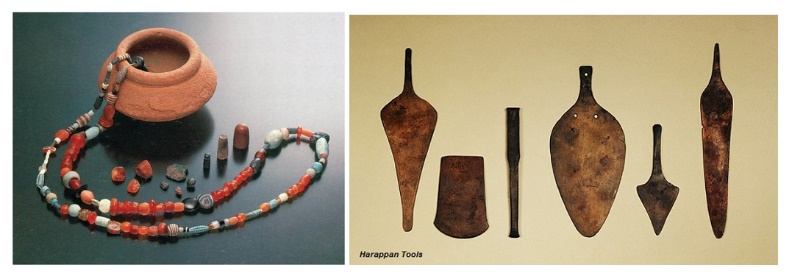 Manufacturing | Terracotta: figurines of animals, humans (more female figurines than male figurines), Bangles, seals Art of Bead-making (Chanhudaro and Lothal), jewelry- gold and silver jewelry G. at Allahdino a lot of necklaces made of gold, silver, and semi-precious stones have been found Harappans did not use Iron but used Copper, bronze, silver, and gold The number of pure copper artifacts was found in far greater number than alloyed bronze ones Harappans were the first to use silver in the world | A large number of terracotta articles show that it was used by common people. Also, Harappans were good at metallurgy and producing alloys. There was a specialization of tasks- Goldsmiths, bronze-smiths, brick-makers. More copper artifacts don’t mean technological backwardness but it was their cultural preference in all likelihood. |
Pottery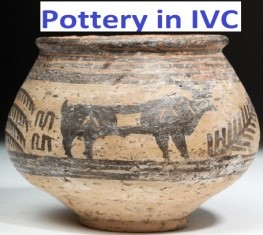 | The Harappans used Red and Black pottery (Redware painted with black designs) and also knew the use of Potter’s wheel with ease | It shows the expertise of Harappans in pottery making e.g. Glazed pottery (Harappa), incised pottery, perforated pottery, etc. |
Trade | Harappans had trade with Mesopotamia (Sumeria), Central Asia, Persia, Afghanistan Makan (Oman), and Dilmun (Bahrain). Trade was through the barter system. Export items: Teak ( obtained from Gujrat), Amazonite (Hirapuri, GJ), Slate (Kangra), Lead (Kashmir and South India), Copper (from Baluchistan and RJ(Khetri mines)) Import Items: Jade (from Central Asia); Turquoise (from Khorasan); Lapis Lazuli, Gold, Silver, Tin ( from Afghanistan) (Gold was also obtained from Iran and Kolar mines in Karnataka); Steatite (Iran) | It shows the advanced trade relations of the Harappan civilization with other parts of India as well as also with other contemporary civilizations. Harappan seals were found at Susa, Ur, and Nippur (Mesopotamia), Failaka, and Bahrain (Persian Gulf). Mesopotamian three-cylinder seals have been found in Mohenjo-Daro |
Weights and Measures | Weights followed a binary system — 1, 2, 8, 16, 32 to 64, 160, 320, 640, 1600, 3200, and so on. Weights were made of chert, limestone, and steatite and were generally cubical. The measure of length was based on a foot of 37.6cm and a cubit | The standardization and accuracy of weights and measures throughout the IVC were remarkable. |
Seals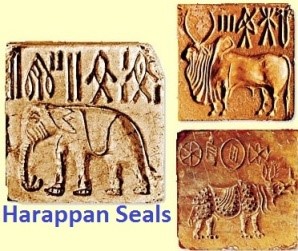 | Harappan seals are made up of Steatite (soft stone) Size- half an inch to 2.5 inch Shape-generally Square and Rectangular seals with carved animals and inscriptions were used Humpless bull is the most used animal in seals | Harappan seals are the greatest artistic creation and were used to mark ownership of property and in trade |
Theory of Decline of IVC
IVC declined after 1900 BCE, however, the reasons for the decline are still disputed. There are various theories for its decline such as – (*No need to remember all these names, just glance at it)
| Causes | Historians |
| Drying of Ghaggar River and increasing aridity | D.P Agrawal and Sood |
| Flood | Macay and S R Rao |
| Low Rainfall | Dales, Vatsa and Lambricks |
| Ecological Disturbance | Fairchild |
| Aryan Invasion | Wheeler and Gordon |
| Earthquake | Raikes and Dales |
| Natural Calamity | K.A.R Kennedy |
A recent finding titled ‘Neoglacial climate anomalies and the Harappan metamorphosis’, done by an international team of scientists has suggested climate change as the possible reason for the decline of the Indus Valley Civilisation. Changes in temperature and precipitation led to the decline of monsoons and the drying up of the Ghaggar-Hakra River. This led to a decline in crops and urban Harappan society turning rural.
Special features of some Important Harappan Sites
| Sites | Features |
| Harappa (on Ravi River) | 1st Indus site to be discovered Two rows of six granaries The largest number of wheat grains Red sandstone torso of nude male Evidence of Coffin Burial Two types of burial practice- type and cemetery H type. 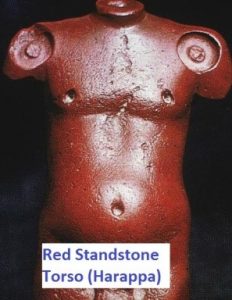 |
| Mohenjo-Daro (Indus river) (mounds of Dead) | 2nd Indus site to be discovered Great granary (the largest building) Pasupati seals Bronze dancing girl Steatite’s image of a bearded man said to be the priest 3 cylindrical seals of Mesopotamia Great Bath Hordes of Skeletons found on stairs (indicating warfare) Multi-pillar assembly halls Mohenjo-Daro has no cemeteries and 5 tragic sites Bronze mirror, needle, saw, and the Bronze statue of the bull. 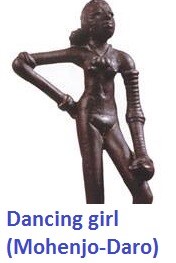 |
| Lothal (Bhogava River, Gujarat) (also means ‘mounds of dead’ like Mohenjo-Daro) | Artificial dockyard (world’s 1st tidal port) Evidence of double burial (male and female) Cultivation of rice (at Lothal and Rangpur) Beadmaker’s shop (also exported) Terracotta model of boats Ivory scale Known for the cotton trade (Manchester of Harappan Civilization) Circular button seal (also called Persian Gulf seal) Two terracotta models of Egyptian Mummies (shows trade relation with Nile Valley civilization) Painted story on Earthen jar resembling story of cunning fox in Panchtantra Sacrificial Altar (at Lothal and Kalibagan)- Shows medical and surgical skills. |
| Dholavira (Khadir bet island in the Kutch Desert Wildlife | Inscription of 10 alphabet signboards Megalith burial Warehousing settlement Gold rings (also at Mandi and Daimabad) Shows all three phases of Harappan culture Located on the Tropic of Cancer Use of Sandstone and bricks Evidence of dams, irrigation, water reservoirs, water harvesting system,s and embankments The town is divided into three parts (Upper, Middle, and lower). It was a walled city with heavy fortification An important center of maritime trade (Dholavira declined with the decline of Mesopotamian civilization, showing the integration of the Trade economy) Dholavira has been named as the UNESCO World Heritage Site(India’s 40th) 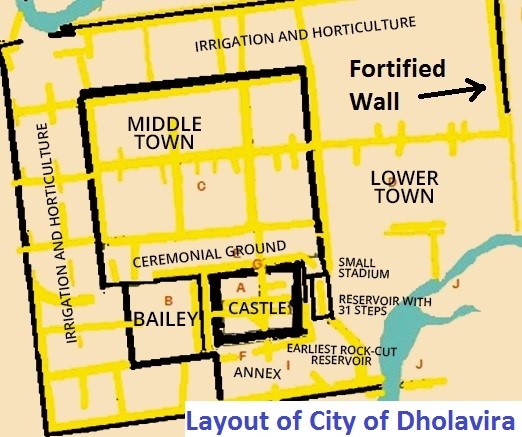 |
| Rakhigarhi (on Ghaggar –Hakra river, Haryana) | Largest IVC site in India ( also claimed to be largest IVC site) Evidence of Domestication of Dog Manufacturing center of terracotta (Idly shaped terracotta) Painted potteries in large numbers (show rich and dominant people lived) Recent findings show Rakhigarhi doesn’t have the last phase of IVC ( earlier it was known to have all three phases of IVC) DNA finding of Skeletal remains of a woman Rakhigarhi’s sudden demise can be explained by the drying up of the Saraswati in 2000 BC Government (2021-22 budget) will fund on-site museums (also at Hastinapur (UP), Shivsagar (Assam), Dholavira (Gujarat), and Adichanallur (TN) |
| Chanhudaro (on Indus river) | Known for cotton textile (Lancashire of IVC)No Citadel (only IVC city)The largest number of copper tools found |
| Kalibangan (on Ghaggar river, RJ) (means ‘Black Bangles’) | Wells found in every house Evidence of mixed cropping The earliest ploughed field in India Fire altars (shows cult of sacrifice) |
| Bhirrana (Haryana) | Now considered to be the Oldest discovered IVC site dating back to 7500 BCE (earlier Mehargarh (Pak) was considered to be the Oldest ) |
Differences between IVC and that of Egyptian and Mesopotamian Civilization:
| Features | HARAPPAN | EGYPTIAN/MESOPOTAMIAN |
| Urban Planning | Planned towns with a grid-like pattern | Towns show haphazard growth |
| Script | Invented their typical pictographic script | Mesopotamia has a cuneiform script and the Egyptian script is known as hieroglyphics. Both scripts have been deciphered |
| Writing Material | The majority of the Script has been found on the seals | The majority of the Mesopotamian script has been found on clay tablets while Egyptians wrote on papyrus sheets made of reeds. |
| Extent of Civilization | Spread was 20 times that of Mesopotamian and Egyptian Civilization | Less area as compared to IVC |
| Building Material | Burnt Bricks | Egyptians used Dried Bricks, whereas Mesopotamians used Baked Bricks |
| Religion | No temples or religious structures have been found | Had elaborate religious practices, magic spells, and dominance of priest |
| Weapons | No clear evidence of war or weapons | Clear evidence of wars and expedition in the other two civilizations |
| Decline of Civilization | Declined after 1900 BCE | Both civilizations continued to exist even after 1900 BCE. |
Similarities in IVC and Egyptian / Mesopotamian Civilization:
- Along river valleys: IVC was along the Indus River basin, Sumerians developed between the Tigris and Euphrates river basins while Egyptian civilization developed along the Nile River basin.
- Agricultural society: They all developed as an agrarian society with a large agricultural class that was responsible for growing food for large centralized urban populations of the city.
- Egalitarian society: Women were relatively empowered in these civilizations with IVC showing evidence of mother goddess worship.
- IVC had a large number of shrines of female deities showing women had a certain degree of independence.
- Women in Mesopotamia and Egypt could make their own businesses and trade contracts and own property and could even become rulers (e.g. female pharaoh Hatshepsut)
- Developed trade, manufacturing, and Commerce: Being free from the burden of growing food, these civilizations had a large merchant and artisans’ base
- Highly urbanized: They had sophisticated transport and economic networks. This enabled them to spread to larger areas and support advanced crafts, artistic production, sophisticated religions, technology, and government bureaucracies.
- Nature worship: Although not much is known about IVC religion, however, other two civilizations had polytheistic religions, consisting of nature worship.
- Writing and Script: All of them had well-established art of writing and script
- Burial practices: All three civilizations buried their dead with items needed in the afterlife
Facets of IVC yet to be Ascertained
Harappan Script
- The Harappan script has not been deciphered yet due to several reasons
- The script shows less than 30 characters, unlike other ancient civilizations with a true writing system that has long writings (more than 100 characters)
- No multi-lingual script like the Rosetta Stone inscription has been found in Harappan script
Origin and Extent of IVC
- Little is known about the origin of the people of the Indus Valley Civilization
- It is unclear where they came from, what language they spoke, what kind of social organization or rulers they had, or what their names were
- New excavations show that Rakhigarhi was a bigger city than Mohenjo-Daro or Harappa, two previously considered centers of the Indus civilization
Decline of IVC
The IVC declined around 1800 BCE, but the reasons for its demise are still debated.
Linkage of IVC to Southern Civilization
- Recent excavations and studies of the Indus Valley script and the Tamil-Brahmi script suggest that there may have been an urban, Bronze Age civilization in India’s southern region
- After the collapse of the Indus civilization, the remaining members of the civilization may have migrated south.
- However, these findings are still disputed.

FAQs:
Q1: What is the Indus Valley Civilization?
A: The Indus Valley Civilization, also known as the Harappan Civilization, was an ancient civilization that existed in the Indian subcontinent around 3300–1300 BCE.
Q2: Where was the Indus Valley Civilization located in India?
A: It primarily covered parts of present-day Pakistan and northwest India, along the Indus River and its tributaries.
Q3: Is there a map that shows the extent of the Indus Valley Civilization?
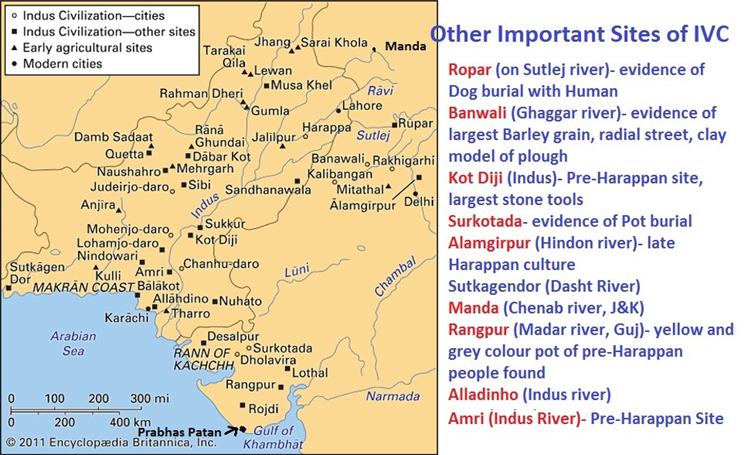
A: Yes, there are maps available that depict the geographical extent of the Indus Valley Civilization. These maps show the locations of major cities and settlements.
Q4: What were the major cities of the Indus Valley Civilization?
A: Major cities included Harappa, Mohenjo-Daro, Dholavira, and Lothal. They were well-planned and had advanced infrastructure.
Q5. What are Indus Valley Civilization seals?
A: Indus Valley Civilization seals are small, intricately carved stone seals with various symbols and inscriptions. They are often considered an important aspect of their culture.
Q6: What were these seals used for?
A: The exact purpose of these seals is not fully understood, but they may have been used for trade, administration, or religious rituals.
Q7: How was town planning in the Indus Valley Civilization different from other ancient civilizations?
A: Towns in the Indus Valley Civilization were remarkably well-planned with a grid-like street layout, advanced drainage systems, and standardized brick sizes, setting them apart from many contemporary civilizations.
Q8: Why was urban planning so advanced in this civilization?
A: The advanced town planning suggests a sophisticated central authority that likely played a significant role in the organization and development of these cities.
Q9: When did the Indus Valley Civilization exist?
A: The Indus Valley Civilization existed from around 3300 BCE to 1300 BCE, making it one of the world’s oldest urban civilizations.
Q10: What caused the decline of the Indus Valley Civilization?
A: The exact reasons for the decline are debated, but factors such as climate change, environmental degradation, and possibly invasions have been suggested.
Q11: Can I find information about the Indus Valley Civilization in Hindi?
A: Yes, there is information available about the Indus Valley Civilization in Hindi. Many books, articles, and websites provide resources in Hindi.
Q12: Where can I visit Indus Valley Civilization sites today?
A: Some of the major sites you can visit include Mohenjo-Daro and Harappa in Pakistan, as well as Lothal and Dholavira in India. These sites offer a glimpse into the ancient civilization’s history and architecture.
Q13: Are these sites well-preserved?
A: While some sites are well-preserved, others have suffered damage over time. Conservation efforts are ongoing to protect and preserve these invaluable historical sites.
In case you still have your doubts, contact us on 9811333901.
For UPSC Prelims Resources, Click here
For Daily Updates and Study Material:
Join our Telegram Channel – Edukemy for IAS
- 1. Learn through Videos – here
- 2. Be Exam Ready by Practicing Daily MCQs – here
- 3. Daily Newsletter – Get all your Current Affairs Covered – here
- 4. Mains Answer Writing Practice – here
Visit our YouTube Channel – here