For decades, “Coaching” was the only buzzword in the UPSC ecosystem. However, as the Preliminary and Mains exams become increasingly unpredictable, a new paradigm has emerged: Mentorship.
At Edukemy, we believe that while coaching gives you the content, mentorship gives you the context. If you are confused about which one you need to clear the IAS exam, this guide will clarify the fundamental differences.
Contents
What is a UPSC Coaching Program?
Traditional coaching is a content-delivery model. It is designed to take a vast syllabus and break it down into digestible lectures.
- The Goal: To complete the syllabus (History, Geography, Polity, etc.) within a fixed timeframe.
- The Format: One-to-many. An educator speaks to a hall (or a digital stream) of hundreds or thousands of students.
- The Focus: Subject matter expertise. You learn the “What” and the “Why” of a topic.
- The Limit: It is often a “one-size-fits-all” approach. Whether you are a working professional or a full-time student, the lecture stays the same.
What is a UPSC Mentorship Program?
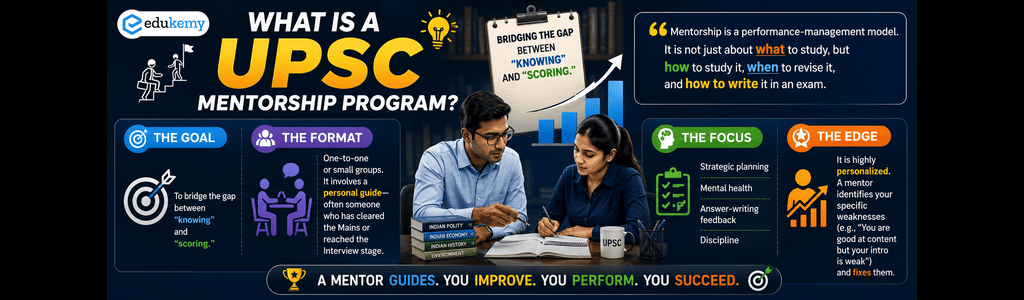
Mentorship is a performance-management model. It is not just about what to study, but how to study it, when to revise it, and how to write it in an exam.
- The Goal: To bridge the gap between “knowing” and “scoring.”
- The Format: One-to-one or small groups. It involves a personal guide—often someone who has cleared the Mains or reached the Interview stage.
- The Focus: Strategic planning, mental health, answer-writing feedback, and discipline.
- The Edge: It is highly personalized. A mentor identifies your specific weaknesses (e.g., “You are good at content but your intro is weak”) and fixes them.
Key Differences: Coaching vs. Mentorship
| Feature | UPSC Coaching | UPSC Mentorship |
| Primary Objective | Syllabus Completion | Exam Readiness & Strategy |
| Approach | Generalized / Mass Learning | Personalized / Individualized |
| Feedback Loop | Limited to Test Series | Continuous & Real-time |
| Focus Area | Teaching the “Subject” | Coaching the “Student” |
| Problem Solving | Academic Doubts | Strategy, Discipline, & Consistency |
| The “Who” | Subject Matter Expert (Teacher) | Strategic Guide (Mentor) |
Why Mentorship is Becoming Essential (The “Edukemy” View)
In the age of the internet, content is a commodity. You can find lectures on the Preamble or Plate Tectonics for free on YouTube. The real challenge in 2026 isn’t a lack of information—it’s information overload.
This is where mentorship becomes a game-changer:
- Micro-Management of Targets: A mentor breaks the 12-month syllabus into daily, achievable tasks.
- Psychological Support: UPSC is a marathon. Mentors provide the emotional scaffolding to handle the “low” phases of preparation.
- Active Feedback: In coaching, you might wait weeks for a test result. In a mentorship program like Edukemy’s GS Integrated Mentorship, the feedback loop is tight, ensuring you don’t repeat mistakes.
Check here for Edukemy’s Foundation Mentorship Program
Do You Need Coaching, Mentorship, or Both?
- Choose Coaching if: If you learn in a classroom set up only. Their is no other reason to join a complete GS Foundation course. You can take classes for your weak areas from expert faculties in that particular area. E.g. Shabbir sir for Geography & Essay. Atish Mathur for GS 2, Mrunal for Economy
- Choose Mentorship if: If you are a beginner and prefer self learning or You have already finished your basic reading but are struggling to clear Prelims, or your Mains marks have stagnated.
- The “Integrated” Solution: Choose classes for weak areas and go for Mentorship for full coverage.
Conclusion: The Final Verdict
Think of Coaching as the textbook and Mentorship as the teacher who sits beside you to ensure you actually understand the page. While coaching provides the maps, a mentor walks the path with you to ensure you don’t get lost.
Transform your prep: Don’t just be a student in a crowd. Become an aspirant with a plan. Check outEdukemy’s Mentorship Programsand get the personalized guidance you deserve.
