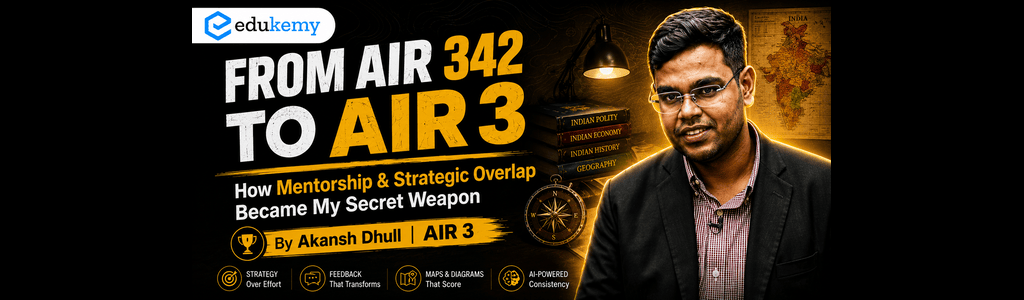
By Akansh Dhull (AIR 3)
When I first started my UPSC journey, I fell into a trap that thousands of aspirants fall into every year: The “Quantity” Trap. I thought that if I just read more books, stayed up longer, and finished more mocks, the rank would follow. But after securing AIR 342 in 2023, I realized something fundamental—most people don’t fail UPSC because they lack effort; they fail because their effort isn’t structured.
To jump from the 300s to the Top 3, I had to stop “studying blindly” and start treating my preparation like a high-precision machine. Here is the first-person breakdown of how mentorship and a “Geography-style” strategic mindset changed the game for me.
Contents
1. The “Examiner’s Mindset” & The Feedback Loop
The biggest differentiator in my second attempt was the Edukemy Mentorship model led by Shabbir Sir. In my first attempt, I was doing a lot of “passive learning”—watching lectures and making notes. Through mentorship, I shifted to Active Accountability.
Every topic I studied was revised, every answer I wrote was evaluated, and every mistake I made was immediately corrected. Shabbir Sir always says, “Don’t just write what you know; write what the examiner is looking for.” This feedback loop turned my weaknesses into scoring zones.
2. Leveraging Strategic Overlap (The Geography Edge)
While my optional was Commerce & Accountancy, I closely followed the logic we often discuss at Edukemy regarding Geography Optional strategy. Even for a GS student, the Geography and Environment sections are “high-yield” areas because they overlap significantly with Prelims, GS Paper 1, and GS Paper 3.
I realized that by mastering Geomorphology, Climatology, and Natural Resources once, I was effectively preparing for nearly 80-100 marks across multiple papers. I stopped treating GS papers as isolated silos and started seeing the “compounding effect” of well-prepared core topics.
3. The “Visual” Advantage: Maps and Diagrams
One of the most important lessons I took from the Geography Optional playbook (as mentioned in the Edukemy syllabus guide) was the power of visual answers. The data is clear: UPSC rewards neat, labeled diagrams and map integration.
In my GS Paper 1 and Paper 3 answers, I stopped writing long, monotonous paragraphs. Instead, I integrated:
- Vulnerability mapping for disaster management questions.
- Flowcharts for industrial location and resources.
- India maps for everything from river systems to infrastructure corridors.
This “diagram-friendly” approach, which is a staple for toppers like Vivek Garg (AIR 114), is what allowed my answers to stand out in a pile of thousands.
4. Consistency via Yooki AI
Staying consistent over 12 months is the hardest part of this exam. This is where Yooki, Edukemy’s AI mentor, became my 24/7 companion. It provided a structured roadmap and daily task monitoring that kept me on track even on days when I felt burnt out. Having a “system” that evaluates your progress in real-time ensures that your growth doesn’t stay “flat”.
Final Thought: Is Mentorship Worth It?
If you have a strong interest in your subjects and are an analytical thinker, you have the potential. But without mentorship and structured practice, you are essentially running a marathon in the dark.
My jump to AIR 3 wasn’t magic—it was the result of limited resources, high-quality feedback, and a relentless focus on the “Correct -> Evaluate -> Improve” cycle.
