Preparing Geography Optional for UPSC requires conceptual clarity, syllabus coverage, current affairs integration, and consistent answer-writing practice. This guide explains a four-stage approach: building a foundation with NCERTs, covering the static syllabus with standard books, integrating advanced concepts and current affairs, and practicing through tests and answer writing. It also covers the Geography Optional syllabus, recommended books, map practice, current affairs preparation, and preparation timelines. The strategy emphasizes understanding concepts and applying them to analytical questions rather than relying on rote memorization.

Contents
- 1 Why Is Geography Such a Popular UPSC Optional?
- 2 Is Geography a “Good” Optional? What Actually Decides Your Result
- 3 What Is Geography, Really? (Beyond Landforms and Maps)
- 4 4 Key Advantages of Choosing Geography Optional
- 5
- 6 Who Should Take Geography Optional — Humanities, Science, or Engineering Students?
- 7 Geography Optional Syllabus Structure
- 8 How to Prepare Geography Optional for UPSC: Step-by-Step Strategy
- 9 Read Current Affairs for Geography Optional: Here
- 10 Best Books for Geography Optional: Here
- 11 How Much Time Does It Take to Prepare Geography Optional?
- 12 Frequently Asked Questions
- 13 In case you still have your doubts, contact us on 9773890604
Why Is Geography Such a Popular UPSC Optional?
Geography sits consistently among the top five or six optional subjects chosen by UPSC aspirants, alongside Public Administration, Sociology, Anthropology, and History. Together, these subjects account for the vast majority of optional-subject qualifiers each year, even though only a fraction of total aspirants choose them.
The reason isn’t that UPSC favors these subjects. It’s that they deal with themes — social issues, political aspects, development concerns, and geopolitics — that are relatively accessible to non-technical students. Unlike engineering-heavy optionals such as Civil or Mechanical Engineering, Geography can realistically be picked up by any serious aspirant in seven to nine months of focused study, regardless of academic background.
Is Geography a “Good” Optional? What Actually Decides Your Result
Here’s the more important point: it is not the optional subject that decides whether you qualify — it’s how you study and how deeply you understand what you read. Across every popular optional, qualifiers typically score in the 270–300 mark range (out of 500), while non-qualifiers often stay in the 150–220 range. This pattern holds across Geography, Sociology, Anthropology, and Public Administration alike.
In other words, Geography doesn’t hand out marks for free, and it doesn’t unfairly withhold them either. The subject rewards comprehension and application — the ability to connect what you’ve studied to real, current issues — over rote memorization.
What Is Geography, Really? (Beyond Landforms and Maps)
A common misconception is that Geography Optional is mostly about landforms, mountains, rivers, and glaciers. That’s only a small slice of it. At its core, Geography is the study of the Earth in relation to man and human activity — not the Earth in isolation.
This distinction splits the subject into two broad halves:
Physical Geography
Covers what nature has given us — the atmosphere, climate, landforms, oceans, forests, and soils.
Human Geography
Covers what humans have built and organized on top of that natural base — agriculture, industry, trade, settlements, population patterns, and political systems.
Once you see the subject this way, the entire syllabus becomes far easier to map out mentally: Paper I covers the physical and human geography of the world, while Paper II covers the physical and human geography of India.
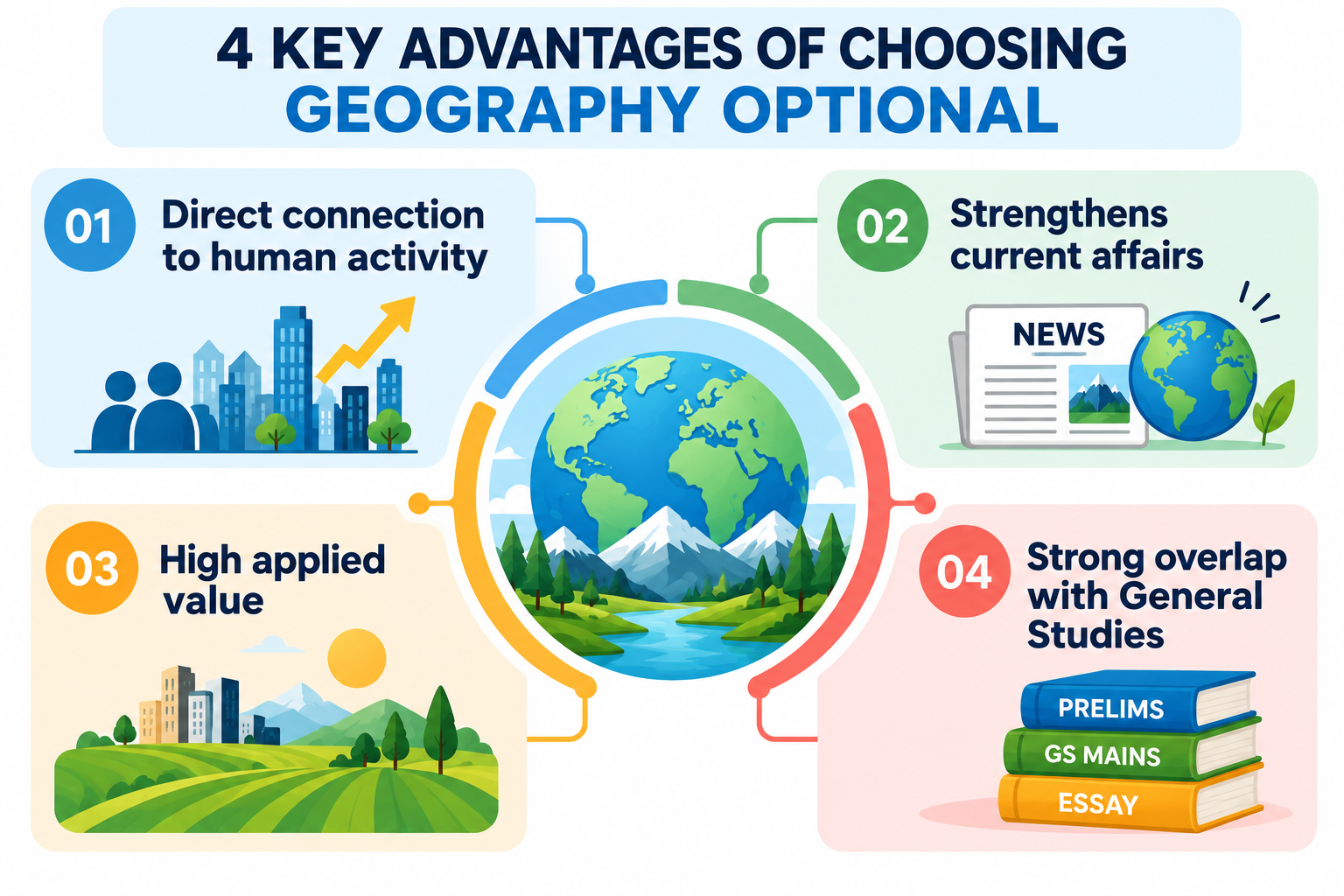
4 Key Advantages of Choosing Geography Optional
- Direct connection to human activity. Because the subject is built around real human concerns — development planning, poverty, migration, industrial growth — it’s easier to stay engaged compared to more abstract or purely theoretical optionals.
- Strengthens current affairs. A large share of Geography topics — food security, disaster management, regional conflicts, resource distribution — show up directly in daily news, so studying the subject naturally sharpens your current affairs base.
- High applied/practical value. Roughly a third of the syllabus deals with regional planning — agricultural planning, urban planning, disaster management, tribal area planning — which mirrors the actual work you’ll do once you’re in civil services.
- Strong overlap with General Studies. Around 20–25 of the 100 Prelims questions typically come from Geography and Environment, and GS Mains papers draw heavily on Geography concepts for topics like disaster management, resource distribution, and development planning.
Who Should Take Geography Optional — Humanities, Science, or Engineering Students?
Geography is not a purely technical subject like Physics or core Engineering — it overlaps with science by only around 10–15%, and even then, only at a basic conceptual level (velocity, momentum, gravity). This makes it accessible to humanities, science, and engineering students alike, which is part of why it draws such a large and diverse aspirant pool.
Geography Optional Syllabus Structure
| Paper | Focus Area | Key Components |
|---|---|---|
| Paper I | Geography of the World | Physical Geography (geomorphology, climatology, oceanography, biogeography) + Human Geography (economic, population, settlement, regional planning) |
| Paper II | Geography of India | Physical Geography of India (climate, relief, soils) + Human Geography of India (agriculture, industry, culture, regional development) |
How to Prepare Geography Optional for UPSC: Step-by-Step Strategy
Read Current Affairs for Geography Optional: Here
Best Books for Geography Optional: Here
How Much Time Does It Take to Prepare Geography Optional?
In a structured, guided format, the full syllabus (excluding the NCERT foundation stage) typically takes around five to five-and-a-half months. Self-study timelines tend to run longer, since self-preparation lacks the pacing and prioritization a structured course provides — but it’s realistic to complete the core syllabus within six to seven months if you stay consistent.
Frequently Asked Questions
1. Is Geography a good optional for UPSC CSE? Yes — historically it delivers consistent, above-average results, largely because its content overlaps heavily with GS papers and rewards conceptual understanding over rote learning.
2. How long does it take to prepare Geography Optional? Roughly six to nine months for a complete first pass through the syllabus, followed by dedicated time for revision, current affairs integration, and answer writing practice.
3. Can engineering students take Geography Optional? Yes — Geography overlaps with science by only about 10–15%, at a very basic level, making it equally accessible to humanities, science, and engineering backgrounds.
4. What books are best for Geography Optional preparation? Savindra Singh’s physical geography series, Majid Husain’s Human Geography, Models in Geography, and Geography of India, along with NCERT textbooks as the foundation.
5. How important is current affairs for Geography Optional? Very important — a significant portion of both Paper I and Paper II questions require linking static syllabus concepts to ongoing geopolitical and developmental issues.
6. When should I start answer writing practice? Only after building genuine conceptual clarity across the syllabus — starting answer writing too early, before understanding the “why” behind topics, tends to produce shallow, fact-based answers that score poorly.
In case you still have your doubts, contact us on 9773890604
Enrol in Geography Optional by Shabbir Sir: Here
Enrol in One on One Personalized Mentorship: Here
Enrol in GS Mentorship Program: Here
Enrol In GS Mains Mentorship Program: Here
Explore One Integrated Platform for UPSC Prep: Yooki