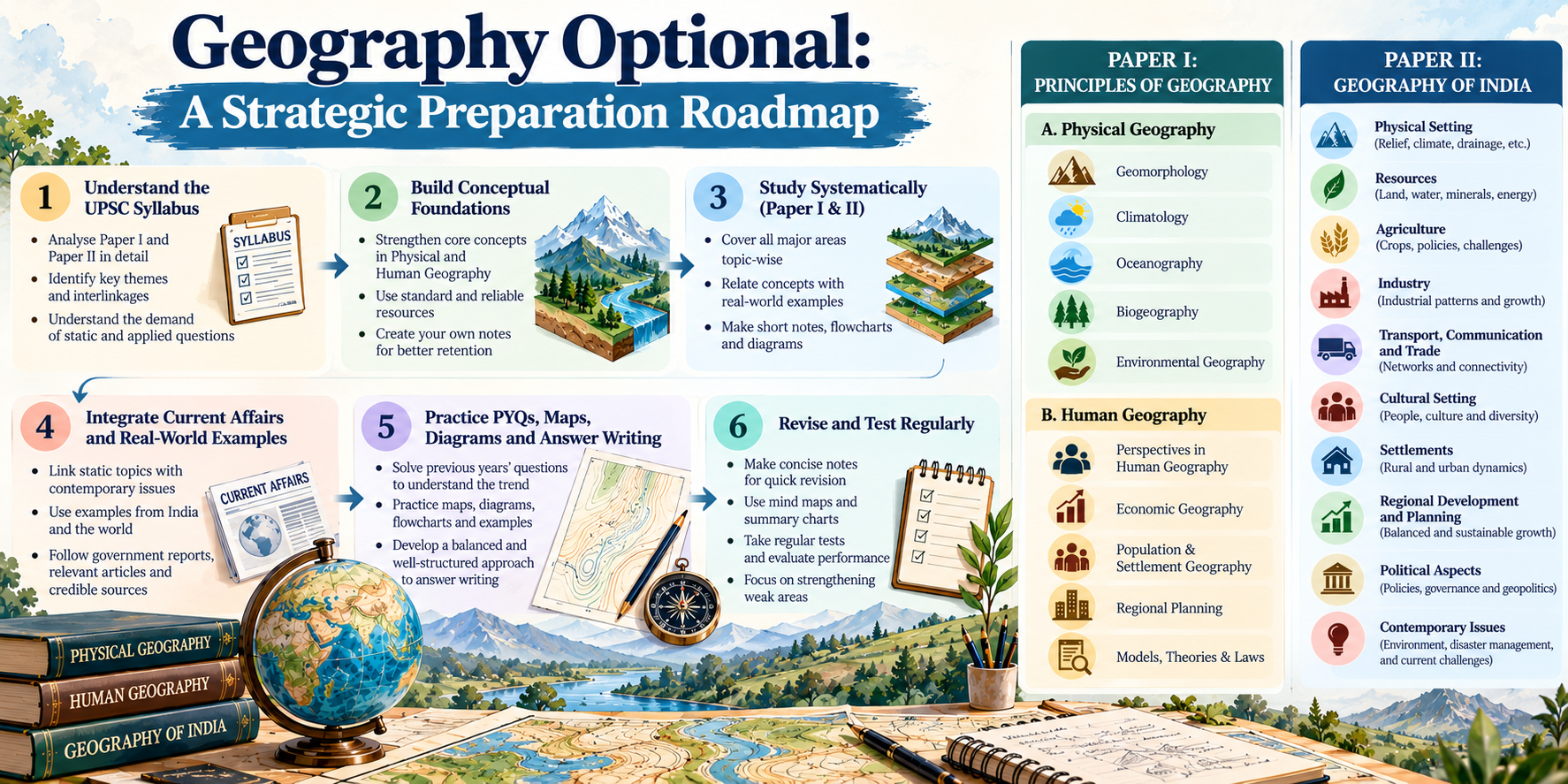
Geography Optional for UPSC requires a clear understanding of Physical Geography, Human Geography, and Indian Geography, along with consistent answer-writing and revision practice. This guide explains the complete Geography Optional syllabus, a step-by-step preparation strategy, recommended books and resources, and techniques for writing effective answers. It covers the use of maps and diagrams, integration of current affairs, and analysis of previous year questions. The guide also highlights common preparation mistakes and practical tips from successful UPSC candidates. It is designed to help aspirants build conceptual clarity, organize their study plan, and prepare systematically for both Geography Optional papers.
Contents
- 1 Why the Exam Pattern Keeps Changing
- 2 The Shift Toward Applied, Current-Affairs Questions
- 3 Stop Debating Physical vs Human Geography
- 4 5 Focus Areas for Applied Questions
- 5 4 Pillars to Truly “Complete” Your Syllabus
- 6 Why Case-Study-Based Learning Works
- 7 Master Answer Writing: The Storyline Approach
- 8 The Role of Synopsis and Summary Writing
- 9 Preparation Checklist
- 10 Explore the course now.
- 11 Frequently Asked Questions
- 12 In case you still have your doubts, contact us on 9773890604
Why the Exam Pattern Keeps Changing
UPSC’s question pattern for Geography Optional shifts every five to six years, a trend also visible in GS papers. Aspirants prepared for the older pattern often get caught off guard today, because the exam has moved from static recall toward applied understanding.

The Shift Toward Applied, Current-Affairs Questions
Nearly every major question now expects you to link a static concept to a live issue. A question on soil enrichment needs organic farming practices and schemes like the Kisan Credit Card, not just definitions. A question on local winds needs real examples — heatwaves, blizzards, cloudbursts in specific regions. Even a classic concept like peneplains lands better with real regional examples than textbook diagrams alone. The same holds for economic geology (mining, tunneling, coastal impacts) and regional planning (economic-environmental trade-offs).
Stop Debating Physical vs Human Geography
Many aspirants debate which section to prioritize — Physical Geography (more structured) or Human Geography (more analytical). This matters far less than it used to. Since applied questions now span both sections, over-investing in one at the other’s expense is a strategic mistake. Master both; the real differentiator is how well you apply either to a live issue.
5 Focus Areas for Applied Questions
Build current-affairs depth specifically around:
- Trade — policy shifts, resource trade, agreements
- Transport — freight corridors, port investments, connectivity projects
- Environment — climate events, disaster management, legislation
- Regional planning — sustainable land management, urban challenges
- Geopolitics — resource-driven conflicts, strategic regions
Standard reference material treats these thinly, so current affairs reading has to fill the gap deliberately.
4 Pillars to Truly “Complete” Your Syllabus
Finishing every chapter isn’t the same as completing it in a way that scores marks.
1. Build strong conceptual understanding. Cover every topic — applied and conceptual — using whatever quality material you can access. Resources exist for nearly every syllabus item if you look.
2. Write in proper geographical language. Understanding isn’t enough; you need precise terminology and contextual framing, which is a distinct, often under-practiced skill.
3. Read standard books, not just booklets. Booklets are fine for quick revision but strip away the connecting narrative between ideas. Standard textbooks preserve the “why,” which makes concepts memorable and applicable.
4. Map concepts to current affairs. Every static concept should link to a live example. This is the pillar most aspirants skip — and exactly what separates high scorers.
Why Case-Study-Based Learning Works
Answers built around real case studies and regional examples consistently score better than generic, textbook-style responses. Aspirants who ground answers in specific current developments write more convincing, differentiated content.
Master Answer Writing: The Storyline Approach
Build every answer as a storyline — a clear opening idea, developed step by step, supported with a diagram where relevant, then populated with full content. This narrative structure produces more coherent, examiner-friendly answers than disconnected bullet points.
The Role of Synopsis and Summary Writing
Understanding content isn’t enough if you can’t recall it under exam pressure. Regular synopsis and summary writing forces active recall and condensation, rather than passive re-reading, and is widely used across serious Geography Optional preparation for this reason.
Preparation Checklist
- [ ] Cover the entire syllabus, including applied dimensions
- [ ] Read standard reference books, not just booklets
- [ ] Map every static concept to a current example
- [ ] Build current affairs depth around trade, transport, environment, regional planning, geopolitics
- [ ] Practice case-study and region-based answer writing
- [ ] Write regular synopses to build recall
- [ ] Use a storyline structure for every answer
Explore the course now.
Frequently Asked Questions
1. What does it mean to “master” Geography Optional? Going beyond syllabus completion to apply static concepts to real-world examples — what today’s UPSC pattern consistently rewards.
2. Should I focus more on Physical or Human Geography? Neither at the other’s expense. Applied questions span both, so balanced depth matters more than picking a side.
3. Are booklets enough to prepare Geography Optional? They’re useful for revision but strip out the connecting narrative that makes concepts exam-ready. Standard textbooks and current affairs should form your primary base.
4. How important is current affairs for this optional? Very — many recent questions are answered well only when static concepts are linked to live examples across trade, transport, environment, planning, and geopolitics.
5. What is the “storyline” approach to answer writing? Building answers as a structured narrative — an opening idea developed step by step with supporting diagrams — rather than disconnected points.
6. How can I improve recall for such a vast syllabus? Regular synopsis and summary writing, since it forces active recall instead of passive re-reading.
In case you still have your doubts, contact us on 9773890604
Enrol in Geography Optional by Shabbir Sir: Here
Enrol in One on One Personalized Mentorship: Here
Enrol in GS Mentorship Program: Here
Enrol In GS Mains Mentorship Program: Here
Explore One Integrated Platform for UPSC Prep: Yooki