Edukemy’s GS Mains Mentorship Program 2027 is a comprehensive, results-driven coaching initiative built to transform your UPSC Civil Services Examination (CSE) Mains preparation. By bridging the gap between conceptual clarity and structured answer writing, this program combines cutting-edge AI evaluation via Yooki with personalized mentorship from interview-appeared experts. Whether you are aiming to master General Studies Paper I, II, III, or IV, this program equips you with subtopic-level micro-notes, PYQ mapping, and rigorous test series practice to maximize your score.
Key Program Features & Benefits
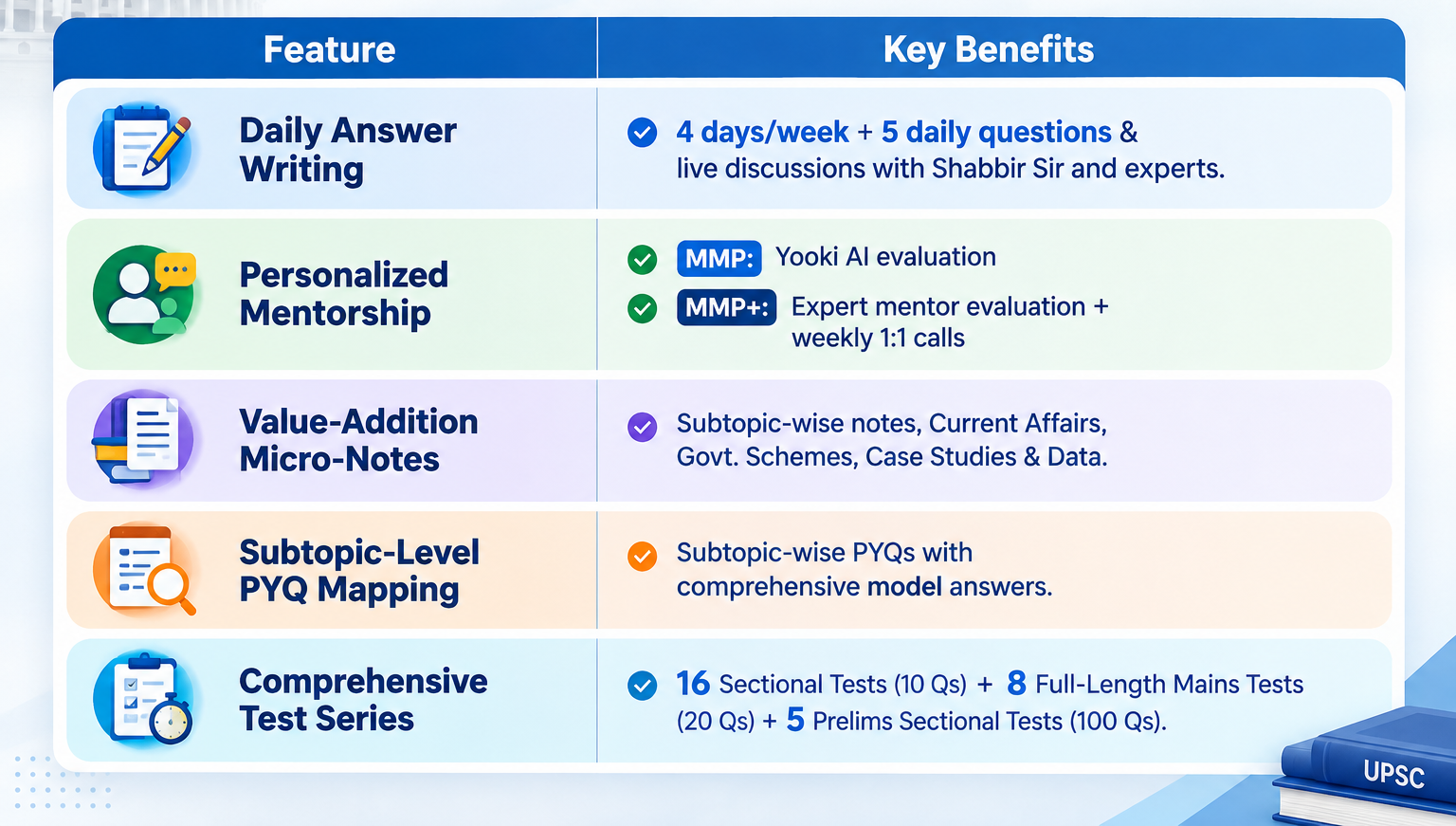
| Feature | Details & Deliverables |
| Daily Answer Writing (DAW) | Practice answer writing 4 days a week, reinforced by daily mini-simulated tests and live answer discussions (5 questions daily) guided by Shabbir Sir and the expert mentor team. |
| Personalized Mentorship & Evaluation | Choose between MMP (evaluation powered by Yooki AI) and MMP+ (comprehensive evaluation by interview-appeared mentors), supplemented by weekly one-on-one mentorship calls. |
| Value-Addition Micro-Notes | Receive exhaustive subtopic-level notes integrated with contemporary current affairs, relevant government initiatives, real-world case studies, authoritative data, and key facts. |
| Subtopic-Level PYQ Mapping | Deconstruct past years' questions mapped directly to subtopics, complete with comprehensive model answers to master structural formatting. |
| Comprehensive Test Series | Rigorous practice featuring 16 Sectional Tests (10 questions each), 8 Full-Length Mains Tests (20 questions each), and 5 Prelims Sectional Tests (100 questions each) to build exam endurance. |

Edukemy’s GS Mains Mentorship Program 2027 is a comprehensive, results-driven coaching initiative built to transform your UPSC Civil Services Examination (CSE) Mains preparation. By bridging the gap between conceptual clarity and structured answer writing, this program combines cutting-edge AI evaluation via Yooki with personalized mentorship from interview-appeared experts. Whether you are aiming to master General Studies Paper I, II, III, or IV, this program equips you with subtopic-level micro-notes, PYQ mapping, and rigorous test series practice to maximize your score.
Key Program Features & Benefits
| Feature | Details & Deliverables |
| Daily Answer Writing (DAW) | Practice answer writing 4 days a week, reinforced by daily mini-simulated tests and live answer discussions (5 questions daily) guided by Shabbir Sir and the expert mentor team. |
| Personalized Mentorship & Evaluation | Choose between MMP (evaluation powered by Yooki AI) and MMP+ (comprehensive evaluation by interview-appeared mentors), supplemented by weekly one-on-one mentorship calls. |
| Value-Addition Micro-Notes | Receive exhaustive subtopic-level notes integrated with contemporary current affairs, relevant government initiatives, real-world case studies, authoritative data, and key facts. |
| Subtopic-Level PYQ Mapping | Deconstruct past years' questions mapped directly to subtopics, complete with comprehensive model answers to master structural formatting. |
| Comprehensive Test Series | Rigorous practice featuring 16 Sectional Tests (10 questions each), 8 Full-Length Mains Tests (20 questions each), and 5 Prelims Sectional Tests (100 questions each) to build exam endurance. |
 Details

General Studies-I
(Indian Heritage and Culture, History and Geography of the World and Society)
Indian Culture - Salient aspects of Art Forms, Literature and Architecture from ancient to modern times.
Modern Indian History from about the middle of the eighteenth century until the present- significant events, personalities, issues.
The Freedom Struggle — its various stages and important contributors/contributions from different parts of the country.
Post-independence Consolidation and Reorganization within the country.
History of the World will include events from 18th century such as Industrial Revolution, world wars, Redrawal of National Boundaries, Colonization, Decolonization, political philosophies like Communism, Capitalism, Socialism etc.— their forms and effect on the society.
Salient features of Indian Society, Diversity of India.
Role of Women and Women’s Organization, Population and Associated Issues, Poverty and Developmental issues, Urbanization, their problems and their remedies.
Effects of Globalization on Indian society.
Social Empowerment, Communalism, Regionalism & Secularism.
Salient features of World’s Physical Geography.
Distribution of Key Natural Resources across the world (including South Asia and the Indian sub-continent); factors responsible for the location of primary, secondary, and tertiary sector industries in various parts of the world (including India).
Important Geophysical Phenomena such as earthquakes, Tsunami, Volcanic activity, cyclone etc., geographical features and their location-changes in critical geographical features (including water-bodies and ice-caps) and in flora and fauna and the effects of such changes.
General Studies-II
(Governance, Constitution, Polity, Social Justice and International Relations)
Indian Constitution—Historical Underpinnings, Evolution, Features, Amendments, Significant Provisions and Basic Structure.
Functions and Responsibilities of the Union and the States, Issues and Challenges Pertaining to the Federal Structure, Devolution of Powers and Finances up to Local Levels and Challenges Therein.
Separation of Powers between various organs Dispute Redressal Mechanisms and Institutions.
Comparison of the Indian Constitutional Scheme with that of Other Countries.
Parliament and State Legislatures—Structure, Functioning, Conduct of Business, Powers & Privileges and Issues Arising out of these.
Structure, Organization and Functioning of the Executive and the Judiciary—Ministries and Departments of the Government; Pressure Groups and Formal/Informal Associations and their Role in the Polity.
Salient Features of the Representation of People’s Act.
Appointment to various Constitutional Posts, Powers, Functions and Responsibilities of various Constitutional Bodies.
Statutory, Regulatory and various Quasi-judicial Bodies.
Government Policies and Interventions for Development in various sectors and Issues arising out of their Design and Implementation.
Development Processes and the Development Industry — the Role of NGOs, SHGs, various groups and associations, donors, charities, institutional and other stakeholders.
Welfare Schemes for Vulnerable Sections of the population by the Centre and States and the Performance of these Schemes; Mechanisms, Laws, Institutions and Bodies constituted for the Protection and Betterment of these Vulnerable Sections.
Issues Relating to Development and Management of Social Sector/Services relating to Health, Education, Human Resources.
Issues relating to Poverty and Hunger.
Important Aspects of Governance, Transparency and Accountability, E-governance- applications, models, successes, limitations, and potential; Citizens Charters, Transparency & Accountability and institutional and other measures.
Role of Civil Services in a Democracy.
India and its Neighborhood- Relations.
Bilateral, Regional and Global Groupings and Agreements involving India and/or affecting India’s interests.
Effect of Policies and Politics of Developed and Developing Countries on India’s interests, Indian Diaspora.
Important International Institutions, agencies and fora - their Structure, Mandate.
General Studies-III
(Technology, Economic Development, Bio-diversity, Environment, Security and Disaster Management)
Indian Economy and issues relating to Planning, Mobilization of Resources, Growth, Development and Employment.
Inclusive Growth and issues arising from it.
Government Budgeting.
Major Crops - Cropping Patterns in various parts of the country, - Different Types of Irrigation and Irrigation Systems; Storage, Transport and Marketing of Agricultural Produce and Issues and Related Constraints; E-technology in the aid of farmers.
Issues related to Direct and Indirect Farm Subsidies and Minimum Support Prices; Public Distribution System - Objectives, Functioning, Limitations, Revamping; Issues of Buffer Stocks and Food Security; Technology Missions; Economics of Animal-Rearing.
Food Processing and Related Industries in India- Scope’ and Significance, Location, Upstream and Downstream Requirements, Supply Chain Management.
Land Reforms in India.
Effects of Liberalization on the Economy, Changes in Industrial Policy and their Effects on Industrial Growth.
Infrastructure: Energy, Ports, Roads, Airports, Railways etc.
Investment Models.
Science and Technology- Developments and their Applications and Effects in Everyday Life.
Achievements of Indians in Science & Technology; Indigenization of Technology and Developing New Technology.
Awareness in the fields of IT, Space, Computers, Robotics, Nano-technology, Bio-technology and issues relating to Intellectual Property Rights.
Conservation, Environmental Pollution and Degradation, Environmental Impact Assessment.
Disaster and Disaster Management.
Linkages between Development and Spread of Extremism.
Role of External State and Non-state Actors in creating challenges to Internal Security.
Challenges to Internal Security through Communication Networks, Role of Media and Social Networking Sites in Internal Security Challenges, Basics of Cyber Security; Money-Laundering and its prevention.
Security Challenges and their Management in Border Areas - Linkages of Organized Crime with Terrorism.
Various Security Forces and Agencies and their Mandate.
General Studies-IV
Ethics, Integrity and Aptitude
This paper will include questions to test the candidates’ attitude and approach to issues relating to integrity, probity in public life and his problem solving approach to various issues and conflicts faced by him in dealing with society. Questions may utilise the case study approach to determine these aspects. The following broad areas will be covered:
Ethics and Human Interface: Essence, Determinants and Consequences of Ethics in - Human Actions; Dimensions of Ethics; Ethics - in Private and Public Relationships. Human Values - Lessons from the Lives and Teachings of Great Leaders, Reformers and Administrators; Role of Family Society and Educational Institutions in Inculcating Values.
Attitude: Content, Structure, Function; its Influence and Relation with Thought and Behaviour; Moral and Political Attitudes; Social Influence and Persuasion.
Aptitude and Foundational Values for Civil Service, Integrity, Impartiality and Non-partisanship, Objectivity, Dedication to Public Service, Empathy, Tolerance and Compassion towards the weaker-sections.
Emotional Intelligence-Concepts, and their Utilities and Application in Administration and Governance.
Contributions of Moral Thinkers and Philosophers from India and World.
Public/Civil Service Values and Ethics in Public Administration: Status and Problems; Ethical Concerns and Dilemmas in Government and Private Institutions; Laws, Rules, Regulations and Conscience as Sources of Ethical Guidance; Accountability and Ethical Governance; Strengthening of Ethical and Moral Values in Governance; Ethical Issues in International Relations and Funding; Corporate Governance.
Probity in Governance: Concept of Public Service; Philosophical Basis of Governance and Probity; Information Sharing and Transparency in Government, Right to Information, Codes of Ethics, Codes of Conduct, Citizen’s Charters, Work Culture, Quality of Service Delivery, Utilization of Public Funds, Challenges of Corruption.
Case Studies on above issues.

Shabbir A Bashir is one of the co-founders of Edukemy and industry’s most lauded professor in UPSC preparation. He has been in the industry...

Sabeeha brings rich experience in the civil services space, having seen this journey both as an aspirant and as an officer — having appeared...

Sree Nidhi brings experience of 2 UPSC interviews and 3 mains, along with 1 State PSC Mains. She has worked as a mentor and an evaluator in the...

Chandrakant Singh is an alumnus of IIM Indore and the University of Delhi, bringing over 8 years of mentoring experience in...
This course is for students who regularly clear the Prelims but find it difficult to score well in the Mains exam. If you struggle to translate your vast knowledge base into high-scoring answers or fall short of the final interview call by a narrow margin, this mentorship provides the precise tactical shifts needed to elevate your scores across GS Papers 1–4. 🔗 Explore the course dynamics here: Edukemy GS Mains Mentorship Programme
Veterans don't need more basic content; they need answer optimization. Our GS answer writing mentorship focuses strictly on value addition, structuring, and multi-dimensional analysis. Instead of generic feedback, you are trained on frameworks to address the core demand of the question, refine your structural layout, introduce inter-paper linkages, and master time management. 🔗 See how the program elevates your presentation: Edukemy GS Mains Mentorship Programme
Yes. The program combines swift evaluation with personalized oversight. It features dual-layered evaluation driven by Yooki and experienced, interview-appeared mentors. More importantly, it includes weekly one-on-one answer copy audits with interview-seasoned mentors to deep-dive into your script, identifying exactly where you are losing half-marks and how to fix your structural trajectory. 🔗 Check out our evaluation mechanism: Edukemy GS Mains Mentorship Programme
Most veterans lose marks on the obscure sub-themes hidden within the UPSC syllabus. Shabbir Sir’s curriculum breaks down the broad syllabus into highly specific subtopic-level micro-notes. You will undergo systematic micro-topic list reviews ensuring that even overlooked static themes and complex current affairs segments are completely covered with pre-prepared dynamic introductions, data points, and conclusions. 🔗 Download the complete micro-topic coverage guide: Edukemy GS Mains Mentorship Programme
Yes. Scoring high in the Mains descriptive papers is difficult without performing well in high-scoring papers like Essay and Ethics (GS Paper 4).
Our UPSC GS Mains Mentorship Programme provides focused guidance on philosophical essays, essay structure, argument building, and Ethics case-study frameworks. You'll learn how to write well-structured, impactful essays and apply ethical theories effectively in GS Paper 4 answers.
🔗 Access specialized GS Paper 4 and Essay value-addition frameworks through the Edukemy GS Mains Mentorship Programme.
Note: The Essay Course is available as a standalone program for aspirants who want dedicated Essay preparation. It is highly recommended by UPSC CSE 2025 Topper Puru for mastering essay writing and improving Mains scores.
🔗 Access specialized GS 4 and value-addition frameworks: Edukemy GS Mains Mentorship Programme
We equip you with actionable templates to structure answers under immense time pressure. You will be provided structural toolkits to instantly organize answers for GS 1 (using geographic/historical timelines), GS 2 (integrating Articles, Supreme Court judgments, and committee recommendations), and GS 3 (incorporating economic data, flowcharts, and policy maps) to guarantee that extra 1.5 to 2 marks per question. 🔗 Review the value-added materials: Edukemy GS Mains Mentorship Programme
Interaction is continuous throughout the programme.
The programme runs under the guidance of Shabbir Sir, who is the Director of the Mentorship Programme. You can directly share your feedback, concerns, or queries with him whenever required, and he personally meets students once every 15 days to review their progress and provide strategic guidance.
In addition, you'll have 4 days of answer writing practice every week with your assigned mentor. Every evening, the mentor conducts a discussion on the day's model answers, explains the ideal approach, highlights common mistakes, and helps you improve your answer-writing skills consistently.
This combination of Shabbir Sir's strategic mentorship and regular mentor interactions ensures continuous guidance, personalized feedback, and steady improvement throughout the programme.
🔗 Check batch dates and live schedules: Edukemy GS Mains Mentorship Programme
Absolutely. To understand the exact pattern of the exam, the course includes meticulous subtopic-level mapping of Mains PYQs accompanied by high-quality model answers. This enables you to observe how micro-topics have evolved over the years and teaches you to apply standard frameworks to repeating core themes. 🔗 View sample model answers and PYQ mappings: Edukemy GS Mains Mentorship Programme
We save you hours of documentation by providing ready-to-use data sheets. You will receive customized value-added material for every subtopic, loaded with relevant contemporary case studies, verified data points, updated charts, Current Affairs and critical government initiatives. These inputs act as immediate fodder to enrich your daily answer writing scripts. 🔗 Download sample value-addition content: Edukemy GS Mains Mentorship Programme
The program follows a structured, rigorous timeline tailored to keep veterans disciplined and sharp. With daily answer writing practices and scheduled weekly evaluation cycles, it ensures you finish the massive syllabus incrementally well before the actual Mains exam without suffering from answer writing burnout. 🔗 Secure your seat for the upcoming batch: Edukemy GS Mains Mentorship Programme
Edukemy’s GS Mains Mentorship Program, personally designed and guided by Shabbir Sir, brings together interview-approved mentors, a program designed by IIT/IIM alumni, is an intensive, strategy-driven ecosystem engineered to convert your General Studies preparation into high-scoring answer transcripts. Scoring 400+ marks across GS Papers I, II, III, and IV requires more than passive reading—it demands daily practice, structural precision, exact subtopic coverage, and actionable feedback.
This program merges artificial intelligence through Yooki with human expertise provided by interview-appeared UPSC mentors. Whether you require fast diagnostic feedback on daily practice or personalized strategic guidance on essay and ethics frameworks, this mentorship program ensures you cover every inch of the UPSC CSE Mains syllabus with high-impact value addition.
Explore our dedicated learning tracks, compare the MMP vs MMP+ plans below, or read our detailed guide on How to Prepare for UPSC GS Mains to build your foundation.
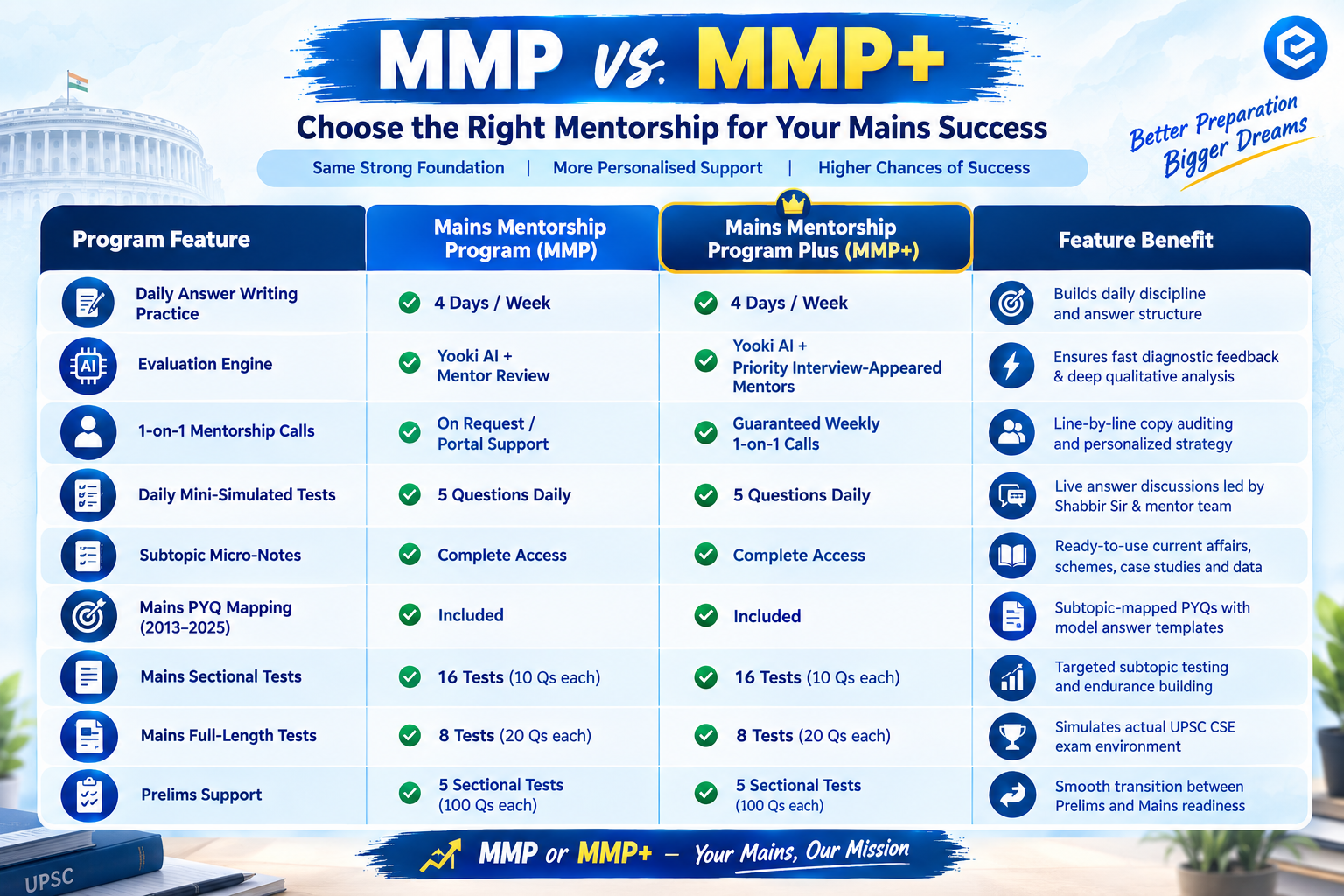
To help you choose the right path for your Mains preparation, here is a detailed breakdown of what each track offers:
| Features | Mains Mentorship Program (MMP) | Mains Mentorship Program Plus (MMP+) |
| Daily Answer Writing Practice | 4 Days a Week | 4 Days a Week |
| Answer Evaluation Mechanism | Yooki AI Evaluation + Mentor Review | Yooki AI + Priority Interview-Appeared Mentor Review |
| One-on-One Mentorship Calls | On Request / Portal Support | Weekly Dedicated 1-on-1 Calls with Interview-Appeared Mentors |
| Daily Mini Simulated Tests | 5 Questions Daily with Video/Live Discussion | 5 Questions Daily with Video/Live Discussion |
| Value-Addition Micro-Notes | Subtopic-Level Micro-Notes (Current Affairs, Schemes, Case Studies, Data) | Subtopic-Level Micro-Notes (Current Affairs, Schemes, Case Studies, Data) |
| PYQ Mapping & Model Answers | 2013–2025 Subtopic Mapped PYQs with Model Answers | 2013–2025 Subtopic Mapped PYQs with Model Answers |
| Mains Sectional Tests | 16 Sectional Tests (10 Questions Each) | 16 Sectional Tests (10 Questions Each) |
| Mains Full-Length Tests | 8 Full-Length Tests (20 Questions Each) | 8 Full-Length Tests (20 Questions Each) |
| Prelims Support | 5 Prelims Sectional Tests (100 Questions Each) | 5 Prelims Sectional Tests (100 Questions Each) |
Daily Answer Writing & Micro-Simulated Tests
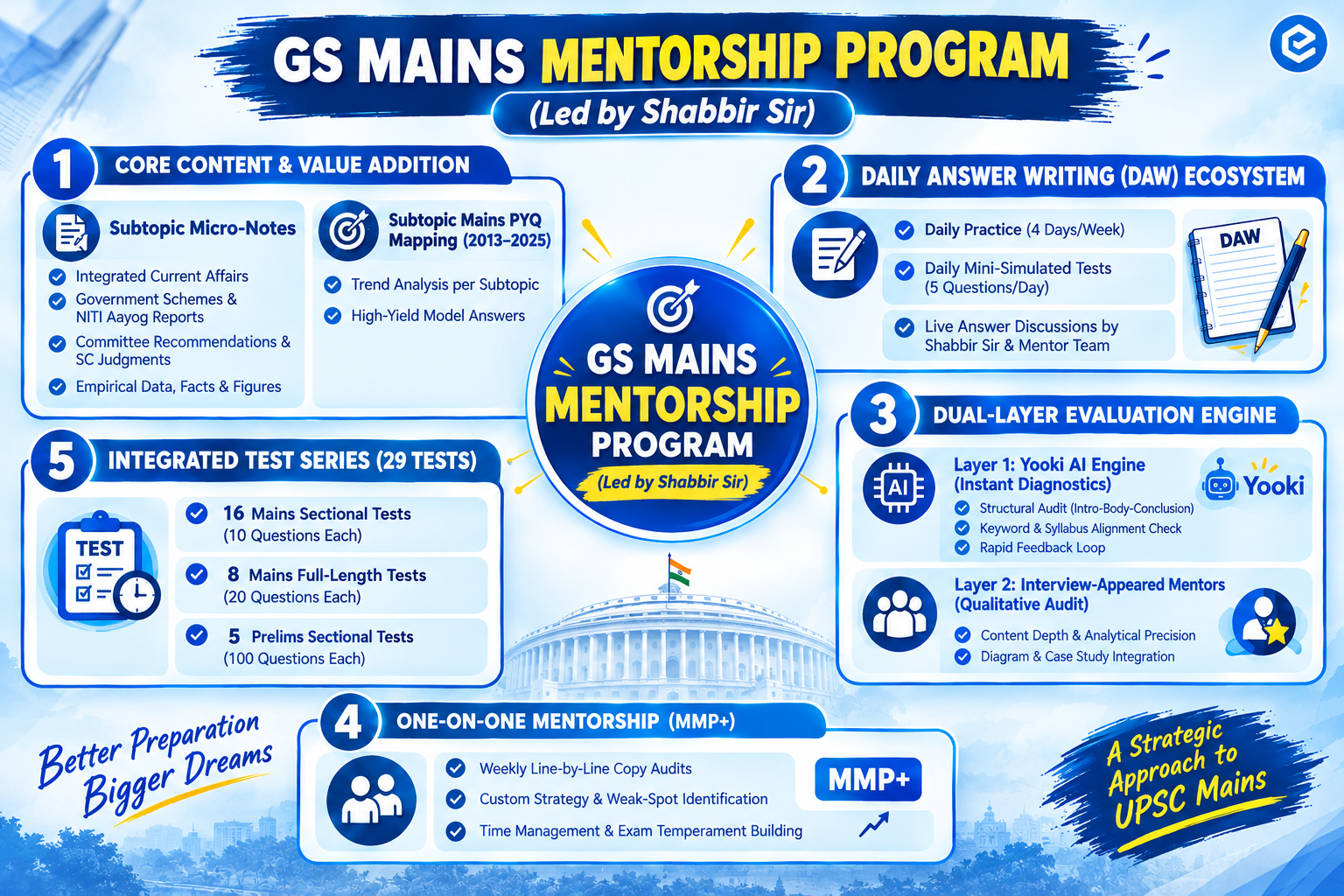
Daily discipline builds exam temperament. Every week, candidates answer structured questions covering GS Papers I through IV. Each session is backed by daily mini-simulated tests featuring 5 targeted questions and comprehensive answer discussions conducted by Shabbir Sir and senior mentor faculty.
Hybrid Evaluation Engine: Yooki AI & Interview-Appeared Mentors
Speed and depth are both essential for revision. Edukemy's proprietary Yooki AI engine checks structural parameters, keyword inclusion, and thematic alignment instantly. Following the AI pass, experienced interview-appeared mentors review content depth, analytical rigor, and diagram integration.
Subtopic-Level Value Addition
Micro-Notes Generic answers yield average marks. Our subtopic micro-notes furnish ready-to-use content for every subtopic in the syllabus, including:
Contemporary case studies for Ethics and Governance
Authoritative statistical data and NITI Aayog report highlights for GS III Economics
Constitutional articles, Supreme Court landmark judgments, and committee recommendations for GS II Polity
Government schemes and international indices for GS I and GS II
Subtopic-Level Mains PYQ Mapping
Understanding UPSC question trends is critical. We deconstruct Previous Years' Questions from 2013 onwards, mapping them directly to individual syllabus subtopics with multi-dimensional model answers.
Integrated Test Series for Mains & Prelims
Practice under actual exam conditions with 16 Mains Sectional Tests, 8 Full-Length Mains Tests, and 5 Prelims Sectional Tests to maintain a smooth transition between Prelims and Mains readiness.
Student submits completed answer sheet on the Edukemy portal or mobile app.
Instant preliminary feedback evaluating answer structure, keyword placement, and syllabus alignment.
In-depth line-by-line review by Interview-Appeared Mentors assessing analytical depth, data, and case studies.
Personalized strategy session (MMP+) to review progress, fix weak areas, and optimize exam strategy.
Frequently Asked Questions:
Q: How can I score 400+ in UPSC GS Mains papers using this mentorship program?
A: Scoring 400+ across GS Papers I, II, III, and IV requires combining core syllabus mastery with structured answer presentation. The GS Mains Mentorship Program Led by Shabbir Sir helps you achieve this by integrating daily evaluated answer practice, subtopic-level micro-notes, empirical data, case studies, and mapped PYQ model answers. For additional strategies on structuring your preparation, explore our detailed guide on How to Prepare for UPSC GS Mains and check out our UPSC General Studies Foundation Course.
Q: What is the difference between MMP and MMP+ in the GS Mains Mentorship Program?
A: MMP (Mains Mentorship Program) includes daily answer writing practice, dual evaluation powered by Yooki AI and mentor reviews, value-addition micro-notes, subtopic PYQ mapping, and full test series. MMP+ (Mains Mentorship Program Plus) includes all MMP features along with guaranteed weekly one-on-one mentorship calls with interview-appeared mentors for personalized answer auditing, time-management guidance, and strategic planning.
Q: How does Yooki AI assist in UPSC Mains answer writing evaluation?
A: Yooki is Edukemy’s proprietary AI-assisted study and evaluation platform. It analyzes answer copies instantly for structural flow, introduction-body-conclusion balance, keyword density, and syllabus alignment. This diagnostic AI report gives candidates rapid feedback before detailed qualitative review and feedback from senior interview-appeared mentors. Learn more about our tech-enabled learning environment on the Yooki AI Study Platform page.
Q: How many tests are included in the GS Mains Mentorship Program led by Shabbir Sir?
A: The program includes a comprehensive test series totaling 29 tests: 16 Mains Sectional Tests (10 questions each), 8 Full-Length Mains Tests (20 questions each), and 5 Prelims Sectional Tests (100 questions each). Candidates also benefit from daily mini-simulated tests with 5 questions each and live discussion sessions. You can also benchmark your performance via our dedicated UPSC Mains Test Series.
Q: What type of study material and micro-notes are provided in the course?
A: Students receive exhaustive, subtopic-level micro-notes covering every syllabus segment of General Studies Papers 1 through 4. These micro-notes include integrated current affairs, NITI Aayog/Committee reports, government schemes, real-world case studies, authoritative data, and mapped previous years' questions (PYQs) with model answers. Complement your study with our downloadable UPSC Free Resources and Micro-Notes.
Q: How do weekly 1-on-1 mentorship calls help improve answer writing?
A: During weekly 1-on-1 calls in MMP+, interview-appeared mentors conduct line-by-line audits of your evaluated answer sheets. Mentors identify recurring content gaps, refine introduction and conclusion frameworks, suggest strategic diagram placements, and assist in managing exam pressure. Read our blog post on The Importance of 1-on-1 Mentorship in UPSC Mains for deeper insights.
Q: Is this program suitable for candidates preparing alongside Geography Optional or other optionals?
A: Yes. The program schedule is specifically optimized to balance GS practice with optional subject revision. For aspirants with Geography Optional, Shabbir Sir provides valuable cross-linkages between GS Paper I (Geography & Society), GS Paper III (Environment, Disaster Management & Agriculture), and Optional Papers 1 & 2. To explore dedicated optional support, visit our Geography Optional Coaching page and Geography Mains Mentorship Program.
Q: How does subtopic PYQ mapping enhance Mains revision?
A: UPSC routinely repeats core themes and analytical concepts across General Studies papers. By mapping previous years' questions (2013–2025) directly to syllabus subtopics, students can identify high-yield topics, analyze shifting question patterns, and internalize high-scoring answer templates. Access our complete repository on UPSC Mains PYQ Analysis & Model Answers.


