
24 Nov to 10 Dec, 2025
CLIMATE IMPACT ON WOMEN
Why in news : A recent study published in the journal Frontiers in Sustainable Food Systems highlights the unequal impact of the climate crisis on women engaged in agri-food systems across the globe.
About :
- Agricultural food systems encompass the entire cycle of food production, distribution, and consumption, involving cultivation, harvesting, processing, packaging, transportation, marketing, and consumption. This complex network includes farmers, processors, distributors, retailers, and consumers.
- Climate change has posed challenges to global agri-food systems, impacting crop yields, food quality, and supply chain stability. These challenges have led to economic disparities and social consequences. The need for resilient and sustainable agri-food systems is crucial to address these multifaceted issues and ensure the stability of the global food supply chain.
ROLE OF WOMEN IN AGRI FOOD SYSTEMS
- Farmers and Producers: According to the Food Agriculture Organisation , women make up nearly 43% of the agricultural labor force at the global level. Eg. In Sub-Saharan Africa, women produce up to 80% of the food, yet they face challenges in accessing resources and credit (World Bank).
- Processing and Distribution: UN Women reported that in Latin America, women-run cooperatives have emerged, enhancing food processing and contribution to economic resilience
- Access to Resources: In Southeast Asia, limited land rights for women impact their ability to adopt sustainable farming practices .
- Entrepreneurship and Innovation: Women entrepreneurs contribute to agri-food innovation and value addition. Example: Start-ups led by women in Africa are introducing innovative solutions in food processing, reducing post-harvest losses
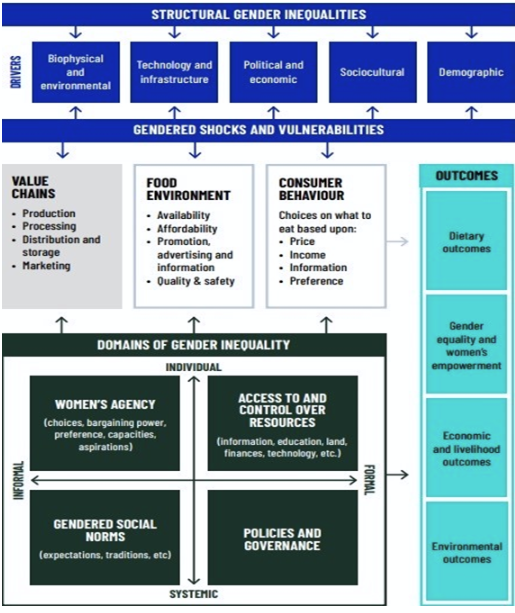
FRAMEWORK FOR GENDERED AGRI FOOD SYSTEMS
SIGNIFICANCE OF AGRI FOOD SYSTEMS IN SUSTAINABLE DEVELOPMENT
- Food Security and Nutrition: Sustainable farming practices, such as agroecology, enhance soil fertility, increase crop diversity, and contribute to improved nutrition. Initiatives promoting sustainable agriculture, like the UN's Food Systems Summit, emphasize the importance of achieving food security through resilient and sustainable food systems.
- Economic Growth and Livelihoods: Agriculture employs over 40% of the global workforce. Investments in sustainable agriculture, such as regenerative farming practices, are gaining traction as governments and businesses recognize their potential for both economic growth and environmental sustainability.
- Environmental Sustainability: Agroforestry and precision farming techniques contribute to sustainable land use, reducing the environmental footprint of agriculture. The global push for carbon-neutral initiatives highlights the need for sustainable agricultural practices to mitigate climate change impacts.
- Innovation and Technology Adoption: Digital technologies are transforming agri-food systems, improving efficiency and sustainability. Precision agriculture, blockchain in supply chains, and AI-driven farming practices enhance productivity while reducing environmental impact.
KEY FINDINGS OF THE REPORT
- Global Ranking of Climate Change Threats: The study ranks 87 countries based on the climate change threat faced by women in agri-food systems.
- India ranks 12th, with other Asian nations like Bangladesh, and Pakistan, Afghanistan, and Nepal also facing significant risks.
- Identification of High-Risk Regions: Agri-food systems, encompassing production, post-harvest handling, and distribution, are particularly at risk.
- Within African and Asian regions, central, east and southern Africa and west and south Asia emerge as regions with heightened vulnerability.
- People living in low-and middle-income countries (LMIC) are at heightened risk.
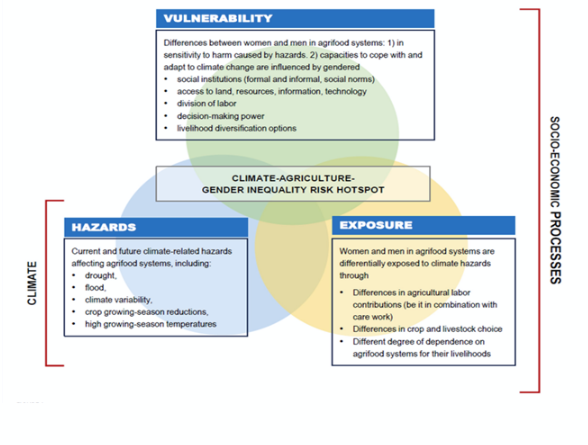
- Climate Agriculture Gender Inequality Hotspots: The research combined insights on climate, gender and agri-food systems to map the regions as ‘climate–agriculture–gender inequality hotspots’.
- The study calculated each country’s risk based on these indicators and plotted the score for each LMIC ( Low Middle Income Country ) country on a color-coded map.
- The hotspot maps can guide gender-responsive climate action, especially in upcoming climate conferences like Climate Conference (COP 28) and climate investments.
- This is particularly relevant in ongoing negotiations around a loss and damage fund and other climate investments.
- Policymaking and Climate Action: The study serves as a crucial entry point for policymaking by illustrating the unequal impact of hazards on women in agriculture.
- Previous studies highlighted that women and girls are more likely to go hungry following natural disasters linked to climate change.
- In India, twice the number of women compared to men reported eating less in response to a drought.
- The hotspot maps can aid decision-makers and investors in targeting finance and investments to areas where women are hardest hit by climate change risks.
CLIMATE - GENDER INEQUALITY - AGRICULTURE HOTSPOTS ACROSS THE GLOBE

|
CASE STUDY : CUBA’S AGRICULTURAL INNOVATION PROJECT EMPOWERING WOMEN AND BUILDING SUSTAINABLE FOOD SYSTEMS Cuba's Local Agricultural Innovation Project with a focus on its gender-specific elements was first introduced in Cuba in the early 2000's as a means of carrying out participatory plant-breeding to facilitate the development and use of locally-adapted seed varieties and help farmers diversify their production. This model facilitates female participation and leadership and how this contributes to positive economic, ecological and sociocultural changes in farming households and communities. Key impacts include increased inclusion of women in developing and implementing farm innovations; increased self-confidence for female farmers and farm-family members; increased productive diversification on family farms; and, increased employment and household income through women-led micro-industry projects and facilitation of commercialization opportunities. |
GENDER DIFFERENTIATED IMPACT OF CLIMATE CHANGE ON WOMEN IN AGRI FOOD SYSTEMS
|
IMPACT |
REASONS |
|
Reduced Food Security & Income |
Climate change disrupts agricultural production, reduces crop yields and quality, and increases the risk of pests and diseases. |
|
Increased workload |
Women farmers also have to adapt to changing weather and rainfall patterns, which may require them to adopt new crops, technologies, or practices, or to migrate to other areas. |
|
Reduce Health and Well being |
Climate change heightens the vulnerability of women farmers in India, limiting their access to healthcare, sanitation, and hygiene, while simultaneously exacerbating gender-based violence, particularly in conflict and disaster scenarios. |
|
Limited Participation & Environment. |
Women farmers also have less access to information, education, and training, which limits their awareness and capacity to adapt to climate change. |
INDIA’ S INITIATIVES
|
Mahila Kisan Sashaktikaran Pariyojana |
Aims to empower women by enhancing their participation in agriculture and to create sustainable livelihood opportunities for them. |
|
National Policy for Farmers (2007) |
Aims for dedicated women centric government efforts. |
|
Gender Based Budgeting |
30% of the budget allocation has been earmarked for women beneficiaries in all ongoing schemes/programmes and development activities. |
|
Women Self-Help Groups (SHG) |
Connect them to micro-credit through capacity building activities. |
|
Recognizing the role of women in agriculture |
15th October of every year as Women Farmer’s Day |
WAY FORWARD
- Adaptive Strategies for Women Farmers: To navigate climate-related challenges, women farmers should be encouraged to adopt adaptive strategies, including income diversification and cultivating climate-resilient crops.
- Training, Capacity Building and Weather Information: Providing women farmers with training in climate-resilient farming techniques, such as agroforestry, crop diversification, water-efficient irrigation, and soil conservation practices.
- Financial Inclusion: Providing women with access to microfinance services and insurance products that cover climate-related risks, ensuring they have the financial capacity to adapt and recover from climate shocks. Establishing women's savings groups that serve as safety nets during times of crop failure or economic stress.
- Access to Resources: Enhancing women's access to water-saving technologies and efficient irrigation methods to cope with water scarcity caused by climate change.
- Role of Policymakers in Resource Availability: Land tenure reforms that prioritise women’s rights and insurance mechanisms tailored to their needs can bolster resilience against climate-induced risks.
- Social Security: Ensuring adequate social cover for all women who work in agriculture is another indispensable factor in modern sustainable farming.
Where to Use ?
Paper II ( Geography ) : Agriculture
Paper III ( General Studies ) : Inclusive Growth, Gender Budgeting , Agriculture
Source :
https://www.frontiersin.org/articles/10.3389/fsufs.2023.1197809/full
MAN ANIMAL CONFLICT
Why in news : A combination of water scarcity, man-made ponds and land-use change is trapping herds in India’s most affected districts.
About :
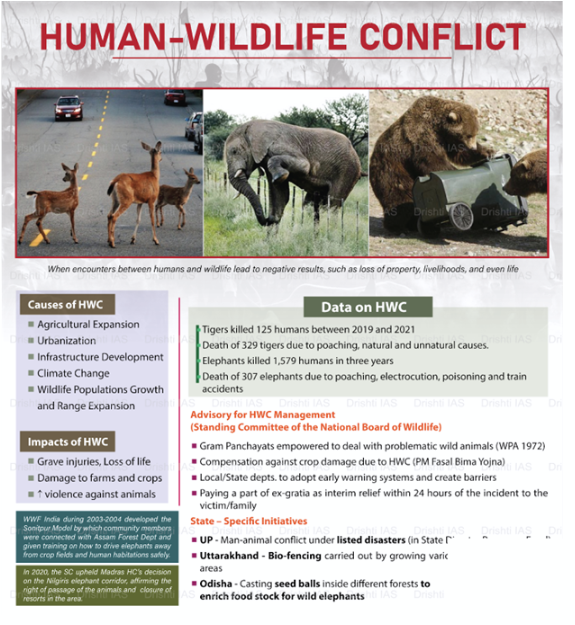
Human–elephant conflict in Odisha has intensified in recent years as elephants increasingly move into farmlands. Water availability near croplands, drought conditions, and land-use changes have altered traditional migration routes, trapping elephants in human-dominated landscapes. Odisha consistently records high conflict levels, particularly in Dhenkanal district, where irrigation development and habitat pressures shape elephant movement.
Water Availability and Drought Dynamics
Drought Scenario in Odisha
- Odisha has experienced 41 natural calamities in the last 50 years, including 19 drought years.
- Western districts are especially vulnerable; water scarcity pushes elephants to seek new territories.
Farm Ponds and Irrigation as Attractants
- Under MGNREGA, thousands of farm ponds have been built for irrigation and drought-proofing.
- In Dhenkanal alone, 1,837 water-related works were active as of Nov 2025, including 93 drought-proofing projects.
- These ponds, along with water-intensive paddy fields, provide reliable resources for elephants.
- Elephants require ~200 litres of water per day, making artificial water bodies major attractants.
Ecological Research Support
A 2024 study in Global Ecology and Conservation identifies deforestation and water concentration near croplands as primary drivers of human-elephant conflict. Rivers, ponds and irrigation systems act as congregation sites.
Blocked Migration Routes and Landscape Trapping
- Traditional migratory corridors have been obstructed due to encroachment, agriculture expansion, mining and industrial growth.
- Many elephants travelling 800–1,000 km are now stranded because people block movement to protect crops.
- Young elephants born in farmlands have never lived in forests, increasing stress and aggression.
Land-Use Change and Habitat Pressure
Carrying Capacity Issues
- Dhenkanal hosts three times more elephants than its ecological carrying capacity.
- Adjacent areas like Chandaka Elephant Sanctuary, which once supported 60 elephants, have lost habitat due to development.
- Shrinking bamboo cover further pushes elephants into agriculture fields.
Comparison with African Context
- In Namibia, conflict peaks during drought when wildlife and communities compete for scarce water.
- Artificial water points change elephant migration behaviour, similar to farm ponds in Odisha.
Interventions and Mitigation Strategies
Changing Crop Patterns
- Jalpaiguri (West Bengal): Farmers shifted from paddy to tea plantations to deter elephants, but tea estates became breeding grounds for leopards — an example of unintended ecological consequences.
Community-based Approaches
- Wildlife Trust of India trains locals on conflict mitigation.
- Encouragement of multi-department participation for integrated solutions.
Behaviour Change Campaigns
- Open defecation increases risky encounters, leading to higher deaths. Regular toilet use could reduce conflict by 40–50%.
- Local NGO efforts focus on sanitation awareness in 50 villages.
Ecological Measures
- Planting 80,000 Palmyra palms (2024–25) to provide food resources for elephants.
- Palm fruits help sustain elephants during lean seasons.
Current Status and Human Toll
- Odisha has 2,103 elephants, including 291 in Dhenkanal.
- The district recorded 58 human deaths in the last two years, showing the urgency of long-term solutions.
Conclusion
Human-elephant conflict in Odisha demonstrates how both abundance and scarcity of water can trigger wildlife movement shifts. While mitigation strategies—crop diversification, palm plantations, improved sanitation, awareness programmes and corridor restoration—may reduce conflict, coexistence challenges will persist as human populations rise and climate pressures intensify. Long-term solutions require landscape-level planning, restoring ecological corridors, and community-centred conflict governance.
Where to use ? :
Paper II ( Geography Optional ) : Human and Animal Conflict
ANTARCTIC OZONE HOLE
Why in news : The Antarctic ozone hole closed on December 1 this year, weeks earlier than usual.
About :
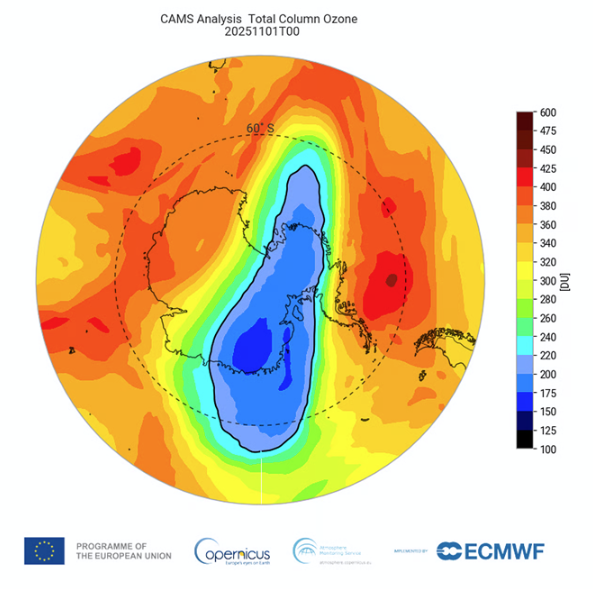
In a year marked by record-breaking global temperatures and escalating climate anxieties, a rare positive environmental milestone has emerged: the complete closure of the Antarctic ozone hole earlier than usual, confirmed by the Copernicus European Earth Observation Agency. The hole that formed in August 2025 fully closed by December 1, 2025, signaling one of the strongest recovery signs in recent years. This development highlights the success of coordinated global environmental governance and offers lessons for climate action.
Understanding the Ozone Hole Phenomenon
The ozone hole refers to the seasonal thinning of the ozone layer in the stratosphere over Antarctica, primarily during the austral spring (September–November). Since the layer absorbs harmful UV-B radiation, its thinning increases risks of skin cancer, cataracts, reduced crop productivity, marine food chain disruption and weakened immune responses.
Scientific Basis
- Ozone depletion is driven largely by chlorofluorocarbons (CFCs) and related chemicals that release chlorine and bromine radicals.
- Unique polar meteorological conditions — extreme low temperatures, polar stratospheric clouds, and isolated circumpolar vortex circulation — intensify destruction rates.
- First detected in 1985, the hole became one of the most alarming symbols of anthropogenic atmospheric impact.
2025 Closure: Key Highlights
- Smallest ozone hole in five years.
- Second consecutive year of relatively small holes, reversing the long series of large events from 2020–2023.
- Reached peak size of 21 million sq km in September, shrinking faster thereafter.
- Historically, the largest recorded was 29 million sq km in 2006.
- Observed during a time when global temperatures rose 1.55°C above pre-industrial levels (1850–1900) in October 2025.
This early closure emerges as an encouraging anomaly against the backdrop of global warming intensification — demonstrating that climate change impacts and ozone recovery processes are interconnected but governed by distinct atmospheric mechanisms.
Drivers of the Recovery
The Montreal Protocol (1987)
The phased elimination of CFCs and HCFCs under the Montreal Protocol is widely considered the most successful global environmental treaty. It includes:
- Replacement of ozone-depleting substances
- Strict monitoring and compliance systems
- Global consensus and equitable transition support.
Scientific Interventions
- The Kigali Amendment (2016) targeting hydrofluorocarbons (HFCs), potent greenhouse gases, strengthens climate–ozone co-benefits.
- Long-term atmospheric chemistry modelling predicts full global ozone recovery by 2066.
Lessons for Global Climate Governance
The recovery represents:
- Proof of the effectiveness of collaborative multilateral environmental agreements
- A model for climate negotiations such as COP processes and carbon reduction frameworks
- Evidence that science-policy synergy can reverse global-scale degradation
The closure is not a victory declaration, but a critical checkpoint, as climate-linked feedback loops could still hinder long-term ozone stability. Thus, constant monitoring and regulatory vigilance are essential.
Where to use :
Paper I ( Geography Optional ) : climate change and human response .
Paper II ( Geography Optional ): Environmental Conventions
BIoremediation - December 2025
BIoremediation : Bioremediation is a natural process in which microorganisms such as bacteria, fungi, or plants are used to clean up polluted environments by breaking down harmful chemicals into harmless substances. It plays a major role in treating oil spills, industrial waste, sewage, heavy metals, and pesticide contamination. For example, oil-eating bacteria were used after the Gulf of Mexico oil spill. It is a cost-effective, eco-friendly and sustainable method supporting environmental restoration compared to chemical treatments.
Solar Cycle
Solar Cycle : The solar cycle is a roughly 11-year periodic change in the Sun’s activity, including the rise and fall of sunspots, solar flares, and solar radiation. It influences space weather, satellite functioning, radio communication, and even climate variations on Earth. Periods of high sunspot activity are called solar maximum, and low activity is solar minimum. For example, strong solar storms during solar maximum can disrupt GPS systems, power grids, and increase Aurora Borealis visibility.
Isotropic
Isotropic : Isotropic refers to a surface, region, or material that has uniform properties in all directions, meaning there is no preferred orientation. In geography, an isotropic plain assumes uniform physical conditions—equal climate, landforms, and accessibility—which is used in models like Von Thünen’s agricultural land-use model. It helps in simplifying spatial analysis by removing external variations. In physics, isotropic materials behave the same regardless of direction, such as glass or some metals.
Migration Selectivity
Migration Selectivity : Migration selectivity means that not all people migrate equally; migration is selective toward certain age groups, education levels, skill types, gender, or economic status. For example, young educated individuals migrate more for jobs, while elderly populations rarely migrate. India sees high out-migration of skilled IT workers to the USA and Gulf countries. Selective migration affects labor markets, population structure, and regional development through brain drain or brain gain.
Epigenetic Drainage
Epigenetic Drainage : Epigenetic drainage refers to a river system whose drainage pattern develops on a newly uplifted land surface that did not originally control the river’s course. The river cuts into the underlying geological structure after uplift or volcanic deposition, ignoring older rock structure. For example, the Damodar and Subarnarekha rivers flow through hard rocks of the Chotanagpur Plateau due to uplift after they were established. It helps in understanding geomorphic evolution and tectonic history.
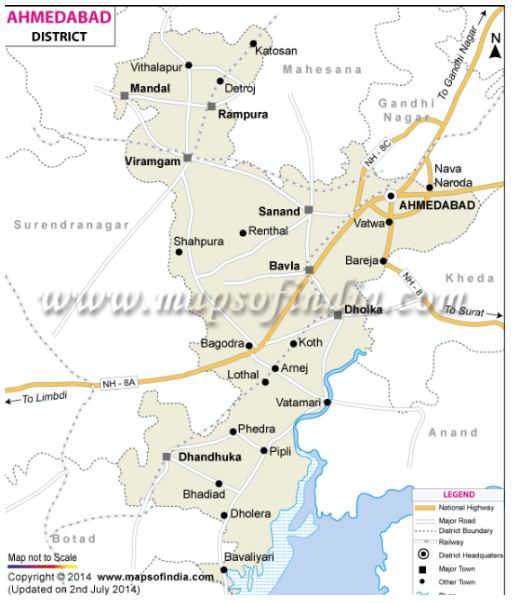
URBAN HEAT ISLAND AHMEDABAD
Satellite analysis for the city shows land surface temperature (LST) in summer days ranges from ~29°C to 47°C, and 26–29°C at night, with hottest pockets in dense built-up zones.cities-and-regions.org
During the April 25–29, 2022 heat episode, surface temperatures crossed 60°C in some locations, while air temperatures in Ahmedabad and Jaipur reached ~47°C.
For October 2013, estimated UHI intensity (urban minus rural LST) over Ahmedabad was about 4.1°C in daytime and 6.0°C at night, confirming a strong night-time UHI.
Places in News - 10 December 2025
1. Wayanad
Why in news: The Union Government recently sanctioned only Rs 260 crore in disaster relief to Kerala following the devastating Wayanad landslides of July 2024, against the State’s estimated losses of Rs 2,200 crore.
About:
- Wayanad is a picturesque district in Kerala, India, known as the "green paradise" for its lush Western Ghats landscapes, spice plantations, rich biodiversity (elephants, tigers).
- The Kabini River, a tributary of the Kaveri River, originates at Wayanad.
- The historically important Edakkal Caves are located in Wayanad district.
- Wayanad district is bordered by Karnataka (Kodagu, Chamarajanagar and Mysore districts) to the north and north-east, Tamil Nadu (Nilgiris district) to the south-east (it is the only district that shares border with both the neighbouring states of Kerala), Malappuram to the south, Kozhikode to the south-west and Kannur to the north-west.
2. Mekedatu dam
Why in news : Karnataka has announced that it would submit a revised Detailed Project Report (DPR) to the Centre for the Mekedatu dam across the Cauvery river.
About :
- The Mekedatu project is a multipurpose project involving the construction of a balancing reservoir near Kanakapura in Ramanagara district, Karnataka.
- Mekedatu, meaning goat’s leap, is a deep gorge situated at the confluence of the rivers Cauvery and its tributary Arkavathi.
- The drive to mekedatu takes one through the rustic interior villages of Karnataka making the drive a memorable one.
3. Talwandi Sabo
Why in news : Punjab has passed a resolution to declare the Amritsar Walled City, Anandpur Sahib, and Talwandi Sabo as holy cities, marking a major cultural and governance decision aligned with the 350th martyrdom anniversary of Guru Tegh Bahadur.
About :
- Talwandi Sabo (also known historically as Guru Kashi) is a town and Municipal Council, in Bathinda District, Punjab, India. It is famous for being the town in which one of the five Takhts of Sikhism where Takht Sri Damdama Sahib.
- It is also famous for its Baisakhi, which is celebrated on the 13th of April every year.
4. Ratanmahal Wildlife Sanctuary (WLS)
Why in news : A tiger has been officially spotted in Gujarat's Ratanmahal Wildlife Sanctuary (WLS), marking the first confirmed sighting of the species in the state since it was declared extinct in 1989.
About :
- It is a protected area of mixed, deciduous forest, located near Devgadh Baria in Dohad district, at Gujarat's border with Madhya Pradesh, within the Kathiawar-Gir dry deciduous forests' ecoregion.
- Ratanmahal Sanctuary is near by river Paanam (a major river of Central Gujarat), which helps to preserve the ecological balance in the forest, besides water conservation.
- The sanctuary is also known as "Ratanmahal Sloth Bear Sanctuary," due to its highest population of sloth bears in the state.
- It is located near tribal towns of Baria and Chhota Udepur.
5. Tirora
Why in news : Adani Power Maharashtra Limited (APML), a subsidiary of Adani Group constructed a super-critical technology based thermal power plant at Tiroda, Maharashtra.
- It is a city and municipal council in the Gondia district of Maharashtra, India.
- It is the largest coal based Thermal Power Plant in the state of Maharashtra, India.
- Kawlewada Dam is one of the major attractions in Tirora.

Fortnightly KOSMOS MCQs Practice - 10th December 2025
Q1. Consider the following pairs:
1. Recent Environmental Initiative — Associated Organization
2. LiFE Movement — UNEP
3. Green Grids Initiative — ISA
4. Mangrove Alliance for Climate — IUCN
Which of the pairs given above is/are correctly matched?
- 1 and 2 only
- 2 only
- 2 and 3 only
- 1, 2 and 3
Q2. Which of the following best describes the phenomenon referred to as “snow droughts” in recent studies of the Hindu Kush Himalaya (HKH) region?
- A prolonged period of heavy snowfall resulting in glacial advance
- A prolonged period of unusually low snowfall or early snow-melt, reducing snow cover
- Drought caused by lack of rainfall in Himalayan valleys
- An unusual form of atmospheric drought caused by high temperatures
Q3. Which recent tropical cyclone caused heavy rainfall and floods in late November to early December 2025, affecting Sri Lanka and Southern India?
- Cyclone Nisarga
- Cyclone Tauktae
- Cyclone Ditwah
- Cyclone Fani
Q4. Urban soils have been recently highlighted as crucial for climate resilience in the context of growing cities. Which of the following is not a benefit of healthy urban soils, as per recent international emphasis (e.g. on World Soil Day 2025)?
- Absorbing and filtering rainwater to reduce urban flooding
- Acting as carbon sinks and helping mitigate heat in cities
- Enhancing soil fertility for urban agriculture and green cover
- Generating geothermal energy to power urban heat-island mitigation
Q5. Consider the following statements about World Meteorological Organization (WMO) latest report on Middle East and North Africa (MENA) region:
1. The report says MENA region’s temperature rise is currently around twice the global average.
2. The report highlights that prolonged periods of temperatures exceeding 50 °C are already posing serious risks to ecosystems, public health and economies in the region.
Which of the statements is/are correct?
- Only I
- Only II
- Both I and II
- Neither
Q6. With reference to the Humboldt penguin, consider the following statements:
1. It is found along the Humboldt Current in the Indian Ocean.
2. It is a fully migratory penguin species with global dispersal.
3. It is classified as Vulnerable under the IUCN Red List.
How many of the statements given above is/are not correct?
- Only One
- Only Two
- All Three
- None
Q7. With reference to outcomes of 30th edition of the Conference of the Parties to the United Nations Framework Convention on Climate Change (UNFCCC COP30), consider the following statements:
1. The Global Mutirão Agreement includes binding timelines for fossil fuel phase-out.
2. A dedicated funding mechanism was finalised to operationalise Just Transition Mechanism.
3. The “Belém 4x” pledge aims to quadruple sustainable fuel production and use by 2035 , from 2024 levels.
How many of the above statements are correct?
- Only One
- Only Two
- All Three
- None
Q8. Consider the following pairs:
|
Martian Landform |
Named After / Associated With |
|
1. Periyar Vallis |
A longest river in the Indian state of Kerala |
|
2. Varkala Crater |
A historic 17th-century coastal fort in Karnataka |
|
3. Thumba Crater |
The birthplace of India's space program |
|
4. Krishnan Crater |
A pioneering Indian geologist |
How many pairs given above are correctly matched?
- Only one pair
- Only two pairs
- Only three pairs
- All four pairs
Q9. Consider the following statements regarding coal in India:
1. India possesses the largest coal reserves in the world.
2. Odisha, Jharkhand and Chhattisgarh collectively constitute nearly 69% of India’s total coal reserves.
3. Lignite is characterised by high moisture content, high volatile matter and low ash content.
How many of the statements given above is/are correct?
- Only one
- Only two
- All three
- None
Q10. Consider the following pairs:
|
Indian Research Station |
Region |
|
1. Maitri |
Antarctica |
|
2. Himadri |
Norway |
|
3. Himansh |
Andaman & Nicobar Islands |
How many of the pairs given above is/are correctly matched?
- Only one
- Only two
- All three
- None
Share the article
Edukemy’s Current Affairs Quiz is published with multiple choice questions for UPSC exams
MCQ
Get Latest Updates on Offers, Event dates, and free Mentorship sessions.

Get in touch with our Expert Academic Counsellors 👋
FAQs
Geography Current Affairs focuses on the contemporary issues, events, and developments in the field of geography. It covers recent geographical phenomena, environmental changes, geopolitical shifts, and related news. This differs from regular geography studies which may focus more on foundational concepts, historical contexts, and theoretical frameworks.
Updates are provided regularly to ensure that subscribers stay informed about the latest developments in geography. Typically, updates are provided on a fortnightly basis, depending on the frequency of significant events and changes in the field.
Absolutely. Geography Current Affairs serves as a valuable resource not only for Geography optional but also for GS papers, especially GS Paper 1 (covering Indian Heritage and Culture, History, and Geography of the World and Society) and GS Paper 3 (covering Technology, Economic Development, Biodiversity, Environment, Security, and Disaster Management). It aids in building a holistic understanding of various topics and strengthens answer-writing skills by incorporating contemporary examples and perspectives.
Geography Current Affairs holds immense importance for UPSC preparation, particularly for aspirants opting for Geography optional. It helps candidates stay updated with the latest developments, geographical phenomena, environmental issues, and geopolitical shifts worldwide, aligning them with the dynamic nature of the subject as tested in the UPSC examinations.