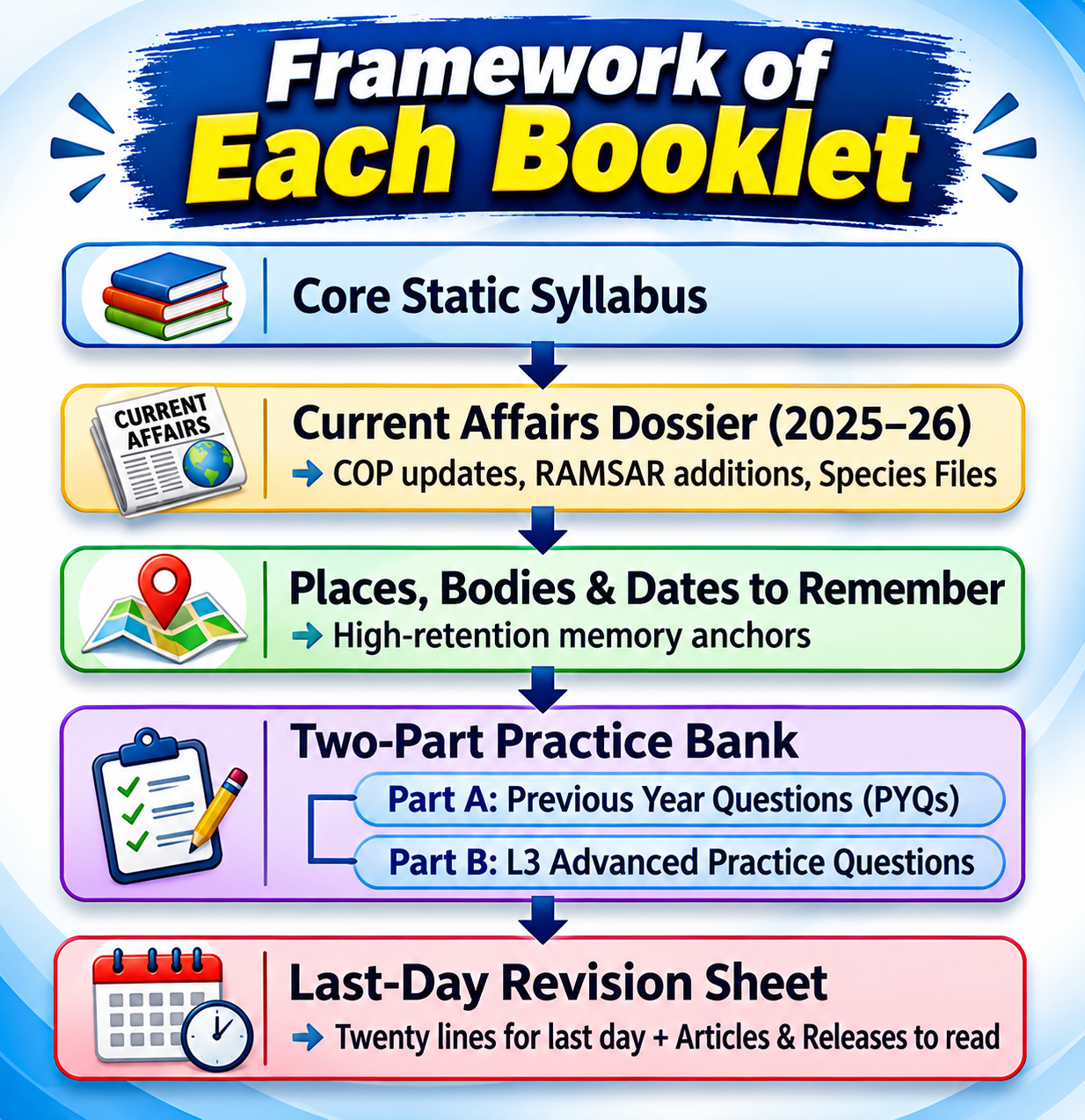
Master the complete UPSC Environment, Ecology, Biodiversity, Climate Change, Energy, Pollution, Governance, and Sustainable Development syllabus with 7 structured PDF booklets, available for instant download directly from your Edukemy student dashboard upon enrollment. Every PDF booklet is built for exam readiness with a Current Affairs Dossier (2025–26), Places/Bodies/Dates to Remember, a two-part Practice Bank (Previous Year Questions + L3 Practice Questions), a dedicated PYQ Compilation, and a Last-Day Revision Sheet (Twenty lines for the last day and Articles/Releases to read).
Key Highlights & Delivery Format
.webp?sv=2017-11-09&sr=b&st=2026-11-24T03:10:47Z&se=2026-11-24T08:15:47Z&sp=r&spr=https&sig=yl0gygCUvoKvo3D6zAhdfw%2F8kaA8V9lNA1xdbX8nl%2Bw%3D)
Master the complete UPSC Environment, Ecology, Biodiversity, Climate Change, Energy, Pollution, Governance, and Sustainable Development syllabus with 7 structured PDF booklets, available for instant download directly from your Edukemy student dashboard upon enrollment. Every PDF booklet is built for exam readiness with a Current Affairs Dossier (2025–26), Places/Bodies/Dates to Remember, a two-part Practice Bank (Previous Year Questions + L3 Practice Questions), a dedicated PYQ Compilation, and a Last-Day Revision Sheet (Twenty lines for the last day and Articles/Releases to read).
Key Highlights & Delivery Format
7 Specialised Digital PDF Booklets: Instant dashboard download access eliminates the need to consult multiple standard textbooks or unorganized notes.
Dedicated Current Affairs Dossiers (2025–26): Every booklet includes integrated, subject-specific current updates (e.g., Climate COP updates, RAMSAR site additions, new Species Files, Energy Transition rules).
Integrated Practice & PYQs: Includes 2-part Practice Banks (Part A – Past Year Questions & Part B – L3 Advanced Practice Questions) inside each PDF booklet.
Last-Day Revision Sheets: Concise "Twenty lines for the last day" and "Articles/Releases to Read" included in every booklet for rapid 24-hour revision before the exam.
Instant Dashboard Access: Access your complete study material immediately after a successful purchase by logging in to edukemy.com with your registered mobile number.
 Details

Complete 7-Booklet Syllabus
Booklet 1: Ecology, Ecosystems, Biogeochemical Cycles & Biomes
Ecology & Ecosystems: Levels of organisation and UPSC vocabulary, structure and components, ecosystem services and natural-capital accounting.
Ecosystem Functions: Productivity and laws of energy flow, grazing and detritus food chains, food webs and ecological pyramids, decomposition, bioconcentration, bioaccumulation, and biomagnification.
Biogeochemical Cycles: Nutrient cycle types, carbon cycle and oxygen link, ocean carbon and ocean acidification, nitrogen cycle and reactive nitrogen, phosphorus, sulphur, and water.
Biomes & Aquatic Ecosystems: Terrestrial biomes of the world; India's forests, grasslands, and deserts; aquatic zones, plankton, and eutrophication; wetlands and Ramsar Convention; mangroves and blue carbon; coral reefs.
Ecological Succession & Population: Ecological succession, population attributes and growth, population interactions.
Included Modules: Current Affairs Dossier 2025–26 (Ecology and Ecosystems), Maps & Places to Remember, Practice Bank (Part A PYQs & Part B L3), PYQ Compilation, and Last-Day Revision Sheet.
Booklet 2: Biodiversity, Conservation, Protected Areas & Laws
Biodiversity Basics: Levels and patterns of biodiversity; hotspots, megadiverse countries, realms, and India's zones.
Threats to Biodiversity: Past and present extinctions, the "evil quartet" and other drivers, wildlife trade and human–wildlife conflict.
In-situ Conservation: In-situ vs. ex-situ, Protected Areas under the Wild Life (Protection) Act, 1972, tiger reserves and Project Tiger, biosphere reserves and MAB programme, elephant reserves, community conservation, World Heritage, and the $30\times30$ goal / OECMs.
Ex-situ Conservation & Species Recovery: Ex-situ conservation, flagship species programmes with latest numbers, and the species file (what UPSC asked and will ask).
Laws, Conventions & Institutions: Wild Life (Protection) Act, 1972 (post-2022 amendment), Biological Diversity Act, 2002 (post-2023 amendment), CBD family, CITES and CMS, IUCN, Red List, and conservation organisations.
Included Modules: Maps & Places to Remember, Current Affairs Dossier 2025–26 (Biodiversity), Practice Bank (Part A PYQs & Part B L3), PYQ Compilation, and Last-Day Revision Sheet.
Booklet 3: Climate Science, Ozone, Climate Change & Global Governance
Climate Science: Greenhouse effect, greenhouse gases, aerosols, black carbon, short-lived climate pollutants, feedbacks, carbon budget, and carbon fertilisation.
The Ozone Layer: Good ozone vs. bad ozone; Montreal–Kigali regime and treaties.
Climate Change Impacts: IPCC conclusions, heat, humidity, and human limits, oceans, ice and sea level, India's vulnerabilities, and tipping points.
Global Climate Governance: UNFCCC and Kyoto Protocol, Paris Agreement, COP26 to COP31, climate finance institutions, REDD+ and forest finance, initiatives, coalitions, and trackers.
Mitigation & India's Climate Policy: Carbon pricing; capture, storage, removal, and geoengineering; India's climate policy architecture.
Included Modules: Current Affairs Dossier 2025–26 (Climate Change), Places, Bodies and Dates to Remember, Practice Bank (Part A PYQs & Part B L3), PYQ Compilation, and Last-Day Revision Sheet.
Booklet 4: Energy Transition, Renewables, Nuclear & Biofuels
Energy Resources & Transition: Classifying energy resources, India's power capacity and targets, grid integration, storage and distributed energy, energy efficiency.
Solar & Wind Energy: Solar power production, India's solar programmes, and wind energy.
Hydro, Ocean, Geothermal & Other Renewables: Hydropower, ocean and geothermal energy, and novel sources and materials.
Nuclear Energy: Basics and India's three-stage programme; capacity, reforms, and small reactors.
Biofuels, Ethanol & Biogas: Types of biofuels, India's ethanol and biofuel policy, biogas and compressed biogas.
Included Modules: Current Affairs Dossier 2025–26 (Energy), Places and Bodies to Remember, Practice Bank (Part A PYQs & Part B L3), PYQ Compilation, and Last-Day Revision Sheet.
Booklet 5: Pollution, Land Degradation, Hazardous Substances & Conventions
Air Pollution: Main pollutants, smog and acid rain, standards, indices, and clean-air programmes.
Water Pollution: Indicators and domestic sewage, drinking water contaminants, treatment and remediation, river cleaning.
Land Degradation, Soil Erosion & Desertification: Soil erosion, desertification, and UNCCD.
Hazardous Substances: Plastics and microplastics, PFAS and persistent organic pollutants (POPs), heavy metals and industrial pollutants, noise and radiation.
Chemical Hazards & Conventions: Industrial and chemical disasters; chemicals and wastes conventions.
Included Modules: Current Affairs Dossier 2025–26 (Pollution and Degradation), Places, Bodies and Dates to Remember, Practice Bank (Part A PYQs & Part B L3), PYQ Compilation, and Last-Day Revision Sheet.
Booklet 6: Environmental Governance, EIA, Forests, Wildlife & Regulators
Constitutional & Legal Framework: The Constitution, core Acts, environmental law principles (Supreme Court and NGT), and recent reforms.
EIA & Clearances: EIA Notification, 2006; post-facto clearance and the Vanashakti episode.
Forest Governance: Forest laws, Forest Rights Act, 2006, forest policy and forest data, afforestation and greening programmes.
Wildlife, Eco-Sensitive Zones & Coastal Regulation: Planning and enforcement for wildlife, eco-sensitive zones and the Western Ghats, coastal regulation.
Regulators & Institutions: National Green Tribunal (NGT), CPCB, CGWA, GEAC, and other regulators.
Included Modules: Current Affairs Dossier 2025–26 (Environmental Governance), Places, Bodies and Dates to Remember, Practice Bank (Part A PYQs & Part B L3), PYQ Compilation, and Last-Day Revision Sheet.
Booklet 7: Sustainable Agriculture, Waste Management, Clean Energy & Global Summits
Sustainable Agriculture & Soil Conservation: Impact of intensive irrigation on soil, soil and water conservation, natural/organic/low-input farming, agroforestry and climate-smart agriculture.
Waste Management & Circular Economy: Waste rules summary table, solid waste management (2016 to 2026), waste-to-energy and treatment technologies, industrial by-products as resources.
Clean-Energy Initiatives: Colours of hydrogen, National Green Hydrogen Mission, fuel cells and alternative powertrains, International Solar Alliance and other alliances.
Sustainable Development: Summit timeline, partnerships, and initiatives.
Global Environmental Reports & Assemblies: Report publishers, assemblies, and new treaties.
Included Modules: Current Affairs Dossier 2025–26 (Agriculture, Waste, Clean Energy and Summits), Places, Bodies and Dates to Remember, Practice Bank (Part A PYQs & Part B L3), PYQ Compilation, and Last-Day Revision Sheet.


Shabbir A Bashir is one of the co-founders of Edukemy and industry’s most lauded professor in UPSC preparation. He has been in the industry...

UPSC Environment Prelims Toolkit (PDF Edition): 7 Digital PDF Booklets for Exam Readiness
Cracking Environment and Ecology in the UPSC Civil Services Preliminary Examination demands targeted, high-yield learning content. With up to 15–20 questions frequently asked from Environment, Ecology, Biodiversity, Climate Change, and Environmental Governance, reliance on outdated textbooks or scattered online notes often leads to preparation gaps.
The Edukemy UPSC Environment Prelims Toolkit (PDF Edition) provides a complete solution: 7 structured, high-yield digital PDF booklets available for instant download directly from your Edukemy course dashboard after logging in with your registered mobile number. Designed by domain experts, these PDF modules bring together core conceptual fundamentals, integrated 2025–26 current affairs, tiered practice banks, and swift last-day revision frameworks into a single unified toolkit.
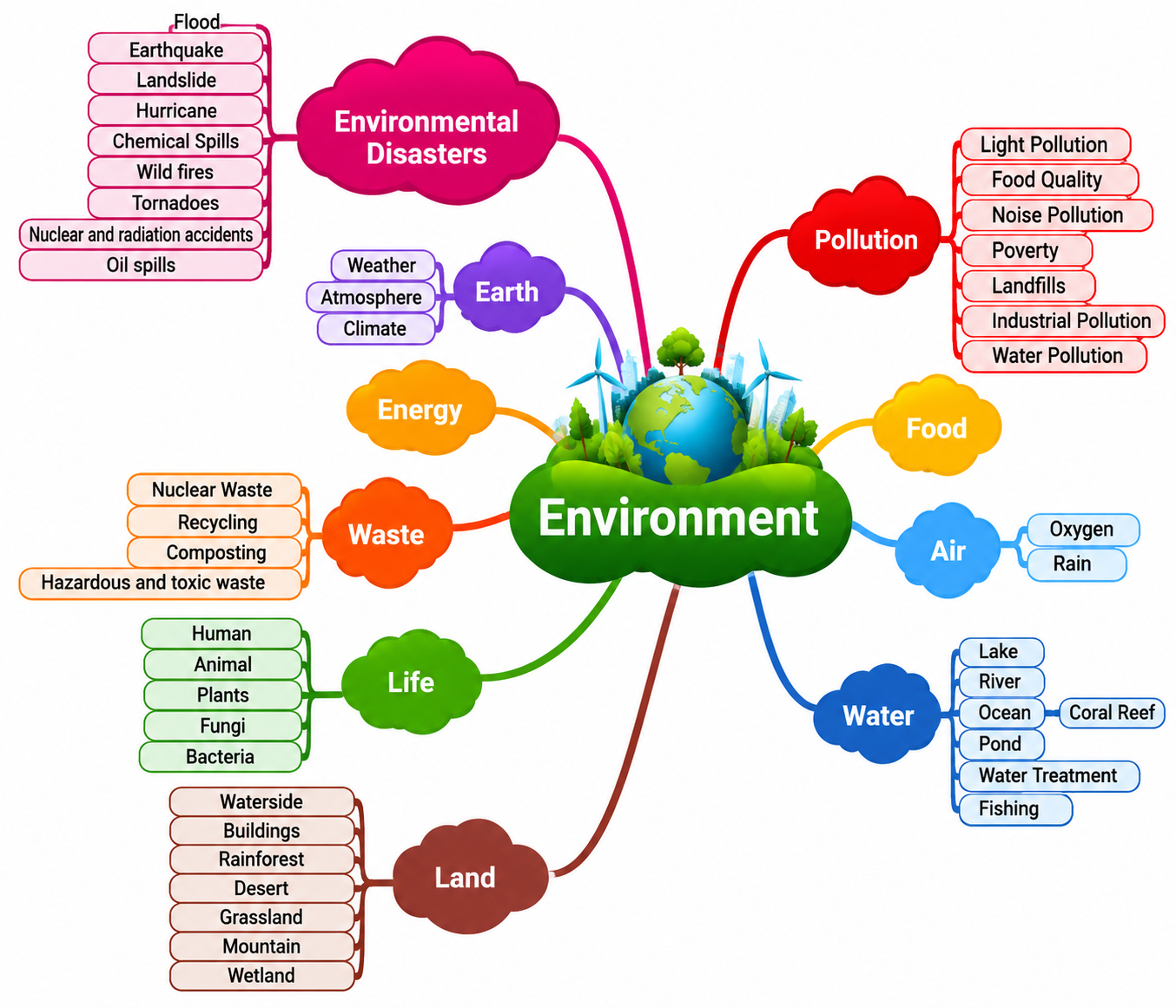
Architectural Overview: Breakdown of the 7 Thematic Booklets
| Booklet Theme | Core Coverage & Focus Areas | Current Affairs & Practice Modules |
| 1. Basic Ecology & Ecosystems | Ecosystem dynamics, trophic levels, nutrient cycles, biomes, and ecological succession | Current Affairs Dossier (2025–26), Places & Dates to Remember, PYQ Bank |
| 2. Biodiversity & Conservation | Flora & fauna classification, endangered species, national parks, wildlife sanctuaries, and biosphere reserves | Updated Species Files, IUCN Red List Updates, L3 Practice Questions |
| 3. Climate Change & Global Warming | Greenhouse gas kinetics, IPCC reports, carbon sinks, ocean acidification, and mitigation strategies | Climate COP Updates, Global Carbon Market developments, PYQ Compilation |
| 4. Environmental Governance & Laws | Environment Protection Act 1986, Wildlife Protection Act (Amendments), Forest Conservation Rules, and Biological Diversity Act | Recent Judicial Rulings, Statutory Body Releases, Practice Bank (Part A & B) |
| 5. International Conventions & Treaties | UNFCCC, CBD, CITES, RAMSAR Convention, Montreal Protocol, and Basel/Stockholm Conventions | New RAMSAR Site Additions, COP Decisions, Places/Bodies to Remember |
| 6. Environmental Pollution & Energy Transition | Air/Water/Soil/E-waste management, renewable energy policies, green hydrogen, and EV roadmaps | Energy Transition Rules (2025–26), Air Quality Index updates, L3 Practice |
| 7. Sustainable Development & Agriculture | Climate-resilient agriculture, organic farming, soil health, water conservation, and ESG frameworks | Government Schemes (2025–26), Last-Day Revision Sheets (20 Lines) |
Why Choose the UPSC Environment Prelims Toolkit (PDF Edition)?
Instant Dashboard Access & Downloadable PDFs: Access and download all 7 structured PDF booklets immediately from your course dashboard on edukemy.com after logging in with your registered mobile number.
Flexible Digital Study & Print Convenience: Keep searchable PDFs handy on your tablet or laptop for quick reference, or print specific sections and revision sheets as needed without waiting for shipping delays.
Up-to-Date Current Affairs (2025–26): Subject-specific Current Affairs Dossiers (2025–26) are embedded into each booklet, ensuring seamless integration of static concepts with recent developments.
Tiered Practice Architecture: Every module features a two-part Practice Bank (Part A: PYQs; Part B: L3) alongside a dedicated PYQ Compilation to build exam accuracy and analytical depth.
Rapid 24-Hour Exam Revision: Includes specialized Last-Day Revision Sheets ("Twenty lines for the last day" and "Articles and releases to read") designed for quick memory recovery right before Prelims.
Frequently Asked Questions (FAQs):
Q1. What is the UPSC Environment Prelims Toolkit (PDF Edition) by Edukemy?
The UPSC Environment Prelims Toolkit (PDF Edition) is a digital preparation package consisting of 7 structured PDF booklets covering the complete UPSC Environment, Ecology, Biodiversity, Climate Change, Energy, Pollution, Governance, and Sustainable Development syllabus.
Q2. How do I access and download the PDFs after purchase?
After a successful purchase, log in to edukemy.com using your registered mobile number. You can then access and download all 7 PDF booklets directly from your course dashboard.
Q3. Are physical hardcopy booklets shipped with this course?
No, this edition provides the notes in digital PDF format via your course dashboard rather than physical courier delivery.
Q4. How recent is the current affairs coverage inside the booklets?
Every booklet features a dedicated Current Affairs Dossier (2025–26) tailored to that booklet's theme—covering areas such as ecology and ecosystems, biodiversity, climate change, energy, pollution and degradation, environmental governance, and agriculture, waste, clean energy, and summits.
Q5. What is included in the Practice Bank of each booklet?
Each booklet includes a Practice Bank divided into Part A (PYQs) and Part B (L3) practice questions, along with a dedicated PYQ Compilation.
Q6. How do the "Last-Day Revision Sheets" assist right before the exam?
Each booklet includes a Last-Day Revision Sheet featuring concise notes ("Twenty lines for the last day") and "Articles and releases to read" to help streamline final revision before the Prelims exam.
Q7. Are international conventions, treaties, and environmental laws covered?
Yes, key laws, conventions, governance frameworks, and treaties—including the Wild Life (Protection) Act, 1972 (post-2022 amendment), Biological Diversity Act, 2002 (post-2023 amendment), Forest Rights Act, 2006, EIA Notification, 2006, UNFCCC, Kyoto Protocol, Paris Agreement, COP26 to COP31, CBD, CITES, CMS, Ramsar Convention, Montreal–Kigali regime, UNCCD, and chemicals/wastes conventions—are covered across the relevant booklets.
Q8. Are these PDF booklets suitable for self-study candidates without a science background?
Yes, each booklet starts with foundational concepts and progresses systematically to applied topics, governance, and current affairs, making it structured and accessible for aspirants from diverse academic backgrounds.
Q9. How does this toolkit consolidate UPSC Environment preparation?
Instead of piecing together multiple reference books, scattered articles, and separate current affairs notes, the 7 booklets organize core topics, maps/places/bodies/dates to remember, 2025–26 current affairs, PYQs, L3 practice questions, and last-day revision sheets into a single structured syllabus sequence.
Q10. What environmental places, bodies, and dates are highlighted in the notes?
Depending on the booklet, dedicated sections highlight Maps & Places to Remember or Places, Bodies and Dates to Remember, alongside regulators and institutions such as NGT, CPCB, CGWA, GEAC, IUCN, and global environmental bodies and reports.
Q11.How can I test my Environment & Ecology preparation with live mock tests and AI tracking?
To validate your conceptual mastery and apply what you've revised, combine this toolkit with the UPSC Prelims Support Program with Test Series. The program pairs your static and dynamic environmental revision with daily micro-topic MCQs, weekly sectional tests, 1-on-1 personalized mentorship, and AI-powered performance analytics to minimize negative marking in the Prelims exam.


