Mastering Geography for the UPSC Civil Services Preliminary Examination requires more than just memorizing standard NCERTs—it demands spatial clarity, current affairs integration, and rapid elimination techniques.
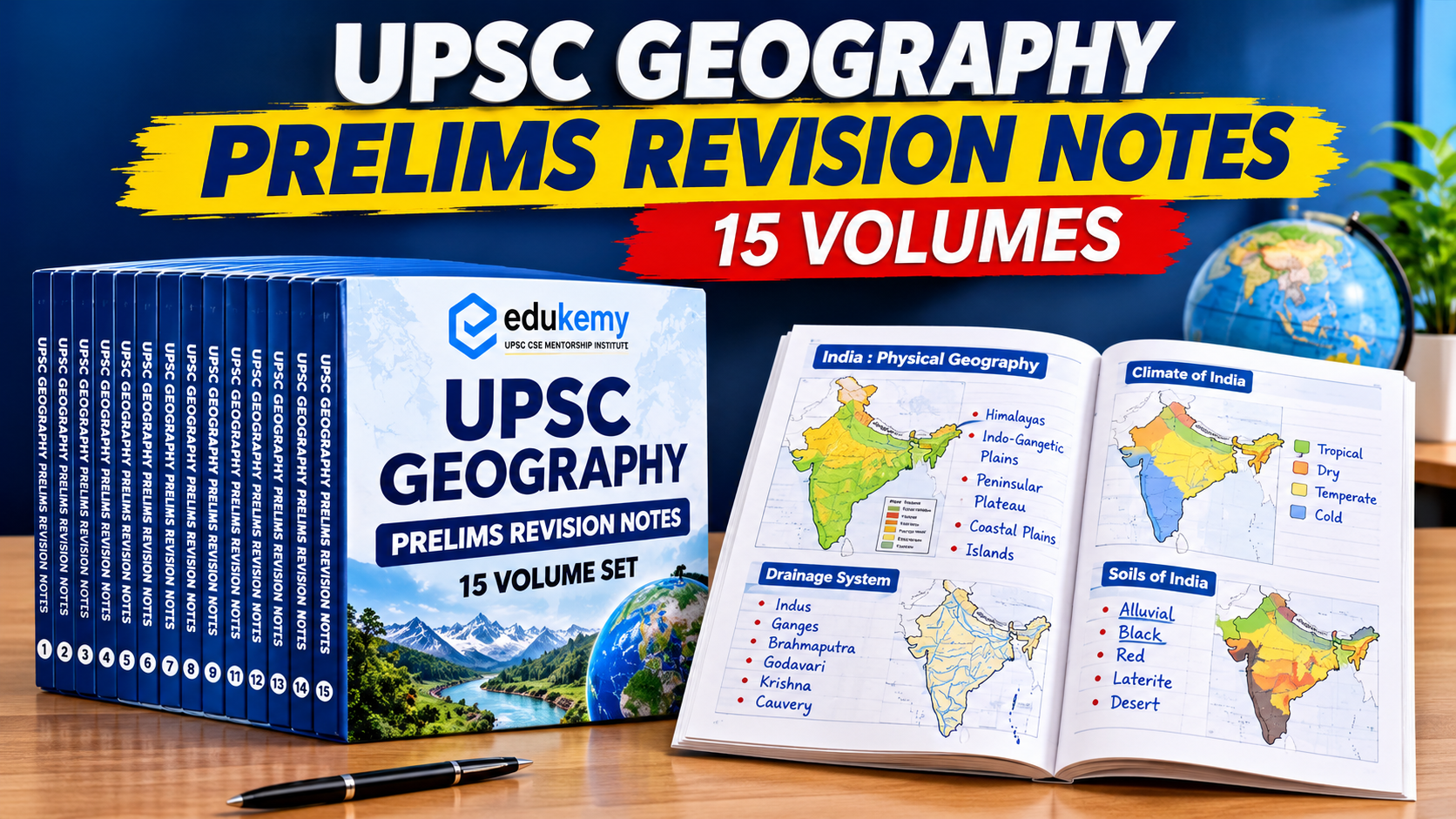
The UPSC Geography Prelims Revision Notes is a comprehensive, exam-engineered 15-volume physical revision series designed to streamline your preparation. Spanning Physical, Indian, Human, Economic, and World Regional Geography, this 15-booklet suite bridges foundational concepts with recent 2025–26 developments, map-based mnemonics, and multi-tiered practice banks.
Delivered as high-quality printed physical booklets straight to your doorstep, this series eliminates digital PDF fatigue, enabling structured multi-pass revision and seamless active recall right up to exam day.
Core Highlights & What Makes This Series Unique
Who Should Enroll / Buy This Kit?
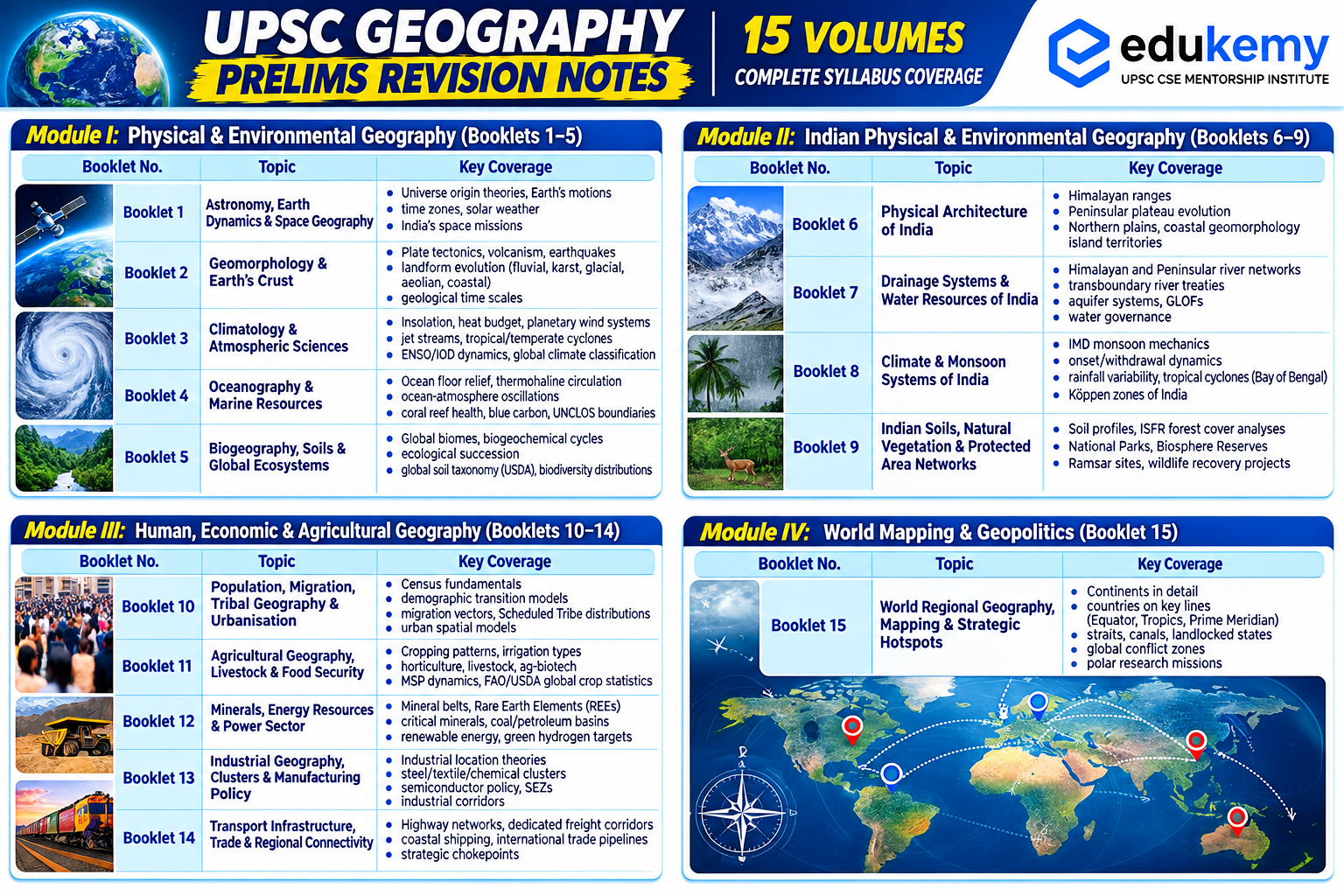
15 VOLUMES. 4 MODULES. COMPLETE GEOGRAPHY.
MODULE I — PHYSICAL & ENVIRONMENTAL GEOGRAPHY
01. Astronomy & Space — Universe, Earth & Space Missions
02. Geomorphology — Landforms, Tectonics & Earthquakes
03. Climatology — Winds, Cyclones & Climate Systems
04. Oceanography — Oceans, Currents & Marine Resources
05. Biogeography — Ecosystems, Soils & Biodiversity
MODULE II — INDIAN GEOGRAPHY
06. Physical India — Himalayas, Plains, Plateaus & Coasts
07. Drainage & Water — Rivers, Aquifers & Water Treaties
08. Indian Climate — Monsoon, Rainfall & Cyclones
09. Indian Environment — Forests, Soils & Protected Areas
MODULE III — HUMAN & ECONOMIC GEOGRAPHY
10. Population & Urbanisation — Demography, Migration & Tribes
11. Agriculture — Cropping, Irrigation & Food Security
12. Minerals & Energy — Critical Minerals & Renewables
13. Industrial Geography — Industries, Clusters & Corridors
14. Transport & Trade — Connectivity & Strategic Routes
MODULE IV — WORLD MAPPING & GEOPOLITICS
15. World Geography — Global Mapping, Straits, Conflicts & Strategic Hotspots
 Details

Module-Wise Syllabus Breakdown (15 Printed Volumes)
Module I: Physical & Environmental Geography (Booklets 1–5)
Booklet 1: Astronomy, Earth Dynamics & Space Geography — Universe origin theories, Earth's motions, time zones, solar weather, and India's space missions.
Booklet 2: Geomorphology & Earth's Crust — Plate tectonics, volcanism, earthquakes, landform evolution (fluvial, karst, glacial, aeolian, coastal), and geological time scales.
Booklet 3: Climatology & Atmospheric Sciences — Insolation, heat budget, planetary wind systems, jet streams, tropical/temperate cyclones, ENSO/IOD dynamics, and global climate classification.
Booklet 4: Oceanography & Marine Resources — Ocean floor relief, thermohaline circulation, ocean-atmosphere oscillations, coral reef health, blue carbon, and UNCLOS maritime boundaries.
Booklet 5: Biogeography, Soils & Global Ecosystems — Global biomes, biogeochemical cycles, ecological succession, global soil taxonomy (USDA), and biodiversity distributions.
Module II: Indian Physical & Environmental Geography (Booklets 6–9)
Booklet 6: Physical Architecture of India — Himalayan ranges, Peninsular plateau evolution, Northern plains, coastal geomorphology, and island territories.
Booklet 7: Drainage Systems & Water Resources of India — Himalayan and Peninsular river networks, transboundary river treaties, aquifer systems, GLOFs, and water governance.
Booklet 8: Climate & Monsoon Systems of India — IMD monsoon mechanics, onset/withdrawal dynamics, rainfall variability, tropical cyclones breeding in the Bay of Bengal, and Köppen zones of India.
Booklet 9: Indian Soils, Natural Vegetation & Protected Area Networks — Soil profiles, ISFR forest cover analyses, National Parks, Biosphere Reserves, Ramsar sites, and wildlife recovery projects.
Module III: Human, Economic & Agricultural Geography (Booklets 10–14)
Booklet 10: Population, Migration, Tribal Geography & Urbanisation — Census fundamentals, demographic transition models, migration vectors, Scheduled Tribe distributions, and urban spatial models.
Booklet 11: Agricultural Geography, Livestock & Food Security — Cropping patterns, irrigation types, horticulture, livestock, ag-biotech, MSP dynamics, and FAO/USDA global crop statistics.
Booklet 12: Minerals, Energy Resources & Power Sector — Mineral belts, Rare Earth Elements (REEs), critical minerals, coal/petroleum basins, renewable energy, and green hydrogen targets.
Booklet 13: Industrial Geography, Clusters & Manufacturing Policy — Industrial location theories, steel/textile/chemical clusters, semiconductor policy, SEZs, and industrial corridors.
Booklet 14: Transport Infrastructure, Trade & Regional Connectivity — Highway networks, dedicated freight corridors, coastal shipping, international trade pipelines, and strategic chokepoints.
Module IV: World Mapping & Geopolitics (Booklet 15)
Booklet 15: World Regional Geography, Mapping & Strategic Hotspots — Continents in detail, countries on key lines (Equator, Tropics, Prime Meridian), straits, canals, landlocked states, global conflict zones, and polar research missions.


Shabbir A Bashir is one of the co-founders of Edukemy and industry’s most lauded professor in UPSC preparation. He has been in the industry...

Master UPSC Geography Edukemy’s 15-Volume Prelims Revision Notes
Mastering Geography for the UPSC Civil Services Preliminary Examination requires more than just memorizing standard NCERTs—it demands spatial clarity, current affairs integration, and rapid elimination techniques.
The UPSC Geography Prelims Revision Notes is an exam-engineered, 15-volume physical revision series designed to streamline your preparation from foundational concepts to advanced preliminary practice. Spanning Physical, Indian, Human, Economic, and World Regional Geography, this comprehensive suite bridges static core concepts with recent 2025–26 developments, map-based mnemonics, and multi-tiered practice banks. Delivered as high-quality printed booklets straight to your doorstep, this series eliminates digital PDF fatigue, enabling structured multi-pass revision right up to exam day.
UPSC Geography Prelims Revision Notes – Module-Wise Syllabus Breakdown
The syllabus is organised into 4 modules covering 15 booklets, with each booklet's major topics listed below.
|
Booklet |
Subject / Topic |
Key Areas Covered |
|---|---|---|
|
1 |
Astronomy, Earth Dynamics & Space Geography |
Universe origin theories, Earth's motions, time zones, solar weather, India's space missions |
|
2 |
Geomorphology & Earth's Crust |
Plate tectonics, volcanism, earthquakes, fluvial, karst, glacial, aeolian and coastal landforms, geological time scales |
|
3 |
Climatology & Atmospheric Sciences |
Insolation, heat budget, planetary winds, jet streams, tropical and temperate cyclones, ENSO/IOD, global climate classification |
|
4 |
Oceanography & Marine Resources |
Ocean floor relief, thermohaline circulation, ocean-atmosphere oscillations, coral reefs, blue carbon, UNCLOS maritime boundaries |
|
5 |
Biogeography, Soils & Global Ecosystems |
Global biomes, biogeochemical cycles, ecological succession, USDA soil taxonomy, biodiversity distributions |
|
Booklet |
Subject / Topic |
Key Areas Covered |
|---|---|---|
|
6 |
Physical Architecture of India |
Himalayan ranges, Peninsular plateau evolution, Northern plains, coastal geomorphology, island territories |
|
7 |
Drainage Systems & Water Resources of India |
Himalayan and Peninsular rivers, transboundary river treaties, aquifer systems, GLOFs, water governance |
|
8 |
Climate & Monsoon Systems of India |
IMD monsoon mechanics, onset and withdrawal, rainfall variability, Bay of Bengal cyclones, Köppen climate zones |
|
9 |
Indian Soils, Natural Vegetation & Protected Area Networks |
Soil profiles, ISFR forest cover, National Parks, Biosphere Reserves, Ramsar sites, wildlife recovery projects |
|
Booklet |
Subject / Topic |
Key Areas Covered |
|---|---|---|
|
10 |
Population, Migration, Tribal Geography & Urbanisation |
Census fundamentals, demographic transition models, migration vectors, Scheduled Tribe distributions, urban spatial models |
|
11 |
Agricultural Geography, Livestock & Food Security |
Cropping patterns, irrigation, horticulture, livestock, agri-biotech, MSP dynamics, FAO/USDA crop statistics |
|
12 |
Minerals, Energy Resources & Power Sector |
Mineral belts, Rare Earth Elements (REEs), critical minerals, coal and petroleum basins, renewable energy, green hydrogen targets |
|
13 |
Industrial Geography, Clusters & Manufacturing Policy |
Industrial location theories, steel/textile/chemical clusters, semiconductor policy, SEZs, industrial corridors |
|
14 |
Transport Infrastructure, Trade & Regional Connectivity |
Highway networks, dedicated freight corridors, coastal shipping, international trade pipelines, strategic chokepoints |
|
Booklet |
Subject / Topic |
Key Areas Covered |
|---|---|---|
|
15 |
World Regional Geography, Mapping & Strategic Hotspots |
Continents, countries along Equator, Tropics and Prime Meridian, straits, canals, landlocked states, global conflict zones, polar research missions |
Frequently Asked Questions (FAQs):
Qs. What is included in the Edukemy UPSC Geography Prelims Revision Notes kit?
Answer: The kit is a comprehensive 15-volume physical revision series covering Physical, Indian, Human, Economic, and World Regional Geography integrated with 2025–26 current affairs dossiers and mapping mnemonics.
Qs. Are these revision notes available as digital PDFs or physical books?
Answer: These notes are delivered exclusively as 15 physical printed booklets via courier/speed post to prevent screen fatigue and facilitate active pencil annotations.
Qs. How are current affairs integrated into these geography revision booklets?
Answer: Each volume includes updated dynamic dossiers covering recent developments such as ISFR forest reports, updated Ramsar sites, Critical Minerals policy updates, and geopolitical conflict zones.
Qs. Do these notes contain practice questions for UPSC Prelims?
Answer: Yes, the series features two-tiered practice banks with 1,000+ chapter-wise Previous Year Questions (UPSC CSE 1979–2026, CDS, NDA, CAPF) alongside Level 2 & 3 practice questions.
Qs. What are "Trap Alerts" and "Memory Aids" in this series?
Answer: "Trap Alerts" highlight recurring examiner tricks and confusing statement pairs, while "Memory Aids" and spatial mnemonics help aspirants eliminate options quickly under timed exam conditions.
Qs. Are these booklets suitable for State PSC examinations?
Answer: Absolutely. The dense factual coverage, detailed mapping features, and PYQ banks make this kit ideal for State Civil Services examinations requiring high factual recall.
Qs. How do these booklets help during the last 48 hours before the Prelims exam?
Answer: Every volume ends with an ultra-condensed "20-Line Last-Day Revision Sheet" specifically designed for rapid memory recall during the final 48 hours before the exam.
Qs. Does this series cover World Mapping and geopolitical conflict hotspots?
Answer: Yes, Booklet 15 is entirely dedicated to World Regional Geography, detailing continents, key latitude lines, ocean chokepoints, landlocked countries, and active conflict zones.
Qs. Can candidates preparing for UPSC Mains benefit from these notes?
Answer: Yes, while engineered for Prelims, the series builds conceptual linkages across spatial resource distributions, environmental governance, and economic geography vital for Mains.
Qs. How long does it take for the 15 booklets to be delivered after ordering?
Answer: Once ordered, the physical 15-booklet suite is dispatched via courier/speed post directly to your registered delivery address.
Qs. How can I integrate these Geography Revision Notes with a complete test series and mentorship?
Answer: To combine your static revision with disciplined mock practice and expert guidance, pair these notes with the UPSC Prelims Support Program with Test Series. This year-long ecosystem offers daily micro-topic MCQs, weekly sectional and full-length tests, 1-on-1 personalized mentorship, and AI-driven performance analytics to ensure complete exam readiness alongside your subject revision.


