
24 Feb to 10 Mar, 2026
DOUBLE INCOME NO KIDS - 10 March 2026
Why in news: Double-Income-No-Kids – problem is a worldwide phenomenon; and it has serious economic and societal ramifications.
About:
Dual income, no kids" (DINK) is a slang phrase for a household in which there are two people earning incomes and no children. Couples living in a DINK household frequently have more disposable income because they do not have the added expenses that come with children. They also often spend less per person on housing than singles because of their ability to share kitchens, bathrooms, and living rooms.
Factors Driving this Trend
- Economic Considerations: The rising cost of living and economic instability discourage childbearing. Eg. Cities like San Francisco, London, Mumbai and Sydney, are known for high real estate prices coupled with high living costs. According to a 2019 survey by CNBC, 64% of millennials report that they have regrets about buying their current homes, primarily because of the hidden costs associated with mortgages and maintenance that could have been mitigated in child-free scenarios.
- Career Prioritization: Study by Pew Research Center highlights that childlessness among women at the end of their childbearing years who hold a Ph.D. is about 30%, which is significantly higher compared to the general population.
- Lifestyle Preferences: Child-free couples often engage in extensive travel, cultural activities, and social events that might be restrictive with children. The growing trend of "experience economy" where experiences are valued over possessions resonates strongly with DINK households.
- Environmental Concerns : Some couples choose not to have children as a personal response to global overpopulation, climate change, and sustainability concerns. In a 2018 survey by the Morning Consult for The New York Times, one of the reasons 33% of surveyed individuals opted out of parenthood was because of climate change.
- Social and Cultural Shifts : Cultural icons and public figures openly embracing child-free lifestyles can validate this choice for others.Celebrities like Oprah Winfrey and Ellen DeGeneres, who have spoken publicly about choosing not to have children, illustrate how societal norms are evolving.
Types of DINKs
There are several situations that can be considered "dual-income, no kids."
- Couples Who Choose Not to Have Children
- Couples Who Cannot Have Children ( Including Gay Couples )
- New Couples: New couples living together may have children one day, but until then they can enjoy a "dual income, no kids" situation.
- Empty Nesters : After the children have grown up and moved out, couples may become part of the dual income, no kids demographic again.
Traps in which DINK couples are falling in
- Overspending: Typically, a household with children or other dependants is able to save 20-30%. Couples with no kids have the potential to save way more than they spend, but often they save about 10-15% of their income. This over-indulgence is largely because couples with fewer financial responsibilities can afford to spend more.
- Wrong investments: Sometimes dink families may have more exposure to real estate than what they require. You must own the house you live in; a second investment in real estate is not recommended. Real estate is not liquid and you end up spending money to maintain it. You also need to think about why you need so many houses or plots. Instead, the funds should be put away in financial investments so that money is readily available to be used.
- Lack of a long-term vision: People in general don’t have the ability to think too much into the future. Children are the driving force that gets people to think and plan for the future. “Most dink couples tend to live in the present. When we look at their lifestyle needs post-retirement we see a huge gap, because most in their working years focus on a lavish lifestyle without saving enough to make sure they are able to sustain it during retirement too.
- Emergency funds: In the short term, the most important goal to achieve is to create an emergency fund. You may not have any financial dependants, but a job loss may set you back financially.
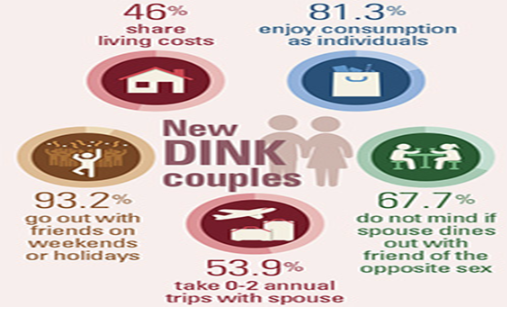
Consequences
- Economic Growth and Consumer Spending: DINK households contribute positively to economic growth through higher consumer spending and investment.A 2021 report from the U.S. Bureau of Labor Statistics highlighted that child-free households spend approximately 25% more on discretionary expenses compared to households with children.
- Labor Market and Workplace Dynamics: Without parental responsibilities, individuals in DINK households may pursue further education, accept jobs with irregular hours, or take on high-travel roles, which can lead to faster career advancement and higher earnings. According to LinkedIn's 2020 Workforce Report, child-free professionals are overrepresented in leadership positions and high-skill sectors like technology and finance, where time flexibility and commitment are highly valued.
- Urbanization and Housing Markets: DINK households are a key market for luxury condominiums and urban renewal projects, preferring amenities-rich environments close to cultural, gastronomic, and entertainment options.Real estate analysis indicates that properties in urban centers with amenities like gyms, communal spaces, and proximity to nightlife tend to attract more DINK buyers, pushing up property values and rents.
- Social and Cultural Impacts: Communities with higher numbers of DINK couples may see a shift in local politics, community planning, and social activities that traditionally revolve around families with children.
- Demographic Shifts and Aging Population: As birth rates decline due to more couples choosing not to have children, countries like Japan and Germany face challenges such as labor shortages, increasing dependency ratios, and pressures on pensions and healthcare systems designed for younger populations.
Strategies to mitigate the trend of rising DINK couples
- Incentivize Parenthood: France has successfully increased its birth rate through comprehensive family support policies, including parental leave, family allowances, and subsidized childcare.
- Retirement Planning Adjustments: Japan is adjusting its pension schemes and promoting private retirement savings plans to cope with its aging population.
- Diversify Housing Options: Singapore’s mixed-use residential planning caters to both family-oriented and singles-focused lifestyles.
- Public Awareness Campaigns: South Korea’s government campaigns to promote the joys and societal benefits of raising children.
- Community Engagement Programs: Australia’s community-based programs that involve all residents in local decision-making, regardless of family status.
- Tax Reforms: Progressive tax systems in Scandinavian countries where tax contributions are balanced fairly among different family structures.
- Invest in Health Technology and Elder Care: Japan’s investment in robotics and AI to care for an aging population.
Conclusion
The DINK phenomenon necessitates thoughtful consideration and proactive strategies across economic, social, and policy spheres. By embracing diversity in household forms and preparing for future demographic shifts with inclusive and sustainable policies, societies can harness the potential benefits while mitigating the challenges posed by increasing numbers of DINK households. These initiatives must be supported by data-driven approaches and public engagements to ensure they meet the nuanced needs of all citizens.
Source:
Where to use ?
Paper II ( Geography Optional ) : Population Geography
Paper I ( General Studies ) : Population and demographic issues
INDUSTRIAL CORRIDOR DEVELOPMENT PROGRAMME
Why in news: The Union Budget 2026–27 has accelerated India’s infrastructure push by prioritising the National Industrial Corridor Development Programme (NICDP) and announcing an Integrated East Coast
Industrial Corridor with a key node at Durgapur, West Bengal, to strengthen the Purvodaya initiative.
About:
- The concept of industrial corridors closely aligns with **Growth Pole Theory proposed by François Perroux. According to this theory, economic development does not occur uniformly but emerges around dynamic nodes or “poles” where key industries concentrate.
Cumulative Causation and Regional Development
Industrial corridors also reflect **Cumulative Causation theory advanced by Gunnar Myrdal. According to this concept, development processes are self-reinforcing.
When a corridor develops:
- Industries attract skilled labour.
- Skilled labour attracts service sectors.
- Better services attract further investment.
This creates a “virtuous cycle” of growth.In contrast, Myrdal also warned about “backwash effects”, where growth in one region drains resources from neighbouring regions. Therefore, balanced corridor planning is essential to ensure spread effects rather than regional polarization.
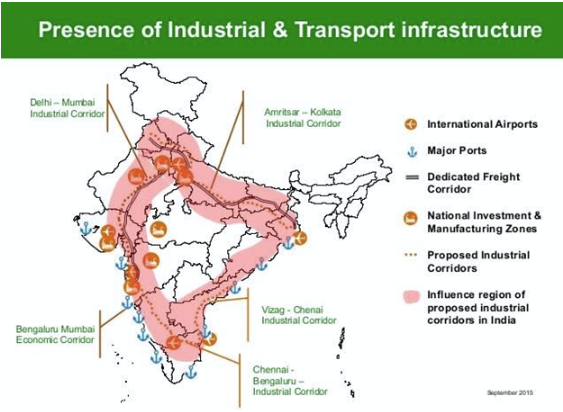
Connectivity and Spatial Integration
Industrial corridors depend heavily on multi-modal connectivity—highways, railways, ports, and logistics hubs.
Geographically, this reflects the concept of spatial interaction, where economic flows increase when transportation costs decrease.
Examples include:
- **Golden Quadrilateral highway network improving freight movement.
Diffusion of Growth
From the perspective of spatial diffusion, industrial corridors promote the spread of innovation, technology, and investment.
According to Torsten Hägerstrand’s diffusion theory, development spreads outward from core areas through networks and interactions.
Industrial corridors facilitate this diffusion through:
- Industrial clusters
- Technology parks
- Skill development centres
- Urban-industrial nodes
Forward and Backward Linkages
Industrial corridors also operate through **Forward and Backward Linkages, a concept developed by Albert O. Hirschman.
- Backward linkages: Industries stimulate demand for raw materials and intermediate goods.
- Example: Steel plants generate demand for iron ore, coal, machinery, and transportation services.
- Forward linkages: Industrial outputs create opportunities for downstream industries.
- Example: Steel production supports automobile, infrastructure, and construction industries.
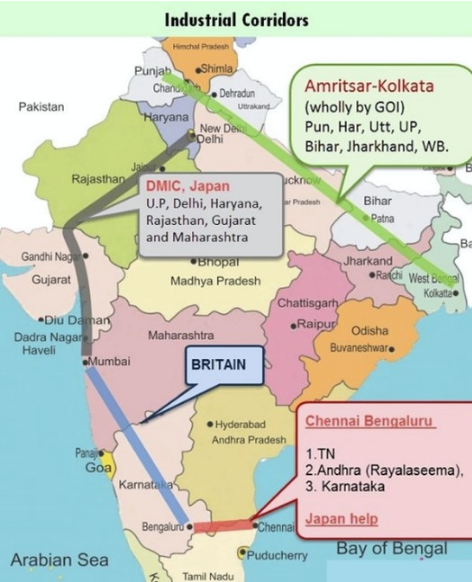
Agglomeration Economies and Industrial Clusters
Industrial corridors foster agglomeration economies, where firms benefit from proximity to each other.
Advantages include:
- Shared infrastructure
- Skilled labour pools
- Knowledge spillovers
- Reduced transportation costs
This idea resonates with the industrial location theories of Alfred Weber, which emphasise cost minimization in industrial location.
Conclusion
Industrial corridors represent a geographical strategy of spatial economic transformation. By integrating infrastructure, industrial clusters, and urban development, they function as growth poles that generate cumulative development effects. Through enhanced connectivity, diffusion of innovation, and strong forward and backward linkages, corridors can reshape regional economic landscapes
Where to use ?
Paper II ( Geography Optional ) : Industrial corridors
Source :
https://www.pib.gov.in/PressReleasePage.aspx?PRID=2232996®=3&lang=2
GREAT NICOBAR PROJECT - 10 March 2026
Why in news: The National Green Tribunal (NGT) has approved the Rs 81,000-crore Great Nicobar project, stating that it found “no good ground” to intervene, while imposing stringent conditions to safeguard the environment.
About:
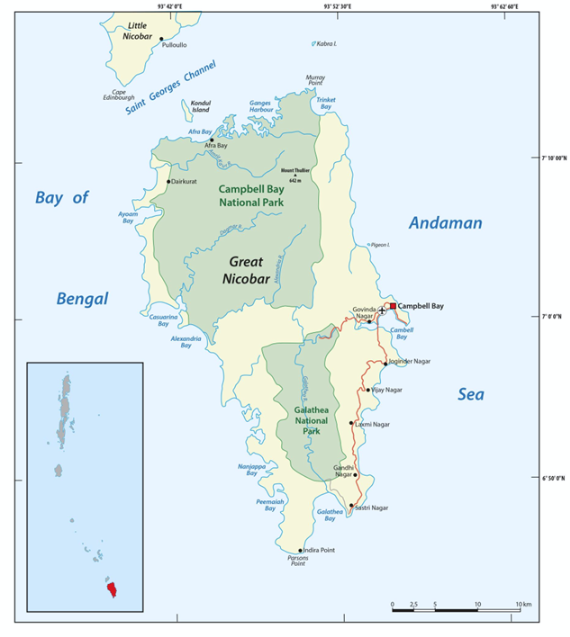
- The Holistic Development of Great Nicobar Island is a ₹72,000-crore mega infrastructure project approved in 2021 to transform **Great Nicobar Island into a strategic economic hub near the **Strait of Malacca, a route carrying nearly 25% of global trade.
- Conceived by **NITI Aayog and implemented by **Andaman and Nicobar Islands Integrated Development Corporation Limited, the project follows a 30-year phased plan. It aims to develop a greenfield coastal city across 166 sq km (≈10% of the island’s area), partly involving denotification of tribal reserves of the **Shompen Tribe and **Nicobarese People
Core Infrastructure Components
The project integrates multiple economic and transport infrastructures:
- International Container Transshipment Terminal (ICTT) at **Galathea Bay
- Intended to rival regional hubs such as **Singapore.
- Could reduce India’s dependence on foreign transshipment ports.
- Greenfield International Airport
- 3,300-m runway capable of handling wide-body aircraft and defence operations.
- Hybrid Energy System
- 450 MVA gas-solar power plant ensuring energy self-sufficiency.
- Urban Township
- Planned settlement to support logistics and industrial workforce.
Additional infrastructure includes a cruise terminal, ship-breaking yard, and coastal transport corridor, creating an integrated maritime economic zone.
Strategic and Economic Importance
The project has strong economic-geographical and geopolitical significance.
- Maritime Trade Hub: The ICTT can capture transshipment traffic in the eastern Indian Ocean.
- Strategic Surveillance: Enhances India’s ability to monitor critical sea lanes such as the **Sunda Strait, **Lombok Strait and **Ombai-Wetar Strait.
- Connectivity Strategy: Supports India’s **Sagarmala Programme and **Maritime India Vision 2030 by strengthening coastal economic infrastructure.
- Regional Integration: Enhances India’s Act East policy by improving connectivity with Southeast Asia and the **BIMSTEC region.
Economic projections suggest the port could generate ₹30,000 crore annually by 2040 and create around 50,000 jobs.
Growth Pole and Regional Development
The project aims to transform Great Nicobar into a regional growth pole.
According to **Growth Pole Theory (by **François Perroux), economic development begins at strategic nodes and diffuses to surrounding regions.
In this context:
- The transshipment port acts as the core industrial node.
- Maritime services, logistics, tourism, and manufacturing create forward and backward linkages.
- Development spreads across the Bay of Bengal and BIMSTEC region.
The project also reflects **Cumulative Causation (by **Gunnar Myrdal), where infrastructure attracts investment, leading to further economic growth.
Environmental and Social Challenges
Biodiversity Risks
Great Nicobar has 85% forest cover and rich biodiversity with nearly 200 bird species, including the **Nicobar Megapode. Large-scale deforestation may threaten endemic ecosystems.
Marine Ecosystem Damage
**Galathea Bay is a nesting site for the **Leatherback Sea Turtle. Port dredging and coral reef destruction could disrupt marine food chains.
Natural Disaster Vulnerability
Mangroves in Galathea Bay function as natural tsunami barriers. Their removal may increase vulnerability, especially since the island lies in a seismically active zone.
Governance and Legal Issues
- Dilution of Coastal Regulation Zone norms raises transparency concerns.
- Alleged bypassing of **Forest Rights Act, 2006 weakens tribal safeguards.
Tribal Displacement
Denotification of reserves threatens the cultural survival of Shompen and Nicobarese PVTGs.
Conclusion
The Great Nicobar Project represents a strategic attempt to integrate maritime geography, economic development, and geopolitical security in the Indo-Pacific. By leveraging its location near the Malacca Strait, the island could evolve into a transshipment hub and growth pole for the BIMSTEC region. However, balancing economic ambitions with ecological sustainability and tribal rights remains crucial for ensuring long-term viability.
Where to use ?
Paper II ( Geography Optional ) : Regional Planning
Source:
‘Bee Corridors
‘Bee Corridors: Bee corridors are connected strips of flowering plants created to help bees and other pollinators move safely between habitats. Urbanization and intensive agriculture often fragment natural habitats, reducing pollination. These corridors provide continuous food and shelter, improving pollinator survival and crop productivity. For example, planting wildflower strips along roads or farms helps maintain pollination services essential for crops like almonds, apples, and mustard.
Katabatic winds
Katabatic winds: Katabatic winds are cold, dense air currents that flow downhill from elevated regions such as mountains, glaciers, or ice sheets due to gravity. As air cools over high surfaces, it becomes heavier and moves downslope toward valleys. These winds are common in polar regions like Antarctica. A famous example is the strong katabatic winds descending from the Antarctic Plateau toward coastal areas, often reaching very high speeds.
Feedback loop
Feedback loop: A feedback loop is a process where the output of a system influences its own functioning, either amplifying (positive feedback) or stabilizing (negative feedback) the system. In climate systems, melting Arctic ice reduces surface reflectivity (albedo), causing more heat absorption and further melting—an example of positive feedback. Conversely, increased plant growth absorbing carbon dioxide acts as negative feedback by reducing atmospheric greenhouse gases.
Trophic cascade - 10 March 2026
Trophic cascade: A trophic cascade occurs when changes at one level of a food chain affect multiple other levels in an ecosystem. Usually, the presence or removal of top predators alters the population of herbivores and vegetation. A classic example is in Yellowstone National Park: after wolves were reintroduced, elk populations declined, vegetation recovered, and river ecosystems improved, demonstrating the ecological influence of predators.
Eustatic changes
Eustatic changes: Eustatic changes refer to global fluctuations in sea level caused by changes in the total volume of water in the oceans or alterations in ocean basin capacity. These changes occur due to factors such as melting or formation of ice sheets, thermal expansion of seawater, or tectonic shifts. For instance, global sea levels have risen in recent decades mainly due to melting glaciers and warming oceans linked to climate change.
Regional Planning in Tribal Areas
1. Location and Background
**Chintapalli block in **Visakhapatnam District lies in the Eastern Ghats, a predominantly tribal region inhabited by communities such as Konda Dora, Bagata and Valmiki tribes. The region has rugged topography, dense forests, and scattered settlements, which historically limited infrastructure and economic development. Regional planning here aimed to integrate natural resource management with socio-economic development of tribal populations.
2. Planning Approach
The planning strategy adopted a watershed-based regional development approach.
Key features:
- The watershed was treated as the basic planning unit.
- Development activities covered the entire ecological unit from hilltop to valley outlet.
- Integration of agriculture, forestry, soil conservation and water management ensured sustainable resource use.
This approach aligns with integrated regional planning, where ecological boundaries rather than administrative boundaries guide development.
3. Major Interventions
Regional planning in Chintapalli involved several development measures:
- Soil and water conservation through check dams, contour bunding and terracing.
- Horticulture and crop diversification, replacing low-yield shifting cultivation.
- Road connectivity and market access to link tribal farmers with nearby towns.
- Afforestation and forest protection to stabilize slopes and maintain biodiversity.
These measures improved productivity and reduced soil erosion in the hill ecosystem.
4. Outcomes and Impact
The regional planning initiative produced measurable improvements:
- Increase in agricultural productivity due to improved irrigation and soil conservation.
- Higher household income from horticulture crops like coffee, pepper and fruits.
- Improved water availability due to watershed management.
- Better integration of remote tribal villages into regional markets.
Such integrated planning helped address the ecological fragility and socio-economic isolation typical of tribal regions.

Places in News - 10 March 2026
1. Kappatagudda Wildlife Sanctuary
Why in news : The Karnataka High Court directed the State government to formally include an arbitrarily omitted 55 sq. km reserve forest area into the Kappatagudda Wildlife Sanctuary located in Gadag district, Karnataka, restoring it to its originally approved size.
About:
- It holds the rare distinction of being the only Wildlife Sanctuary in the state declared specifically for the conservation of wild flora, safeguarding a vast endemic gene pool of medicinal herbs and grasses.
- is a classic example of a dryland ecosystem, predominantly featuring scrub jungles and grasslands, alongside patches of dry deciduous and riverine forests in its depressions and valleys.
- Despite its dry terrain, it hosts a rich variety of wildlife including Leopards, Indian Wolves, Striped Hyenas, Blackbucks, and Four-Horned Antelopes, bridging the gap between lesser and greater carnivores.
2. Kuno National Park
Why in news: Nine cheetahs arrived from Botswana at Kuno National Park in Madhya Pradesh, marking a significant milestone in India's ambitious cheetah reintroduction project.
About:
- Located in the Sheopur district of Madhya Pradesh within the Vindhyan hills
- Established as a sanctuary in 1981 and upgraded to a national park in 2018, it features dry deciduous forests, savannah grasslands, and the Kuno River
- The Kuno River, a tributary of the Chambal River, flows through the center of the park.
3. V.O. Chidambaranar (VOC) Port
Why in news : Union Minister of Ports, Shipping and Waterways inaugurated and laid the foundation for infrastructure and green energy projects worth over Rs 1,500 crore at V.O. Chidambaranar (VOC) Port in Tuticorin, Tamil Nadu.
About:
- V.O. Chidambaranar (VOC) Port, located in Thoothukudi, Tamil Nadu, is a major, all-weather, deep-sea container terminal and one of India’s 13 major ports.
- It is India's first port-based Green Hydrogen production facility, designed to power streetlights and electric vehicles.
- The port is heavily upgraded under the Sagarmala programme, with substantial investment in modernization.
4. Visakhapatnam
Why in news : Indian Navy has established a dedicated MILAN village in Visakhapatnam to facilitate cultural and social exchanges among delegates participating in 13th Exercise MILAN 2026 (15th to 25th February 2026).
About:
- It is the largest and most populous city in the Indian state of Andhra Pradesh.
- It is the second largest city on the east coast of India after Chennai, and the fourth largest in South India.
- Vizag is popularly known as shipbuilding capital of India due to presence of multiple shipyards such as Hindustan Shipyard, Naval Dockyard and being the central naval command of the east coast.
5. Trikuta Hills
Why in news : Vaishno Devi Shrine Board begins aerial seed dispersal in Trikuta Hills
About:
- Trikuta Hills, located near Katra in Jammu and Kashmir, are sacred mountains rising to 5,200 feet, famous as the abode of the holy shrine of Mata Vaishno Devi.
- These, part of the outer Shivalik range, feature a 12 km trek from Katra to the main temple, offering panoramic views, intense spiritual significance, and lush natural surroundings
- There is another, smaller Trikut Hill located in Jharkhand, India, which is also a Hindu pilgrimage site with three peaks.

Fortnightly KOSMOS MCQs Practice - 10th March 2026
Q1. With reference to Indian Ocean Dipole ( IOD ) , consider the following statements:
1. IOD is said to be positive when the western side of the Indian Ocean, near the Somalia coast, becomes warmer than the eastern Indian Ocean.
2. IOD is said to be negative when the western side of the Indian Ocean, near the Somalia coast, becomes cooler than the eastern Indian Ocean.
Which of the above mentioned statements is/ are correct?
- Only 1
- Only 2
- Both 1 and 2
- Neither 1 nor 2
Q2. Consider the following pairs:
Places. : Nearby location
1. Kedarnath. : On the way of Sonprayag
2. Badrinath. : On the way of Joshimath
3. Yamunotri. : On the way of Rudraprayag
Which of the above mentioned pairs are correct?
- One pair
- Two pairs
- Three pairs
- None
Q3. Consider the following statements regarding Bald Eagle:
1. It breeds in Russia, Kazakhstan, and Mongolia during the winter season.
2. The bird has moved from ‘Least Concern’ to ‘Endangered’ under IUCN Red List.
Which of the above mentioned statements is/ are correct ?
- Only 1
- Only 2
- Both 1 and 2
- Neither 1 nor 2
Q4. Consider the following:
1. Antimony and copper
2. Erbium and Rhodium
3. Potash and Barite
Which of the above mentioned pairs are considered as Critical minerals in India ?
- One pair
- Two pairs
- Three pairs
- None
Q5. With reference to Coalition for Disaster Resilient Infrastructure , consider the following:
1. It is a global partnership of national governments, United Nations and private sector, on promoting the resilience of infrastructure systems to climate risks.
2. It is anchored on the four priorities for action set out in the Sendai Framework.
Which of the above mentioned statements is/ are correct ?
- Only 1
- Only 2
- Both 1 and 2
- Neither 1 nor 2
Q6. With reference to Green Credit Programme , consider the following statements:
1. The ‘Green Credit’ means a singular unit of an incentive provided for a specified activity, delivering a positive impact on the environment.
2. It was first announced in the 2023 -24 Union Budget with a view to leverage a competitive market-based approach and incentivize voluntary environmental actions of various stakeholders.
Which of the above mentioned statements is/ are correct ?
- Only 1
- Only 2
- Both 1 and 2
- Neither 1 nor 2
Q7. Consider the following statements regarding Debrigarh wild life sanctuary:
1. It is located in the Kandhmal district of Odisha.
2. It also forms the catchment area of the Jonk River.
3. The sanctuary is bound on the east and north by the huge Hirakud reservoir.
Which of the above mentioned statements are correct ?
- Only one statement is correct
- Only two statements are correct
- Only third statement is correct
- All three statements are correct
Q8. India witnessed significant advancements in its biodiversity knowledge in the year 2022 with the addition of numerous animal and plant species to its faunal and floral databases. A significant discovery was the Sela macaque (Macaca selai), a new macaque species found in which among the following place ?
- Kerala
- Tamil Nadu
- Arunachal Pradesh
- Assam
Q9. With reference to’ Global Environment Facility’, which of the following statements is / are correct ?
- It serves as financial mechanism for ‘ Convention on Biological Diversity ‘ and ‘ United Nations Framework Convention on Climate Change ‘
- It undertakes scientific research on environmental issues at global level.
- It is an agency under OECD to facilitate the transfer of technology and funds to underdeveloped countries with specific aim to protect their environment.
- Both ( a) and ( b)
Q10. Consider the following statements regarding Solar radiation management ( SRM ):
1. Both Stratospheric Aerosol Injection and Marine Cloud Brightening are methods of Solar radiation management.
2. SRM has unintended side effects on regional or global climate systems, such as altering precipitation patterns.
Which of the above mentioned statements is/ are correct ?
- Only 1
- Only 2
- Both 1 and 2
- Neither 1 nor 2
Share the article
Edukemy’s Current Affairs Quiz is published with multiple choice questions for UPSC exams
MCQ
Get Latest Updates on Offers, Event dates, and free Mentorship sessions.

Get in touch with our Expert Academic Counsellors 👋
FAQs
Geography Current Affairs focuses on the contemporary issues, events, and developments in the field of geography. It covers recent geographical phenomena, environmental changes, geopolitical shifts, and related news. This differs from regular geography studies which may focus more on foundational concepts, historical contexts, and theoretical frameworks.
Updates are provided regularly to ensure that subscribers stay informed about the latest developments in geography. Typically, updates are provided on a fortnightly basis, depending on the frequency of significant events and changes in the field.
Absolutely. Geography Current Affairs serves as a valuable resource not only for Geography optional but also for GS papers, especially GS Paper 1 (covering Indian Heritage and Culture, History, and Geography of the World and Society) and GS Paper 3 (covering Technology, Economic Development, Biodiversity, Environment, Security, and Disaster Management). It aids in building a holistic understanding of various topics and strengthens answer-writing skills by incorporating contemporary examples and perspectives.
Geography Current Affairs holds immense importance for UPSC preparation, particularly for aspirants opting for Geography optional. It helps candidates stay updated with the latest developments, geographical phenomena, environmental issues, and geopolitical shifts worldwide, aligning them with the dynamic nature of the subject as tested in the UPSC examinations.