For more details, reach out to us at +91 9773890604 Available in English only
For more details, reach out to us at +91 9773890604
Available in English only

Geography Optional by Shabbir Sir - Foundation Course

Looking for the best UPSC Geography Optional coaching? Edukemy’s Foundation Course, led by Shabbir Sir—widely recognized as the best Geography Optional teacher—is designed to align perfectly with PYQs and real exam needs.

Our unique module-wise, marathon-focused, and mission-oriented pedagogy transitions smoothly from initiation classes to foundational principles, and ultimately to advanced enrichment and answer-writing.

Why Top UPSC Toppers Trust Edukemy:

  • Proven Track Record: Crucial in boosting scores and refining answers for top rankers like Utkarsh (Rank 32, 2025), Ishitwa (Rank 50, 2025), and Preksha (Rank 30).

  • Comprehensive Strategy: Integrated format covering foundation, enrichment, and Test Series thoroughly before Prelims (highly recommended by Rank 41, Shubham).

  • Zero-to-Hero Guidance: Perfect for beginners, providing both conceptual clarity and life long mentorship.

Master the syllabus with structured guidance. Join Edukemy’s Geography Optional Foundation Course by Shabbir Sir today!

Access of recorded videos:
1. For Online Batch- Till 2027 Mains from the date of Scheduled Class (Unlimited views)
2. For Offline Batch: Till 2027 Mains. However, during the course, video will be available till 3 days after scheduled class . Post the course completion, videos will be made available till Mains 2027.

150+

PDF Notes

150+

Live Classes

6

Months

Looking for the best UPSC Geography Optional coaching? Edukemy’s Foundation Course, led by Shabbir Sir—widely recognized as the best Geography Optional teacher—is designed to align perfectly with PYQs and real exam needs.

Our unique module-wise, marathon-focused, and mission-oriented pedagogy transitions smoothly from initiation classes to foundational principles, and ultimately to advanced enrichment and answer-writing.

Why Top UPSC Toppers Trust Edukemy:

  • Proven Track Record: Crucial in boosting scores and refining answers for top rankers like Utkarsh (Rank 32, 2025), Ishitwa (Rank 50, 2025), and Preksha (Rank 30).

  • Comprehensive Strategy: Integrated format covering foundation, enrichment, and Test Series thoroughly before Prelims (highly recommended by Rank 41, Shubham).

  • Zero-to-Hero Guidance: Perfect for beginners, providing both conceptual clarity and life long mentorship.

Master the syllabus with structured guidance. Join Edukemy’s Geography Optional Foundation Course by Shabbir Sir today!

Access of recorded videos:
1. For Online Batch- Till 2027 Mains from the date of Scheduled Class (Unlimited views)
2. For Offline Batch: Till 2027 Mains. However, during the course, video will be available till 3 days after scheduled class . Post the course completion, videos will be made available till Mains 2027.

No Cost EMI Plans available
No Cost EMI Plans available for all modes of courses.
Select a batch below to know more details about EMI plans.
No Cost EMI Plans available
No Cost EMI Plans available for all modes of courses.
Select a batch below to know more details about EMI plans.

Choose Batch

New batch starts from 20th Jul, 2026
Select mode of course & batch to enroll

Online Live Classes

Classroom

  • 150+ Live Interactive classes with Class Notes
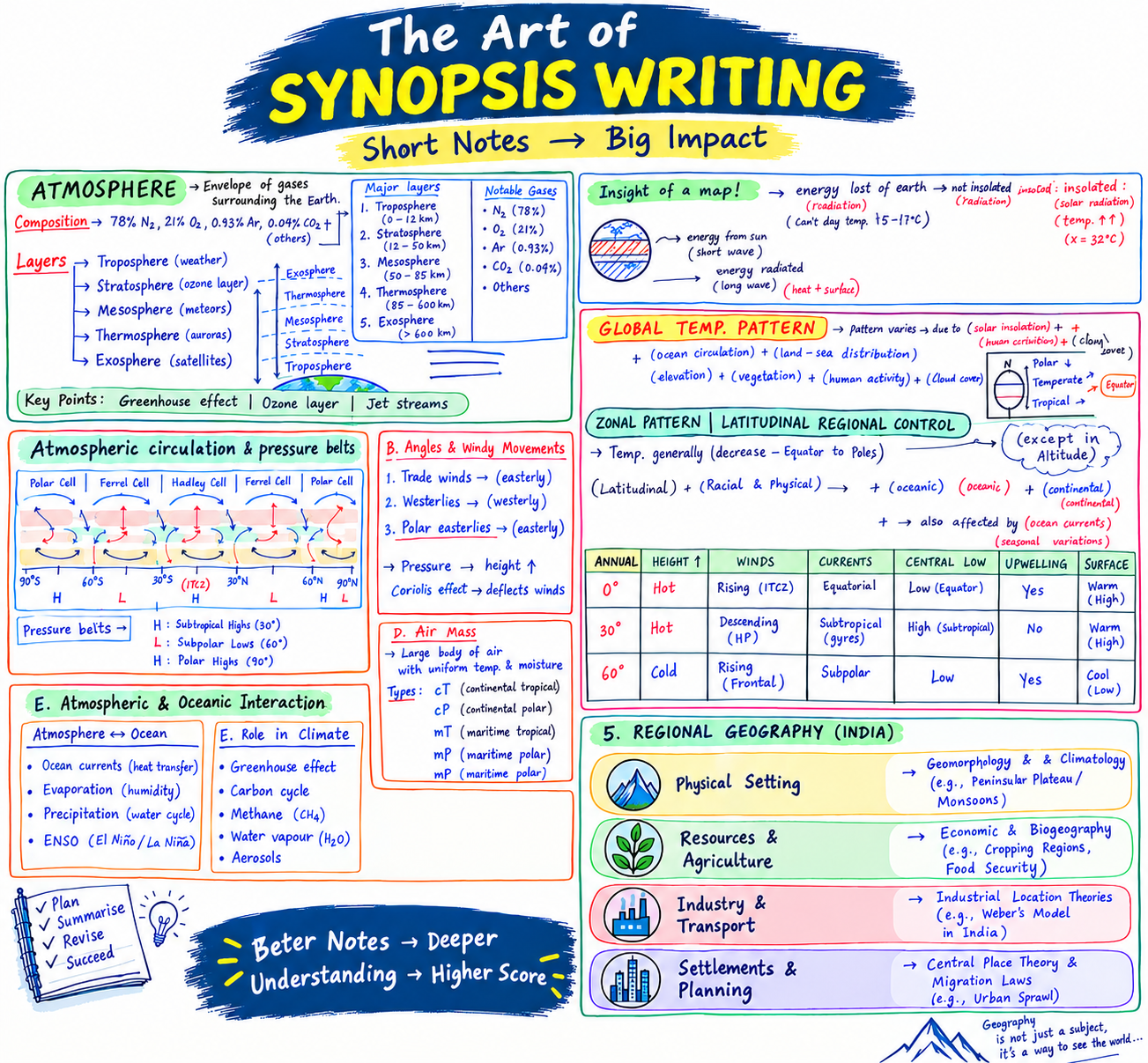
  • Learning Art of Synopsis Writing
  • Module Based Approach
  • Completion through Module Wise Workbooks
  • 200+ L1 & L2 Level Questions with Model Answers (PDF)
Scheduled Batches
20% OFF

Geography Optional Online - (Foundation August Batch - 2027)

Full Course Fee: ₹44,999 ₹56,300
Batch starts: 17 Aug’26 Schedule File Details
20% OFF

Geography Optional Online - (Foundation July Batch - 2027)

Full Course Fee: ₹44,999 ₹56,300
Batch starts: 20 Jul’26 Schedule File Details
On-going Batches
20% OFF

Geography Optional Online - (Foundation June Batch - 2027)

Full Course Fee: ₹44,999 ₹56,300
Batch started: 10 Jun’26 Schedule File Details
EMI plans are available. Schedule a free counselling session to get the EMI plans
Know more about the Geography Optional Course!

Know more about the Geography Optional Course!

Preferred time to call

Free Resources

Preksha Agarwal - Rank 30

Topper Copy 1

Download
Geography Optional PYQ Sample

Geography Optional PYQ 2023 - Solved Sample

Download
Synopsis Sample

Synopsis Made by a Student at Edukemy!

Download
Geography Optional Strategy

How to Prepare?

Download

Geography Optional – Syllabus given by UPSC

Syllabus of Geography Paper – I (PRINCIPLES OF GEOGRAPHY)

Physical Geography

  1. Geomorphology: Factors controlling landform development; endogenetic and exogenetic forces; Origin and evolution of the earth’s crusts; Fundamentals of geomagnetism; Physical conditions of the earth’s interior; Geosynclines; Continental drift; Isostasy; Plate tectonics; Recent views on mountain building; Volcanicity; Earthquakes and Tsunamis; Concepts of geomorphic cycles and Landscape development; Denudation chronology; Channel morphology; Erosion surfaces; Slope development; Applied Geomorphology; Geomorphology, economic geology, and environment.
  2. Climatology: Temperature and pressure belts of the world; Heat budget of the earth; Atmospheric circulation; Atmospheric stability and instability. Planetary and local winds; Monsoons and jet streams; Air masses and fronts; Temperate and tropical cyclones; Types and distribution of precipitation; Weather and Climate; Koppen’s Thornthwaite’s and Trewartha’s classification of world climate; Hydrological cycle; Global climatic change, and role and response of man in climatic changes Applied climatology and Urban climate.
  3. Oceanography: Bottom topography of the Atlantic, Indian, and Pacific Oceans; Temperature and salinity of the oceans; Heat and salt budgets, Ocean deposits; Waves, currents, and tides; Marine resources; biotic, mineral, and energy resources; Coral reefs coral bleaching; Sea-level changes; Law of the sea and marine pollution.
  4. Biogeography: Genesis of soils; Classification and distribution of soils; Soil profile; Soil erosion, Degradation, and conservation; Factors influencing world distribution of plants and animals; Problems of deforestation and conservation measures; Social forestry, agro-forestry; Wildlife; Major gene pool centers.
  5. Environmental Geography: Principle of ecology; Human ecological adaptations; Influence of man on ecology and environment; Global and regional ecological changes and imbalances; Ecosystem their management and conservation; Environmental degradation, management, and conservation; Biodiversity and sustainable development; Environmental policy; Environmental hazards and remedial measures; Environmental education and legislation.

Human Geography

  1. Perspectives in Human Geography: Areal differentiation; regional synthesis; Dichotomy and dualism; Environmentalism; Quantitative revolution and locational analysis; Radical, behavioral, human, and welfare approaches; Languages, religions, and secularisation; Cultural regions of the world; Human development index.
  2. Economic Geography: World economic development: measurement and problems; World resources and their distribution; Energy crisis; the limits to growth; World agriculture: a typology of agricultural regions; Agricultural inputs and productivity; Food and nutrition problems; Food security; famine: causes, effects, and remedies; World industries: location patterns and problems; Patterns of world trade.
  3. Population and Settlement Geography: Growth and distribution of world population; Demographic attributes; Causes and consequences of migration; Concepts of the over-under-and optimum population; Population theories, world population problems and policies, Social well-being and quality of life; Population as social capital. Types and patterns of rural settlements; Environmental issues in rural settlements; Hierarchy of urban settlements; Urban morphology; Concept of primate city and rank-size rule; Functional classification of towns; Sphere of urban influence; Rural-urban fringe; Satellite towns; Problems and remedies of urbanization; Sustainable development of cities.
  4. Regional Planning: Concept of a region; Types of regions and methods of regionalization; Growth centers and growth poles; Regional imbalances; regional development strategies; environmental issues in regional planning; Planning for sustainable development.
  5. Models, Theories and Laws in Human Geography: System analysis in Human geography; Malthusian, Marxian and demographic transition models; Central Place theories of Christaller and Losch; Perroux and Boudeville; Von Thunen’s model of agricultural location; Weber’s model of industrial location; Ostov’s model of stages of growth. Heartland and Rimland theories; Laws of international boundaries and frontiers.

Syllabus of Geography Paper – II

Geography of India

  1. Physical Setting: Space relationship of India with neighboring countries; Structure and relief; Drainage system and watersheds; Physiographic regions; Mechanism of Indian monsoons and rainfall patterns; Tropical cyclones and western disturbances; Floods and droughts; Climatic regions; Natural vegetation, Soil types and their distributions.
  2. Resources: Land, surface and ground water, energy, minerals, biotic and marine resources, Forest and wildlife resources and their conservation; Energy crisis.
  3. Agriculture: Infrastructure: irrigation, seeds, fertilizers, power; Institutional factors; land holdings, land tenure and land reforms; Cropping pattern, agricultural productivity, agricultural intensity, crop combination, land capability; Agro and social-forestry; Green revolution and its socio-economic and ecological implications; Significance of dry farming; Livestock resources and white revolution; Aquaculture; Sericulture, Agriculture and poultry; Agricultural regionalisation; Agro-climatic zones; Agroecological regions.
  4. Industry: Evolution of industries; Locational factors of cotton, jute, textile, iron and steel, aluminum, fertiliser, paper, chemical and pharmaceutical, automobile, cottage, and ago-based industries; Industrial houses and complexes including public sector undertakings; Industrial regionalisation; New industrial policy; Multinationals and liberalisation; Special Economic Zones; Tourism including ecotourism.
  5. Transport, Communication, and Trade: Road, railway, waterway, airway, and pipeline networks and their complementary roles in regional development; Growing importance of ports on national and foreign trade; Trade balance; Trade Policy; Export processing zones; Developments in communication and information technology and their impacts on economy and society; Indian space programme.
  6. Cultural Setting: Historical Perspective of Indian Society; Racial linguistic and ethnic diversities; religious minorities; Major tribes, tribal areas, and their problems; Cultural regions; Growth, distribution, and density of population; Demographic attributes: sex-ratio, age structure, literacy rate, work-force, dependency ratio, longevity; migration (inter-regional, intraregional and international) and associated problems; Population problems and policies; Health indicators.
  7. Settlements: Types, patterns, and morphology of rural settlements; Urban developments; Morphology of Indian cities; Functional classification of Indian cities; Conurbations and metropolitan regions; Urban sprawl; Slums and associated problems; Town planning; Problems of urbanisation and remedies.
  8. Regional Development and Planning: Experience of regional planning in India; Five Year Plans; Integrated rural development programmes; Panchayati Raj and decentralised planning; Command area development; Watershed management; Planning for backward area, desert, drought-prone, hill tribal area development; Multi-level planning; Regional planning and development of island territories.
  9. Political Aspects: Geographical basis of Indian federalism; State reorganization; Emergence of new states; Regional consciousness and inter-state issues; International boundary of India and related issues; Cross-border terrorism; India’s role in world affairs; Geopolitics of South Asia and Indian Ocean realm.
  10. Contemporary Issues: Ecological issues: Environmental hazards: landslides, earthquakes, Tsunamis, floods and droughts, epidemics; Issues related to environmental pollution; Changes in patterns of land use; Principles of environmental impact assessment and environmental management; Population explosion and food security; Environmental degradation; Deforestation, desertification, and soil erosion; Problems of agrarian and industrial unrest; Regional disparities in economic development; Concept of sustainable growth and development; Environmental awareness; Linkage of rivers; Globalisation and Indian economy.

Key Highlights

Class Synopsis
Class Synopsis
Recorded Videos of Live Classes
Live Interactive Classes
Simplified Pedagogy with Quality Content

What our learners are saying?

About the Faculty

Shabbir A Bashir
Shabbir A Bashir

Shabbir A Bashir is one of the co-founders of Edukemy and industry’s most lauded professor in UPSC preparation. He has been in the industry...

Learn more Learn more

Frequently Asked Questions

This program is designed for UPSC CSE aspirants who have chosen Geography as their optional subject. It is ideal for both beginners who need to build a strong foundation and veterans looking to refine their analytical skills and conceptual clarity under the guidance of Shabbir Sir.

  • Course Duration: 9 Months of comprehensive learning.

  • Batch Start Date: 24th April 2026.

  • Syllabus Coverage: Holistic coverage of Paper I & Paper II with high-quality content.

  • Class Summary: Concise summaries provided after every session to aid quick revision.

Shabbir Sir’s pedagogy focuses on interlinking static concepts with current affairs, which is the current trend in UPSC. The course offers spontaneous interaction in Live Classes, expert mentorship through test feedback, and a well-crafted curriculum that prioritizes topics based on their weightage in the Mains exam.

Absolutely. Shabbir Sir starts from the absolute basics, ensuring that students from Engineering, Science, or Humanities backgrounds can grasp complex concepts like Geomorphology and Climatology with ease.

Map work is integrated into the daily lectures. We provide specialized sessions for Location-based marking and help students develop the skill of drawing hand-drawn maps and schematics to score extra marks in the Mains exam.

Yes. Answer writing is a core component. Students receive regular assignments, and the pedagogy focuses on building structural flow—Introduction, Body (with diagrams/case studies), and Conclusion—to meet UPSC standards.

Geography is a dynamic subject. Our faculty ensures that every static topic (like Agriculture or International Trade) is updated with the latest Global Reports, Government Schemes, and Environmental summits.

Yes, students receive comprehensive PDF study material / class notes. These are curated to act as a one-stop resource, reducing the need to refer to multiple standard textbooks like Savindra Singh or Majid Husain.

We offer Live Interactive Classes (Online & Offline) where you can ask doubts in real-time. However, if you miss a class, you will have access to the recorded lectures on our portal for flexible viewing.

Geography has a huge overlap (nearly 40%) with the UPSC syllabus. It covers GS Paper 1 (Physical Geography), GS Paper 3 (Environment, Agriculture, Disaster Management), and even International Relations in GS Paper 2.

Yes. To score high in Indian Geography (Paper II), case studies are vital. We provide over 100+ unique case studies and examples that help your answers stand out from the competition.

Students usually get access to the recordings for the duration of the course plus additional time to support their Mains revision phase. (Check your specific plan for the exact validity period).

Yes, we maintain a dedicated Telegram Community and a doubt-clearing portal where students can interact with peers and the Edukemy faculty to resolve queries quickly.

Most aspirants struggle to use Physical Geography theories (Paper I) in Indian Geography (Paper II). Shabbir Sir’s unique pedagogy ensures you learn to apply models like Weber’s Industrial Location or Rostow’s Stages of Growth to Indian scenarios. This "interlinking" is the secret to moving your score from the 230s to the 280-300+ range, as it demonstrates a deep, scholarly understanding to the UPSC examiner.

Once you enroll, the course will be accessible via the Edukemy Web Portal or the Edukemy App (available on Play Store). You can log in using your registered mobile number with OTP or through your registered email ID and the password created by you.

Related Tags

Know more about the Geography Optional Course!

Know more about the Geography Optional Course!

Preferred time to call

Related Courses

Geography Optional Strategy

Geography is one of the most chosen optional among UPSC aspirants, along with History, Sociology, PSIR & Public Administration. Annually, 3000 students write Mains Exam, who have Geography as their optional!

In the journey of becoming a civil servant, the selection of an appropriate optional is important. Optionals account for 500 marks on the Mains Exam, and Geography Optional has produced toppers with marks ranging from 298 to over 320 marks.

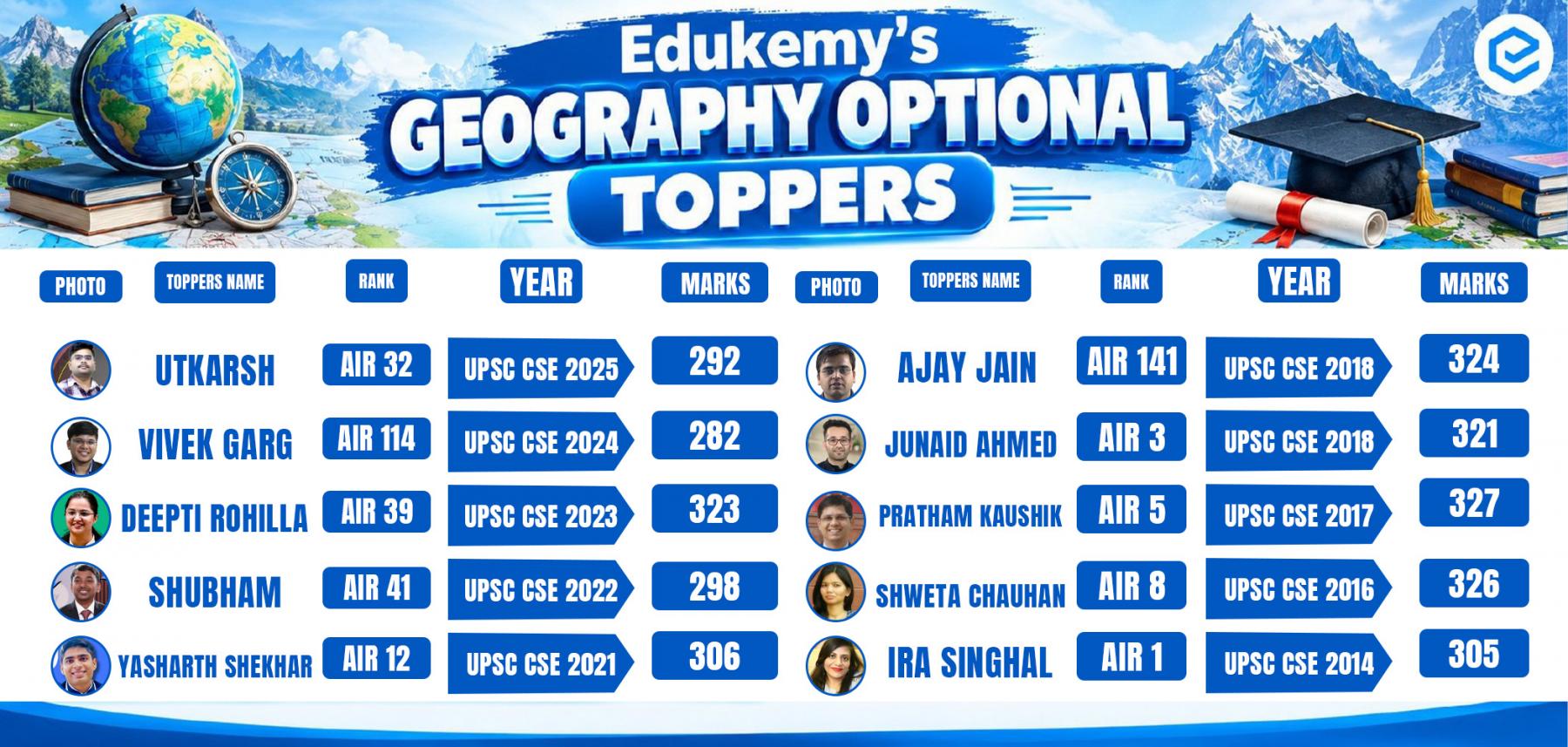
Here are the toppers along with their marks

Year

Geography Optional Topper

Marks

2025

Utkarsh

292

2024

Vivek Garg

282

2023

Deepti Rohilla

323

2022

Shubham

298

2021

Yasharth Shekhar

306

2018

Ajay Jain

324

2018

Junaid Ahmed

321

2017

Pratham Kaushik

327

2016

Shweta Chauhan

326

2014

Ira Singhal

305

Geography, no doubt, is a comprehensive subject, with topics all over General Studies. Be it Indian Society, International Relations, Disaster Management, Environment - we have Geography as a part of all major General Studies subjects. Here, we will tell you exactly how you can manage Geography Optional as a subject, with the right strategy to guide you.

Going through the Geography Optional syllabus!

You need to ensure that each and every topic mentioned in the UPSC Geography Optional Syllabus is known to you. This will assist you in reading only what is relevant, instead of going through a lot of sources and keeping your preparations unorganized!

Here are the major heads and sub-heads of the Geography Optional Syllabus:

Physical Geography has the following topics:

Human Geography has the following topics:

Indian Geography has the following topics:

Why is it important to understand keywords in the Geography Optional Syllabus?

It is really important to know the keywords mentioned in the Syllabus. This is because, many questions are directly asked from picking up topics which is mentioned in the syllabus. Let's understand it with a few examples!

Question - The concept of Plate Tectonics has been derived from the  Isostasy and Continental Drift Theory. Elaborate citing  suitable examples. (2021)

Question - Explain the techniques to calculate potential  evapotranspiration suggested by Thornthwaite. (2019)

Question - Examine the relevance of the Central Place Theory of  Christaller in the present context. (2021)

Question - Drainage pattern in Peninsular India is a result of its geological structure and topography. Elaborate. (2017)

Question - Critically examine the relevance of Ravenstein’s law of population migration with reference to India. (2021)

Can you see the reference we are trying to make?

Most of the questions have topics that are mentioned in the syllabus. So, it is important that you have notes for each topic mentioned in the syllabus.

What is the trend of Questions being asked in Geography Optional?

The questions asked in Geography Optional can be divided into Direct Questions, which are L1 level questions, Open Ended Questions which are L2 & L3 level questions, & Map-Based Questions.

What are the current trends in Geography Optional Questions?

Let’s look at this question for example:

“Automation is rapidly changing the economics of labor and will affect trade patterns in significant ways”. Clarify? (CSE 2022)

Let’s look at this question:

“Explain how various aspects of channel morphology are used in transportation settlement, land use planning, flood control, and flood management. (CSE 2022)

The same is the case with Geography Optional, where questions, more so in Paper 2, are being asked from dynamic and contemporary issues about global and regional trends.

Look at this question for example:

“Climate change is serious problem to global food security and eradication of poverty”. Critically examine. (CSE 2022)

For example, compare these two questions based on the same theme - Climate Change.

"Discuss the trends in migration focusing on its major thrust. (CSE 2014)"

"Critically examine the relevance of Ravenstein’s Law of Population migration with relevance to India. (CSE 2021)"

We can clearly see, that instead of asking questions just based on the theme and topic or a direct question, UPSC has shifted to more in-depth concept-based questions. You cannot write an answer if you don’t exactly know about Ravenstein’s Law of Population Migration.

Doing an Analysis of UPSC Previous Year Questions in Geography Optional

Analyzing the Geography Optional Previous Year Questions is an important task in Exam Preparation. It helps an aspirant understand the pattern, the language, and the concepts that UPSC is repeating. One can be closest to the syllabus when he understands the pattern of the Previous Year Questions.

We have collated the Module-Wise Questions for Geography Optional in our Blog Section.

Select the right sources for Geography Optional

If you want to master Geography Optional, it is important that you don't overload yourselves with excessive study material and limit your sources.

The subject is vast - it's like covering 3 years of Bachelor's, and 3 year's of Masters in one go.

The only way to be able to cover the portion is to stick to the syllabus, PYQs, and limiting your sources.

If you want the Booklist to be followed for Geography Optional, you can check this out!

Dealing with Current Affairs for Geography Optional

We need a structured approach to be able to cover required current affairs topics in Geography Optional. Geography Optional is highly current affairs based. While UPSC may ask you a static topic, if you are able to link it to a current event, it's highly possible that you will fetch extra marks because of that.

It is also important to note that Current Affairs shouldn't be focused only on for Paper 2. It holds equal importance in Paper 1.

Following are some of the important current affairs topics to look at:

So, as Geography Optional is changing the pattern, we are getting more and more dynamic questions. Apart from that, it is also important to use case-studies, examples, and contemporary issues to get the extra 1-2 marks in the Geography Optional Mains Exam. Hence, we recommend you to read dedicated Current Affairs for Geography Optional. 

We thus, recommend – KOSMOS Magazine, a feature magazine for Geography Optional including Environment & Ecology.

We try and consolidate all important current affairs relevant for Geography Optional, from popular magazines like EPW, The Hindu, Indian Express and Down to Earth.

How to write effective Geography Optional Answers?

To get high scores, it is important to write an answer that is both distinctive and detailed. This includes offering a thorough examination of both the question at hand and the proposed solution.

It is important that you are not writing Geography Optional answers like a simple Geography GS Answer. The following are the ways in which you can do that:

1. Use names of Geographers and their concepts.

2. Use definitions given by Geographers. Example - Areal differentiation by Hartshorne.

3. Use examples that are used by Geographers. Example - Julian Wolpert's Swedish farm.

4. Use recommendations, reports, and committees. Example - Gadgil Committee report.

5. Debate quoting Geographers instead of writing your own understanding or philosophy!

6. Use of Definitions - We need to write precise definitions. For example, Areal Differentiation can be defined in a number of ways, but if we write the definition mentioned by by Richard Hartshorne, the impact would be more.

7. Quote Examples which credible Geographers. Example, for Behavioralism, quoting Julian Wolpert's 1964 paper on Swedish farmers relating to behaviouralism can fetch us more marks!

8. Quote Important Scholars and their work. Example, quoting Weber to explain Theory of Industrial Location.

9. Use flow charts, diagrams, maps, & schematics in answers.

10. Link concepts with Current Affairs - For Example - Try linking Joshi Math News to Geomorphology.

11. Use Case Studies - Example, quote Marathawada region for a question on Agragriam Crisis.

12. Integrated Learning and Linking of Paper 1 and Paper 2 - Always try and link Paper 1 and 2. Example, topics like Population, Climatology, Environment & Settlement Geography can be quoted in both papers. More specifically, incorporate aspects from both Physical and Human Geography.


To conclude

Geography Optional, over the years, has evolved - both in quantity of how much is to be read, and quality of what is to be covered.

Geography Optional requires more than just rote learning - it also requires conceptual understanding. Prepare well for the exam. The above strategy, if applied well, will definitely do wonders for your Geography Optional Preparation!

Frequently Asked Questions (FAQs) – Geography Optional by Edukemy

What makes the Geography Optional offline foundation course at Edukemy unique?

The course follows a structured, module-based approach designed by Shabbir Sir. It transitions students from foundational principles to advanced learning through initiation classes, comprehensive class notes, and a mission-oriented focus on syllabus completion. The program specifically emphasizes the art of synopsis writing and includes 200+ Level 1 and Level 2 practice questions with model answers.

How long will I have access to recorded videos for the offline batch?

For the offline foundation batch, videos are accessible for three days following each scheduled class to aid in revision. Once the entire course is completed, you will retain access to all recorded lectures until the UPSC Mains 2027 examination.

Does the Geography Optional offline course include practice materials?

Yes, the course is highly practice-oriented. It includes module-wise workbooks to ensure steady progress and provides a collection of 200+ questions (categorized into L1 and L2 levels) accompanied by detailed model answers in PDF format to help you master answer writing.

Is the Geography Optional course suitable for beginners?

Absolutely. The curriculum is designed to support students starting from scratch. Shabbir Sir’s pedagogical approach begins with initiation classes that simplify complex geographical concepts, making the subject accessible and engaging even for those who have no prior background in Geography.

How does this course help in improving UPSC Mains answer writing?

Beyond theoretical knowledge, the course focuses heavily on the "Art of Synopsis Writing." By integrating regular feedback, module-wise workbooks, and a strategic focus on previous year questions (PYQs), students learn how to structure their answers to meet the specific demands of the UPSC examination.

Are the classes interactive for offline students?

Yes, the offline foundation course consists of 150+ live, interactive classes. This format allows for real-time engagement, enabling you to clarify doubts directly with the faculty and participate in discussions that enrich your understanding of the optional subject.

Who provides the best guidance for UPSC CSE: Shabbir Sir at Edukemy or Himanshu Sir at Guidance IAS?

Both educators are widely respected, but they cater to slightly different learning preferences. Himanshu Sir at Guidance IAS is well-known for his comprehensive lecture notes and dense dictation frameworks. However, if your goal is conceptual application rather than just rote learning, Shabbir Sir at Edukemy is widely considered the choice for geography optional best institute. Edukemy’s advanced pedagogy transitions you away from generic note-taking by offering scientific, mapping-heavy conceptual frameworks through their flagship Geography Optional Foundation Course, helping you apply geographical theories directly to dynamic Mains questions.

How do the test series compare between Guidance IAS and Edukemy's Integrated Course?

Guidance IAS utilizes traditional large-batch answer writing, which can sometimes result in slower personalized feedback loops. In contrast, Edukemy’s Geography Optional Integrated Course functions as a precision testing ecosystem. It includes 5 sectional tests and 4 full-length tests mapped perfectly to evolving UPSC trends. Edukemy’s standout advantage is its detailed micro-evaluation framework and mentorship support, ensuring that your answer structure, diagram placement, and case studies are fine-tuned much faster than in conventional coaching models.

Why do toppers choose Edukemy over traditional institutes like Guidance IAS for answer writing?

While traditional programs like the "500+ Program" by Himanshu Sharma at Guidance IAS offer a heavy repository of probable questions, they can sometimes lead to rigid, template-style answers among thousands of aspirants. Edukemy breaks this monotony by focusing on synopsis writing and customized L1/L2 problem-solving levels. At Edukemy, you learn the art of concise, unique answer-mapping under Shabbir Sir’s direction, giving your Mains scripts a distinct edge over common coaching templates.

Which institute offers better course flexibility and post-batch support for Geography Optional?

Course duration and access timelines are crucial for multi-year UPSC journeys. Guidance IAS courses traditionally run on strict timelines with limited video playbacks. Edukemy, positioning itself as a modern geography optional best institute, solves this issue by offering unlimited views of recorded live classes. Whether you opt for the foundational tracking or the rigorous testing in the Geography Optional Integrated Course, your digital portal access remains valid up until the 2027 Mains exam, giving you complete retention flexibility.

I have no prior geography background. Should I choose Guidance IAS or Edukemy?

Aspirants coming from non-humanities backgrounds (such as engineering or science) often find the vast syllabus of Guidance IAS overwhelming due to the sheer volume of study material provided from day one. Edukemy resolves this through a dedicated Initiation Phase. Shabbir Sir assumes you know nothing about the subject initially, building your baseline through interactive workbooks. To build an unshakable foundation with step-by-step mentoring, beginners heavily lean toward the Geography Optional Foundation Course to steadily master intricate physical and human geography concepts.

Understanding the Geography Optional Roadmap provides additional perspective on the syllabus architecture and the preparation strategy needed to excel under Himanshu Sharma Sir's framework.


Ask an Expert

Enquiry

Help us make sure you are you through an OTP:

Please enter correct Name

Please authenticate via OTP

Resend OTP
Please enter correct mobile number
Please enter OTP

Geography Optional Offline - (Integrated August Batch - 2027)

Please enter correct Name
Resend OTP
Please enter correct mobile number

OTP has been sent.

Please enter OTP