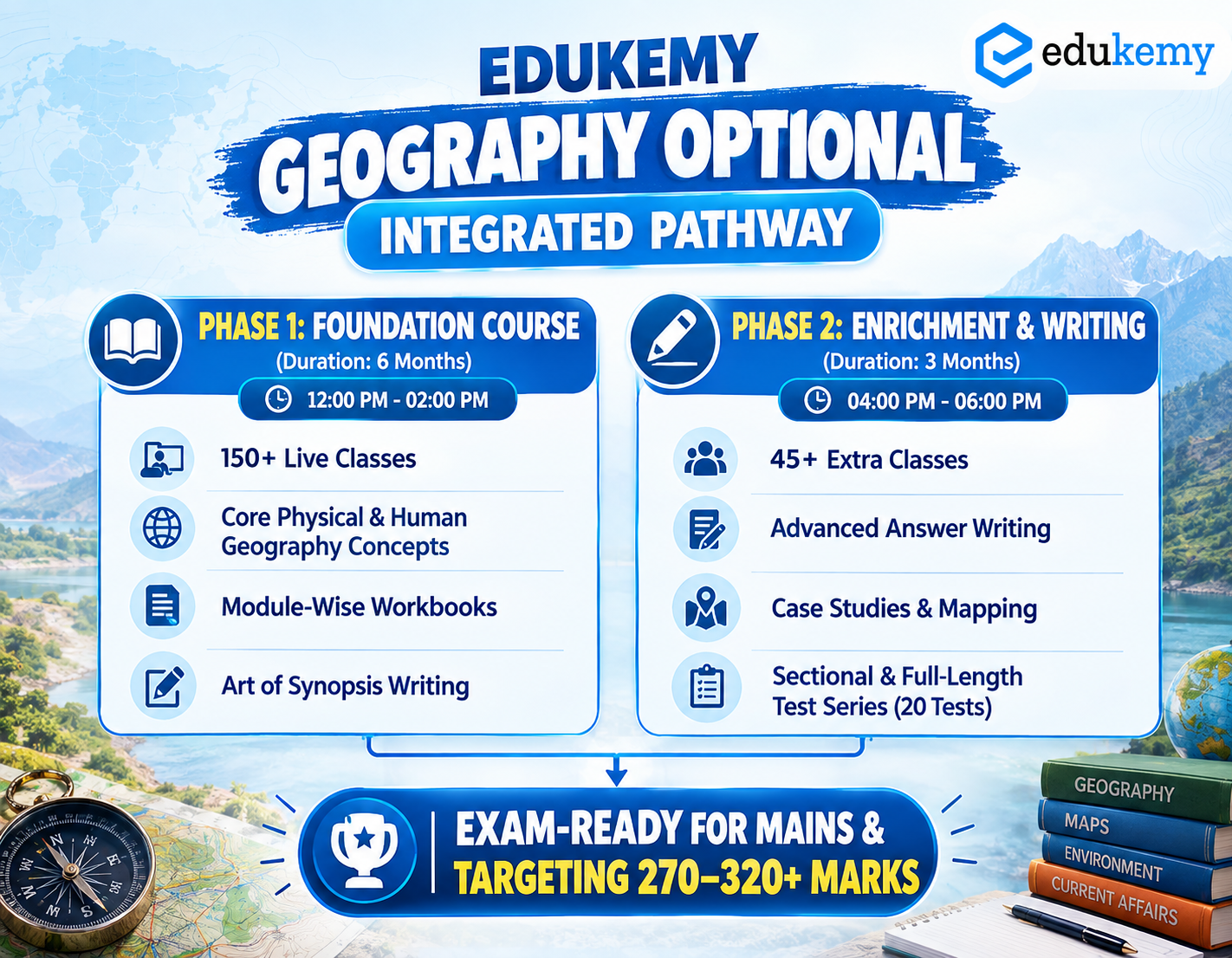
Looking for the best UPSC Geography Optional Coaching? Join Edukemy’s highly acclaimed Integrated Course (Foundation + Test Series + Enrichment) led by Shabbir Sir, a trusted mentor with over 26 years of teaching experience. Designed to take aspirants from foundational concepts to advanced exam-ready answer writing, this program is structured to help you achieve top scores (270–320+) in the UPSC Civil Services Examination.
Expert Faculty: Led by Shabbir A. Bashir (Shabbir Sir), co-founder of Edukemy and former Vajiram faculty, who has guided over 75% of Geography Optional toppers in the last 10 years.
Comprehensive Duration: A 6+3 month program comprising a 6-month Foundation Course (150+ live interactive classes) and a 3-month Enrichment & Answer Writing phase (45+ extra classes).
Batch Details: Commencing on 22nd October 2026 for UPSC CSE 2027/2028 aspirants, available in both Online and Offline (Old Rajendra Nagar, New Delhi) modes.
Advanced Test Series: Includes 20 comprehensive tests (5 Sectional Tests with complete evaluation, 4 Full-Length Tests, and 11 Practice Tests) along with 200+ L1/L2 level questions with model answers.
Innovative Learning Tools: Features daily class notes, module-wise workbooks, the unique Art of Synopsis Writing methodology, and a subscription to Yooki AI—an all-in-one self-study platform for 24x7 query resolution, PYQs, and essay/notes evaluation.
High Scoring Potential: Geography is one of the most preferred and high-scoring optional subjects in the UPSC exam, with achievable scores ranging between 270 and 320+.
Extensive GS & Essay Overlap: Covers significant portions of General Studies Prelims (12–16 questions) and Mains (GS Paper I, II, III covering agriculture, disaster management, environment, and economic geography), plus vital utility for essay papers and interviews.
Proven Track Record: Trusted by top rankers year after year, including Utkarsh Yadav (AIR 32), Ishitwa (AIR 50), Shubhankar (AIR 52), Preksha Agrawal (AIR 30), and hundreds of others.
Online Batch: Available with unlimited views until Mains 2027 from the date of the scheduled class.
Offline Batch: During the course, videos are available for up to 3 days after the scheduled class. Post course completion, videos are made available until Mains 2027.
Looking for the best UPSC Geography Optional Coaching? Join Edukemy’s highly acclaimed Integrated Course (Foundation + Test Series + Enrichment) led by Shabbir Sir, a trusted mentor with over 26 years of teaching experience. Designed to take aspirants from foundational concepts to advanced exam-ready answer writing, this program is structured to help you achieve top scores (270–320+) in the UPSC Civil Services Examination.
Expert Faculty: Led by Shabbir A. Bashir (Shabbir Sir), co-founder of Edukemy and former Vajiram faculty, who has guided over 75% of Geography Optional toppers in the last 10 years.
Comprehensive Duration: A 6+3 month program comprising a 6-month Foundation Course (150+ live interactive classes) and a 3-month Enrichment & Answer Writing phase (45+ extra classes).
Batch Details: Commencing on 22nd October 2026 for UPSC CSE 2027/2028 aspirants, available in both Online and Offline (Old Rajendra Nagar, New Delhi) modes.
Advanced Test Series: Includes 20 comprehensive tests (5 Sectional Tests with complete evaluation, 4 Full-Length Tests, and 11 Practice Tests) along with 200+ L1/L2 level questions with model answers.
Innovative Learning Tools: Features daily class notes, module-wise workbooks, the unique Art of Synopsis Writing methodology, and a subscription to Yooki AI—an all-in-one self-study platform for 24x7 query resolution, PYQs, and essay/notes evaluation.
High Scoring Potential: Geography is one of the most preferred and high-scoring optional subjects in the UPSC exam, with achievable scores ranging between 270 and 320+.
Extensive GS & Essay Overlap: Covers significant portions of General Studies Prelims (12–16 questions) and Mains (GS Paper I, II, III covering agriculture, disaster management, environment, and economic geography), plus vital utility for essay papers and interviews.
Proven Track Record: Trusted by top rankers year after year, including Utkarsh Yadav (AIR 32), Ishitwa (AIR 50), Shubhankar (AIR 52), Preksha Agrawal (AIR 30), and hundreds of others.
Online Batch: Available with unlimited views until Mains 2027 from the date of the scheduled class.
Offline Batch: During the course, videos are available for up to 3 days after the scheduled class. Post course completion, videos are made available until Mains 2027.
 Details
Details
Details

Geography Optional – Syllabus given by UPSC


Shabbir A Bashir is one of the co-founders of Edukemy and industry’s most lauded professor in UPSC preparation. He has been in the industry...


Geography is a good, scoring subject when it comes to choosing it as an Optional for UPSC.
In the Prelims Exam, each year we get around 25-30 questions being asked from Geography & Environment (a part of Geography Optional).
Similarily, the overlap of Geography Optional with GS Mains Subjects like Indian Society, Agriculture, International Relations, Disaster Management, Environment further helps students attempt around 200-220 marks in the GS Mains Paper.
Hence, we can safely say that Geography is a good optional for UPSC.
Yes. Infact, Pratham Kaushik scored 327 in 2017, one of the highest marks in any optional. In 2023, Deepti Rohilla- one of our students scored -323 Marks. Over the years, the UPSC Toppers have secured 280-300 marks in Geography Optional on an average. In 2024, based on 56 marksheets average marks for Geography optional was -276.
We would say that the amount of overlap that it has with GS, it also helps you prepare for the GS Papers.
Hence, while it might be considered a lengthy optional, it only makes sense to choose it for the amount of marks it helps an aspirant with in the UPSC Exam!
With over 2 decades of experience, and having produced numerous toppers who chose Geography as an optional and studied with sir, Shabbir Sir is undoubtedly the best Geography Optional Faculty.
No. If someone is telling you that they can teach you Geography Optional in such a short duration, they are definitely doing something wrong, or skipping a part of the syllabus.
Geography Optional minimum requires 6 months of Classes/Self-Study to cover.
Building a strong foundation is necessary for Geography Optional, or any other Optional.
We recommend you start with your basics through NCERTs, GC Leong, and then go to standard books like Khullar or Savinder Singh.
Apart from that, you can also take up Geography Optional Coaching by Shabbir Sir!
✅ The first step is to go through the Geography Optional Syllabus. Ensure that you are going through the syllabus in an extensive manner, knowing each part of the mentioned official syllabus.
✅ Next, in the syllabus, you need to note down all keywords and ensure that you have Foundation, and value-added notes for each keyword mentioned.
✅ Third, you need to go through all the topic-wise and module-wise questions and try and understand the level of questions, along with knowing which topics are being repeated.
✅ Knowledge of the trend of questions is an important aspect of UPSC Geography Optional preparation. Post that, you need to do a proper analysis of the UPSC Previous Year Questions.
✅ Next, you need to identify the right sources for Geography Optional. Which books to read? Which sources to refer? A proper booklist of the same is covered here!
✅ Further, it is important to cover the Current Affairs for Geography Optional. Make sure you are referring to KOSMOS Magazine by Edukemy, twice in a month!
✅ The most important part of all the preparation strategy of Geography Optional is - you need to learn to write good and effective answers for the subject. We have made a detailed video on the same, which can be accessed here!
Every Optional has its Pros and Cons. When it comes to popular Optional like Geography, there are some pros, and some cons. Students need to, however, consider their interest in the subject first.
Pros of Geography Optional:
Interest and Passion: If you have a genuine interest and passion for geography, studying it as an optional subject can be enjoyable and fulfilling. It allows you to delve deeper into various geographical concepts, theories, and phenomena.
Scoring Potential: Geography is often considered a scoring optional subject because it is perceived to have a relatively straightforward syllabus and scoring potential. With proper understanding and preparation, candidates can secure high marks in this subject.
Overlapping with General Studies: Geography overlaps with various components of the General Studies paper in competitive exams, particularly in areas such as physical geography, environmental studies, and human geography. This can reduce the overall workload and preparation time for candidates.
Availability of Resources: There are abundant study materials, reference books, online resources, and coaching institutes available for geography optional. This makes it easier for candidates to access quality study materials and guidance for preparation.
Interdisciplinary Nature: Geography encompasses aspects of physical sciences, social sciences, and environmental studies, making it an interdisciplinary subject. Studying geography can provide a holistic understanding of various socio-economic and environmental issues.
Cons:
Vast Syllabus: Geography has a vast and comprehensive syllabus, covering both physical and human geography along with regional geography. Mastering all the topics within the limited time frame available for preparation can be challenging.
Analytical and Conceptual Depth: Geography optional exams often require candidates to demonstrate a deep understanding of concepts and analytical skills to answer questions effectively. Some candidates may find it difficult to grasp complex geographical theories and phenomena.
Dynamic Nature: Geography is a dynamic subject with continuous updates and changes in theories, data, and interpretations. Staying updated with the latest developments and incorporating them into preparation can be time-consuming.
Mr. Shabbir A. Bashir, the co-founder of Edukemy is the best geography teacher for UPSC preparation. With experience of over 20 years in the industry, he provides exceptional guidance to each & every student in his/her UPSC journey. The geography classes taken by Shabbir sir follow a module-wise approach. His pedagogy involves initiation classes, moving on to foundational principles, and ultimately to advanced/enriched learning.
The course is structured to ensure thorough preparation and includes:

Enrol in the Best UPSC Geography Optional Course Online / Offline
For aspirants preparing for the UPSC Civil Services Examination with Geography Optional, finding the right mentor and structured roadmap is half the battle won. Enrol in a program led by the best Geography Optional teacher for UPSC to transform your preparation. Edukemy offers an industry-leading Geography Optional Integrated Course available in both online and offline modes in Old Rajendra Nagar, New Delhi, under the direct mentorship of Shabbir A. Bashir (Shabbir Sir).
Designed meticulously for UPSC CSE 2027/2028, this course bridges core syllabus foundations, map work, spatial models, and contemporary current affairs to help aspirants target score brackets of 270–320+ marks.
Standard Self-Study vs. Edukemy’s Integrated Module-Wise Pipeline
| Feature / Parameter | Standard Self-Study / Basic Lecture Programs | Edukemy’s Integrated Module-Wise Pipeline |
|---|---|---|
| Curriculum Structure | Fragmented, linear reading of massive optional syllabi without structured milestones. | Structured 6+3 Month Pipeline: Seamless transition from foundation concepts to advanced answer writing. |
| Faculty Mentorship | Minimal to none; reliance on passive recorded lectures or standard unguided reading. | Direct Expert Guidance: Led by Shabbir Sir (26+ years of experience, mentor to 75%+ toppers). |
| Answer Writing Practice | Unsupervised practice; students struggle with time management and structure. | Rigorous Evaluation Framework: 20 comprehensive tests (Sectional & Full-Length) with expert evaluation and model answers. |
| Revision & Notes Strategy | Bulky, unmanaged notebook volumes that become difficult to revise before Mains. | The Art of Synopsis Writing: Proprietary technique teaching students to build high-impact, single-page visual summaries. |
| Technology & Support | Limited to basic video streaming with strict viewing caps or no peer/AI support. | Yooki AI Integration: All-in-one AI platform providing 24×7 query resolution, PYQs, and evaluation templates. |
| Video Access Flexibility | Strict expiry timelines or limited watch counts per video. | Extended Multi-Year Access: Unlimited online views or structured offline backups valid all the way up to Mains 2027. |



.webp/NJFMvb0MbkPJbQlerv85rC06reXScr3K3WldBXV5.webp?sv=2017-11-09&sr=b&st=2026-10-06T13:04:32Z&se=2026-10-06T18:09:32Z&sp=r&spr=https&sig=Pt6EtVllP51sjhVXmor3oVZlg58thXSZDU4XhWTqguc%3D)