

UPSC Geography Optional Courses

UPSC Geography Optional Courses
Optional


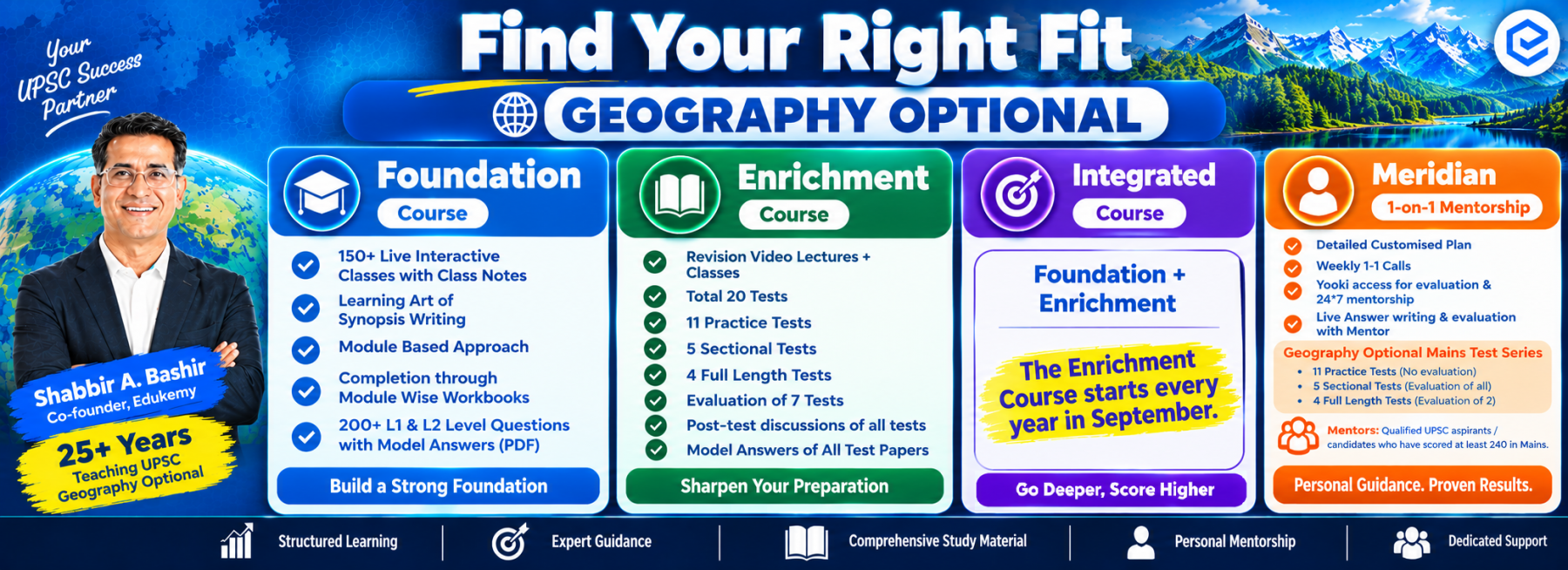
Geography Optional for UPSC
Geography Optional is widely recognized as one of the most popular and scoring optional subjects for UPSC Civil Services aspirants. Its high appeal stems from its substantial syllabus overlap with the General Studies (GS) papers—particularly GS Paper I (Physical and Human Geography) and GS Paper II/III (Indian Geography, Environment, and Agriculture). While the UPSC Geography Optional syllabus is extensive, structured study materials, previous years' question analysis, and expert guidance can make preparation systematic and manageable.
For aspirants looking for structured mentorship, Edukemy is a leading platform for UPSC Geography Optional Coaching. Located in Old Rajinder Nagar (ORN), Karol Bagh, New Delhi, Edukemy offers both online and offline learning formats tailored for civil services preparation. Led by seasoned educators such as Shabbir A. Bashir, the programs utilize a module-based approach, comprehensive synopses, and dedicated answer-writing practice to help students build conceptual clarity and interdisciplinary perspectives throughout their UPSC journey.
Best Geography Optional Teacher for UPSC
Mr. Shabbir A. Bashir, co-founder of Edukemy and widely recognized as a leading Geography Optional teacher for UPSC, brings over 25 years of extensive teaching experience to civil services preparation. His structured Geography Optional coaching classes employ a comprehensive, module-wise pedagogical approach. This methodology begins with core conceptual initiation classes, advances through foundational principles, and culminates in advanced enrichment and rigorous answer-writing practice.
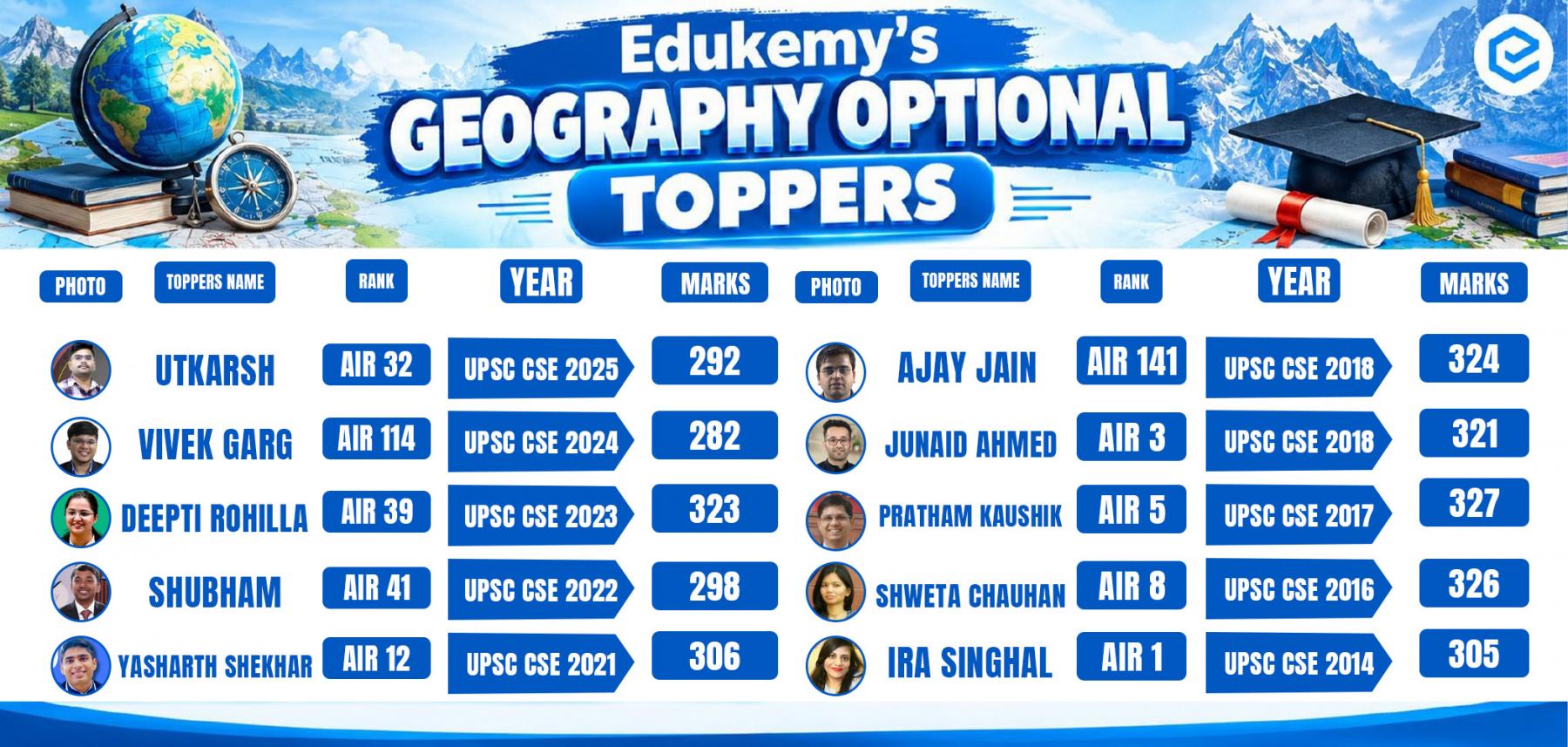
The consistent track record of Edukemy's UPSC toppers—including high-scoring ranks in recent civil services examinations—stands as a clear testament to the depth of mentorship and strategic guidance provided by Shabbir Sir.
Here are the toppers along with their rank & marks:
To gain expert visual-spatial clarity and strategic exam insights, watch this Edukemy Geography Optional Guidance Video, where Shabbir A. Bashir breaks down effective preparation methodologies, syllabus decoding techniques, and answer-writing frameworks specifically designed for the UPSC Civil Services Examination.
Decoding the Geography Optional Syllabus in UPSC
To successfully master the UPSC Civil Services Examination, aspirants must thoroughly analyze the official Geography Optional Syllabus. The curriculum is systematically divided into two core papers:
- Geography Optional Paper I: Focuses on foundational theoretical concepts across Physical and Human Geography.
- Geography Optional Paper II: Emphasizes regional applications, particularly the Geography of India.
To understand how to deconstruct this extensive syllabus effectively, you can watch the Edukemy Geography Optional Orientation Video on YouTube, where expert faculty break down syllabus prioritisation, PYQ mapping, and integrated preparation frameworks.
Comprehensive Syllabus Breakdown:
1. Paper I: Principles of Geography
- Physical Geography:
- Geomorphology
- Climatology
- Oceanography
- Biogeography
- Environmental Geography
- Human Geography:
- Perspectives in Human Geography
- Economic Geography
- Population and Settlement Geography
- Regional Planning
- Models, Theories, and Laws in Human Geography
2. Paper II: Regional Geography (Geography of India)
- Physical Setting
- Resources
- Agriculture
- Industry
- Transport, Communication, and Trade
- Cultural Setting
- Settlements
- Regional Development and Planning
- Political Aspects
- Contemporary Issues

Structured Learning Programs:
-
Geography Optional Foundation Course: Led by Shabbir A. Bashir, this flagship program features 150+ live interactive classes with class notes, a systematic module-based approach, module-wise workbooks, training in synopsis writing, 200+ L1 and L2 level questions with model answers (PDF), and 14 comprehensive Geography Optional booklets (PDF).
-
Geography Optional Integrated Course: Builds directly upon the Foundation curriculum by adding an extensive Test Series comprising 9 targeted tests (5 sectional tests with complete evaluation, 4 full-length tests with evaluation for 2, and 10 practice tests).
-
Geography Optional Enrichment with Test Series: Advanced mentorship and answer-writing refinement for aspirants aiming to maximize their mains score.
-
Meridian — UPSC Geography Optional Mentorship: Premium, personalized guidance tracks designed for focused conceptual restructuring and high-performance strategy.
Study Resources & Materials:
-
Geography Optional Hard Copy Notes: Curated by Shabbir Sir, offering exhaustive syllabus coverage, 90 additional high-yield questions with model answers, and visual representations through flowcharts and diagrams for enhanced retention.
-
Free Demo Kit & PYQs: Designed for UPSC Civil Services Mains aspirants, featuring introductory video snippets of core concepts by Shabbir Sir, alongside free downloadable resources including the official UPSC syllabus and topic-wise/year-wise Geography Optional Previous Years' Questions (2013 - 2023). You can also watch the Edukemy Geography Optional Orientation Video on YouTube for a visual walkthrough of syllabus breakdown strategies.
Core Strategy for Geography Optional Success:
To ace the geography optional for the UPSC Civil Services Examination, aspirants must adopt a multi-dimensional preparation framework:
-
Decode Syllabus Keywords: Questions frequently map directly to syllabus nomenclature (e.g., analyzing Ravenstein's law of population migration under the Cultural Setting module).
-
Develop an Interdisciplinary Perspective: Integrate concepts across Environment, Economics, and Sociology.
-
Practice Applied Thinking: Shift away from static rote learning toward application-based analysis connecting contemporary geography with current affairs.
-
Systematic PYQ Analysis: Master exam trends, repeated conceptual frameworks, and answer structuring by reviewing module-wise PYQs.
Advanced Answer Writing Framework:
To secure high scores in UPSC geography answer writing, incorporate these core scholarly techniques:
-
Attribute Concepts to Geographers: Cite foundational thinkers and precise definitions (e.g., Richard Hartshorne's concept of Areal Differentiation).
-
Integrate Empirical Case Studies & Reports: Reference credible committees and real-world studies (e.g., Gadgil Committee Report or the Marathwada region for agrarian crises).
-
Use Visual Schematics: Integrate clean, rapid line diagrams, maps, and flowcharts into every technical answer.
-
Cross-Link Papers I and II: Bridge physical and human geography dynamics (e.g., linking climatology and population distribution frameworks).
Recommended Booklist:
-
Basic Readings: NCERT Class 6th–10th (Old Edition) and Class 11th–12th (New Edition); Certificate Physical and Human Geography by Goh Cheng Leong; Geography Made Simple (Vols. 1 & 2) by Rupa Publications.
-
Standard Reference Books:
-
Geomorphology, Climatology, Oceanography, and Environmental Geography by Savindra Singh.
-
Human Geography, and Models and Theories in Geography by Majid Hussain.
-
Geographical Thought by R.D. Dikshit; Fundamentals of Geographical Thought by Sudipta Adhikari.
-
India - Comprehensive Geography by D.R. Khullar.
-
Orient Blackswan School Atlas / Oxford School Atlas.
-
To fast-track your preparation through structured online or offline coaching, explore the Edukemy Guided Courses for Geography Optional or schedule a free counseling session with our experts.

Geography Optional UPSC FAQs: Topic-wise Preparation Strategy
Section 1: Geomorphology
Q: How should beginners study Geomorphology for Geography Optional?
A: Beginners should approach Geomorphology by building visual-spatial clarity rather than rote memorization. Start by understanding the driving forces (endogenetic vs. exogenetic processes). Focus heavily on landform evolution, tracking how a landscape changes from youth to maturity, and finally to old age.
Pro-Tip: Instead of reading chapters in isolation, connect landforms to their underlying tectonic and structural settings. Shabbir Sir teaches this like a maestro and makes learning Geomorphology genuinely fun. By breaking down complex earth movements into intuitive, visual stories, you will be completely Mains-ready by the end of this module in his foundation classes itself. Check out Edukemy’s Geography Optional Foundation Course to experience this firsthand.
Q: Which thinkers are MOST important in Geomorphology?
A: The foundational trio of Geomorphology consists of William Morris Davis (Geomorphic Cycle), Walther Penck (Morphological Analysis), and King (Pediplanation). Beyond these classics, modern thinkers like J.T. Hack (Dynamic Equilibrium) and Schumm (Episodic Erosion) are crucial. You must grasp how their competing theories critique and build upon one another to write comprehensive, high-scoring answers.
Q: Did you memorize theories or understand concepts visually in Geomorphology?
A: Top-scoring students always prioritize visual and conceptual understanding over blind memorization. For instance, instead of memorizing Davis’s stages, visualize how a river's energy drops over time, changing the valley cross-section. Once you internalize the mechanics of landform evolution, you can reproduce any theory effortlessly in the exam hall without worrying about forgetting specific text.
Q: How to write and use diagrams in Geomorphology?
A: In Geomorphology, diagrams are not decorative; they are the core of your answer.
-
Use sequential diagrams: Show the evolution of a landform (Stage 1 > Stage 2 > Stage 3) rather than just a single final output.
-
Annotate thoroughly: Label block diagrams with structural controls (e.g., fault lines, resistant rock layers).
-
Keep them simple: Practice clean, free-hand line sketches that can be drawn in less than 60 seconds under exam pressure.
Q: What is the biggest mistake students make in Geomorphology answers?
A: The biggest mistake is writing purely descriptive, static answers. Many students describe what a landform looks like instead of explaining the process and dynamics behind how it formed. Missing out on the geological structure, the balance between forces, or failing to include a clear, annotated block diagram will significantly drop your marks.
Q: Which topics in Geomorphology are repeatedly asked indirectly by UPSC?
A: UPSC frequently twists questions around Applied Geomorphology (e.g., how geomorphic knowledge helps in disaster management or resource mapping), Channel Morphology, and Palaeo-climatology/Denudation Chronology. Concepts like Anticlines/Synclines are rarely asked directly anymore; instead, they are masked under questions about structural controls on landform evolution.
Section 2: Climatology
Q: How to make Climatology intuitive and easy to understand?
A: Climatology is the physics of Geography. To make it intuitive, anchor your preparation around a few core physical rules: Differential Heating, Pressure Gradient Force, and the Coriolis Effect. Once you master how air and moisture behave under these laws, complex global phenomena—like Tri-cellular circulation, Monsoon dynamics, and Jet Streams—become logical and self-explanatory.
Q: How important are current affairs in Climatology?
A: Extremely important. While the foundational theory remains static, UPSC heavily tests your ability to apply these concepts to recent global weather anomalies. You must link textbook concepts to real-world events like recent Extreme El Niño/La Niña years, Arctic amplification, shifting tracks of Tropical Cyclones, and Heatwaves.
-
How to Master This: In Edukemy’s Geography Optional Integrated Course, Shabbir Sir bridges this exact gap by dynamically linking core Climatology concepts with contemporary climate data and current affairs.
Q: What is the best way to remember complex atmospheric concepts?
A: The best way is to construct a cause-and-effect chain. For example: Heating $\rightarrow$ Low Pressure $\rightarrow$ Convergence $\rightarrow$ Ascent $\rightarrow$ Adiabatic Cooling $\rightarrow$ Condensation $\rightarrow$ Precipitation. If you remember the chain link-by-link, you will never mix up frontogenesis, cyclone formation, or atmospheric stability.
Q: How many diagrams should I include per Climatology answer?
A: Aim for at least 1 to 2 diagrams per 10-marker and 2 to 3 diagrams for 15 and 20-markers. In Climatology, your diagrams should feature cross-sections (e.g., a vertical slice of a shifting Front or a Tropical Cyclone), global planetary wind belts, or pressure maps to show horizontal and vertical air movements clearly.
Section 3: Human Geography
Q: Why do students underperform in Human Geography?
A: Most students underperform because they treat Human Geography like a general studies (GS) paper. They write generic, essay-type points on population, urbanization, or development without using geographical language, spatial perspectives, spatial data, or referencing core geographical models.
Q: How to enrich Human Geography answers with thinkers?
A: Avoid "dropping" thinkers' names randomly at the beginning or end of an answer. Instead, use them to validate your arguments. Instead of writing "Urban sprawl is happening rapidly," write "As observed in Sinclair's or Burgess's spatial frameworks, the transition zone faces unique land-use competitions..." This integrates the thinker seamlessly into the spatial analysis.
Q: Which Human Geography models are actually worth remembering?
A: Focus heavily on the core spatial and economic models: Von Thünen’s Agricultural Location, Weber’s Industrial Location, Christaller’s Central Place Theory, Rostow’s Stages of Growth, and Core-Periphery Models (Myrdal/Hirschman). UPSC frequently rotates questions around these models, their contemporary relevance, and their critiques.
Q: How do I avoid writing “GS-type” answers in Human Geography?
A: To transform a GS answer into an optional-level answer, use the 3M Rule: Models, Maps, and Methodology. Always use geographical terminology (e.g., spatial segregation, core-periphery, locational interdependence), use schematic maps to show spatial patterns, and explicitly cite the relevant geographical paradigm (like Quantitative Revolution, Behavioralism, or Radicalism) that fits the context.
Section 4: Models & Thinkers (Geographical Thought)
Q: How did top rankers memorize so many geographical thinkers?
A: Top rankers don't memorize thinkers in isolation; they learn them chronologically as an evolutionary story. Understand why a particular school of thought emerged. For example, the Quantitative Revolution (QR) emerged because older descriptive geography was losing relevance. Once you understand the historical reaction of one era against another, remembering who led each movement becomes natural.
Q: Did you use flowcharts, maps, or one-pagers for Perspectives & Models?
A: Yes, one-pagers are indispensable for this section. Create a concise revision matrix for every thinker/model featuring:
-
Core Philosophy/Hypothesis
-
Key Book & Year
-
The Spatial Diagram/Flowchart
-
2-3 Major Critiques
Condensing a 20-page chapter into a single visual page makes active recall exceptionally fast before the mains exam.
Q: How many thinkers are enough to secure a high score in Geography Optional?
A: Quality and contextual application beat sheer volume. Mastering around 40 to 50 core thinkers across major paradigms (Environmental Determinism, Possibilism, Quantitative Approach, Behavioral, Radical, and Humanistic Geography) is more than enough to handle any twist UPSC throws at you.
Q: How do I use thinkers naturally in an answer without forcing it?
A: Use thinkers as the perspective lens through which you view a problem. For instance, if a question asks about regional disparities in India, do not just list economic points. Frame it through Myrdal's Cumulative Causation theory or John Friedmann’s Core-Periphery model. This shows the examiner that you are analyzing a real-world issue purely through a geographer's toolkit.
Ready to Master Geography Optional?
Whether you are a beginner looking to build foundational conceptual clarity or an advanced aspirant aiming to enrich your answers with top-tier diagrams and thinker integration, learn from the best.
-
🚀 For Comprehensive Syllabus Coverage from Scratch: Explore Geography Optional Foundation Course by Shabbir Sir.
-
📈 For Answer Writing, Current Affairs Integration, and Test Series: Check out Geography Optional Integrated Course by Shabbir Sir.
Geography Optional for UPSC: Preparation Strategy & FAQs:
Q: Is geography optional for upsc a good choice for beginners without a science background?
Answer: Yes, it is one of the most popular choices because its concepts are highly logical and visual-spatial rather than abstract. While it has a scientific edge in physical geography modules like Geomorphology and Climatology, the human and Indian geography sections are entirely humanities-based. The biggest advantage of choosing the geography optional for upsc is its massive overlap with the General Studies (GS) papers (especially GS Paper 1 and GS Paper 3), which saves significant preparation time. Beginners can easily bridge the conceptual gap by starting with basic NCERT textbooks and structured mentorship.
Q: How much time does it take to complete the syllabus of geography optional for upsc?
Answer: On average, comprehensive coverage of the entire syllabus takes about 4.5 to 5 months of dedicated study. Because the syllabus is extensive, a structured approach is essential to avoid getting overwhelmed. Utilizing a module-wise learning strategy—starting with foundational physical principles before moving to applied human and regional geography—helps streamline the process. If you want a structured timeline with daily interactive schedules, you can explore the comprehensive Geography Optional Foundation Course.
Q: What is the best strategy to score 300+ in geography optional for upsc?
Answer: Scoring high requires shifting from a generalist "GS-style" writing approach to a specialist geographical perspective. To hit the 300+ mark, implement the 3M Rule: Models, Maps, and Methodology. Always substantiate your answers with core geographical theories (like Weber or Von Thünen), cleanly annotated sketch maps, and precise terminology. Additionally, always interlink Paper 1 (Principles) with Paper 2 (Indian Geography) to show applied thinking. For dedicated practice on this approach, consider checking out the Geography Optional Integrated Course which features advanced answer-writing test series.
Q: How can I integrate current affairs into my preparation for geography optional for upsc?
Answer: Current affairs are vital, particularly for Paper 2 (Indian Geography) and dynamic sections of Paper 1 like Environmental Geography and Climatology. Instead of just writing generic news points, you must actively link real-world events to core geographical concepts. For example, connect a recent seismic event or landslide directly to geomorphic structural controls, or analyze a global supply chain disruption using industrial location models.
Q: Can I prepare for the geography optional for upsc exam through self-study or online courses?
Answer: Absolutely. With high-quality online learning ecosystems, physical location is no longer a barrier. Successful preparation requires access to precise, curated study notes, timely evaluation of your answers, and clear conceptual explanations. For aspirants who want to test the waters before committing to a full program, downloading a Geography Optional Demo Kit is an excellent way to access free video snippets, official syllabi, and year-wise past question bank resources.
Q: Why is Geography Optional a popular choice for UPSC CSE, and what is its syllabus?
Answer: Geography is one of the most popular optional subjects because of its high overlap with General Studies (GS Paper 1, GS Paper 3, and Prelims) and its scientific, scoring nature. The syllabus covers Physical Geography, Human Geography, and Indian Geography. To master the syllabus step-by-step with structured guidance and expert mentorship, aspirants often rely on dedicated geography optional for upsc courses, which combine full-syllabus lectures with integrated test series and answer-writing practice.
Q: How should I prepare for Geography Optional for UPSC to score 300+ marks?
Answer: Scoring 300+ in Geography Optional requires a dual focus on strong conceptual clarity and effective visual representation, such as maps, flowcharts, and diagrams. Key preparation steps include:
-
Standard Textbooks & Notes: Master core fundamentals using NCERTs and standard reference books like Savindra Singh and Majidd Husain.
-
Map-Pointing & Case Studies: Practice real-world examples and regional mapping regularly.
-
Structured Mentorship: Enroll in guided programs like Edukemy's geography optional for upsc preparation courses for faculty-led coverage and detailed answer evaluation.
-
Answer Writing: Solve previous years' questions (PYQs) and complete mock tests under exam conditions.
Q: How long does it take to prepare Geography Optional for UPSC, and can non-geography students take it?
Answer: It typically takes 4 to 6 months of consistent study to complete the Geography Optional syllabus thoroughly. You do not need a background in geography to excel; the subject is semi-scientific and logical, making it accessible to students from humanities, science, and engineering backgrounds alike. Joining a structured guided learning path via Edukemy's Geography Optional for UPSC programs helps non-background aspirants build concepts from foundational basics to advanced answer writing smoothly.
Q: Which are the best geography optional classes for UPSC CSE preparation?
Answer: The best geography optional classes offer comprehensive syllabus coverage, map-pointing practice, current affairs integration, and regular answer writing with feedback. Edukemy’s guided geography optional classes are widely recognized among top choices. Led by expert faculty like Shabbir Sir, these classes provide structured live and recorded lectures, interactive doubt resolution, and integrated test series to help aspirants build strong conceptual clarity for both Paper 1 and Paper 2.
Q: What features should I look for in online geography optional classes?
Answer: Effective online geography optional classes should offer the same depth, structure, and individual attention as traditional offline coaching. Essential features to look for include:
-
Interactive Live & Recorded Lectures: Flexibility to attend live sessions or review recorded classes anytime.
-
Integrated Test Series & Mentorship: Regular answer writing with personalized 1-on-1 feedback.
-
Diagrams & Mapping Focus: Specialized sessions on drawing diagrams, flowcharts, and map work to boost marks.
You can access all these features directly through Edukemy’s guided courses for geography optional classes, designed for flexible, top-tier home preparation.
Q: How many hours of geography optional classes are required to cover the complete UPSC syllabus?
Answer: A comprehensive syllabus coverage typically requires 250 to 300 hours of structured classroom instruction spread across 4 to 5 months. This duration ensures complete coverage of Physical, Human, and Indian Geography along with PYQ (Previous Years' Questions) analysis. Enrolling in Edukemy's geography optional classes for UPSC helps you follow a well-paced study timeline with daily lecture targets, study materials, and timely test evaluations.
Q: Why is Geography Optional one of the most popular choices for UPSC CSE Mains?
Answer: Geography Optional is a top choice among UPSC aspirants due to its high scoring potential, logical nature, and vast overlap with the UPSC Mains syllabus. Up to 30–40% of General Studies Paper 1 (Physical & Human Geography), GS Paper 3 (Environment, Agriculture, Disaster Management), and Essay topics directly align with Geography. Additionally, the availability of structured study materials and map-based questions allows students to score high with precise, diagrammatic answers.
Q: Can a non-geography or non-science background student clear UPSC with Geography Optional?
Answer: Yes, absolute beginners from Humanities, Commerce, or Engineering backgrounds can excel in Geography Optional. Physical Geography relies on logical principles rather than pure science, while Human and Indian Geography require analytical and conceptual clarity. At Edukemy, our foundational modules led by Shabbir Sir start from baseline concepts and step-by-step map-work, ensuring even non-geography students build strong conceptual depth and answer-writing skills.
Q: What is included in Edukemy’s Geography Optional Foundation and Integrated Courses?
Answer: Edukemy’s Geography Optional program offers comprehensive online and offline preparation led by Shabbir Sir. Key highlights include:
-
150+ Live Interactive Classes covering both Paper 1 and Paper 2 with module-wise workbooks.
-
Updated Study Material: 14 hard-copy booklets and 200+ Level-1 & Level-2 model answer sets.
-
Integrated Test Series & Mentorship: Mains evaluation, PYQ analysis, synopsis-writing techniques, and continuous enrichment modules.
Q: Which is the best geography optional coaching in Delhi for UPSC CSE?
Answer: Edukemy is widely recognized as the best geography optional coaching in Delhi, operating in the hub of UPSC preparation at Karol Bagh / Old Rajinder Nagar (ORN). Under the leadership of Shabbir A. Bashir Sir, who brings over 25 years of teaching experience, Edukemy offers a structured module-wise pedagogy, integrated map-marking sessions, and personalized mentorship. Students can choose between offline interactive batches in Delhi and flexible online courses. Explore our Geography Optional Foundation Course to view current batch schedules and demo modules.
Q: Why is Shabbir Sir considered the best teacher for Geography Optional in Delhi?
Answer: Shabbir A. Bashir Sir is considered the best geography optional teacher in Delhi due to his concept-first, visual pedagogy. His approach moves away from rote memorization to emphasis on synopsis writing, spatial mapping, structural application in Mains answers, and interlinking Paper 1 (Physical/Human Geography) with Paper 2 (Indian Geography). With a track record of mentoring top rankers (such as Deepti Rohilla - 323 marks, Ajay Jain - 324 marks), his guidance at Edukemy sets the benchmark for UPSC Geography preparation in Karol Bagh and ORN.
Q: Where are Edukemy's offline geography optional classes located in Delhi?
Answer: Edukemy provides offline classroom programs in the heart of Delhi's civil services preparation hub near Old Rajinder Nagar (ORN) and Karol Bagh. The offline center features state-of-the-art infrastructure, live interactive sessions with Shabbir Sir, dedicated doubt-clearing counters, and offline test series evaluation rooms. For exact classroom locations, contact numbers, and batch timings, visit our Delhi Offline Center details.
Q: What is the fee structure for Geography Optional coaching in Karol Bagh / Old Rajinder Nagar?
Answer: The fee structure for Geography Optional coaching in Delhi varies based on course selection (Foundation vs. Integrated Test Series vs. Mentorship):
-
Geography Optional Foundation Course (Offline Delhi / Online): Includes 150+ live interactive classes, 14 comprehensive physical booklets/notes, workbook exercises, and model answers.
-
Geography Mains Support & Test Series: Designed for candidates preparing for immediate Mains attempts.
For detailed fee breakdowns, installment options, and early-bird discounts, request a callback through the Edukemy Geography Optional Course page.
Q: Can I switch between Offline Delhi classes and Online Geography Optional batches at Edukemy?
Answer: Yes, Edukemy offers a hybrid learning model for UPSC aspirants. Students enrolled in the Delhi offline batch get backup access to recorded portal lectures, allowing them to catch up on missed sessions due to illness or travel. Additionally, online students moving to Delhi can apply for transition to classroom batches subject to seat availability. Check our Integrated Geography Optional Programs for hybrid enrollment rules.
Q: How does Edukemy’s Geography Optional coaching cover the dynamic trends of Paper 2?
Answer: Paper 2 (Indian Geography) requires a heavy integration of contemporary socio-economic issues, regional developments, and current affairs. Edukemy addresses this through:
-
Case Study Integration: Linking recent environmental, industrial, and urban events (e.g., Joshimath land subsidence, Jal Jeevan Mission) to core theoretical concepts.
-
Applied Geomorphology & Climatology: Teaching students how to apply Paper 1 principles directly to Indian geographic phenomena.
-
Current Affairs Enrichment: Regularly updated supplementary handouts curated by Shabbir Sir’s core research team.
Q: What study material and notes are provided in Delhi offline Geography Optional batches?
Answer: Students enrolled in Edukemy’s Delhi offline or online classes receive:
-
14 Printed Geography Optional Booklets: Covering both Paper 1 and Paper 2 systematically.
-
200+ Level 1 & Level 2 Questions with Model Answers: For daily answer-writing practice.
-
Handcrafted Diagrams & Flowcharts: Visual templates created by Shabbir Sir for high retention during exam hours.
-
Module Workbooks: For active synopsis creation and topic consolidation.
Q: Is Delhi offline coaching necessary for Geography Optional, or is Online sufficient?
Answer: Offline coaching in Delhi offers immersive peer learning, real-time discipline, and immediate face-to-face mentorship. However, Edukemy's online Geography Optional course offers the exact same curriculum, live interactive environment, and evaluated test series as the Delhi classroom batch. Aspirants who cannot move to Karol Bagh/ORN can achieve the same level of preparation online through Edukemy's digital portal.
Q: How does Edukemy compare with other Geography Optional IAS coaching institutes in Delhi?
Answer: Edukemy stands out among Delhi's IAS coaching institutes due to three main pillars:
-
Mentorship Quality: Direct evaluation and feedback guidance under Shabbir Sir (25+ years experience).
-
Answer Writing Methodology: Specific focus on incorporating geographers' quotes (e.g., Hartshorne, Richard Dikshit, Harvey), precise spatial diagrams, and inter-paper linkages.
-
Tech-Enabled Evaluation: Fast turnarounds on evaluated answer copies with detailed micro-feedback on map accuracy, structural flow, and content depth.
Q: When do new Geography Optional batches start at Edukemy Delhi center?
Answer: Edukemy launches multiple foundation and enrichment batches throughout the year targeting CSE 2026/2027:
-
Integrated Foundation Batches: Launched periodically in June, August, and October.
-
Mains Enrichment & Test Series Batches: Start immediately after the UPSC CSE Prelims exam (June/July).
To check the upcoming batch dates for the Delhi classroom or online live streams, visit the official Edukemy Guided Courses page.